RIYADH: Saudi Arabia’s non-oil activities expanded 0.9 percent year on year in the second quarter of 2026, even as the Kingdom’s real gross domestic product declined by 4.7 percent during the same period, official data showed.
According to the latest estimates from the General Authority for Statistics, government and non-oil activities both saw annual growth of 0.9 percent in the second quarter, while oil activities fell 24.8 percent, weighing on overall GDP expansion.
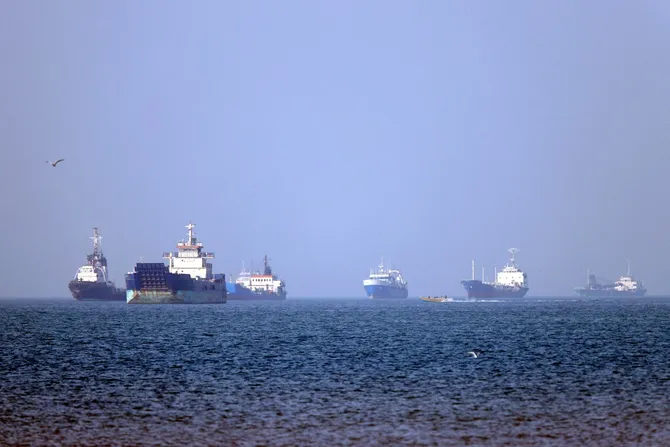
The figures comes as the ongoing US-Iran war, which began in late February, continues to disrupt oil markets and shipping through the Strait of Hormuz, a key waterway that normally carries about one-fifth of global crude supplies.
Traffic through the strait has collapsed from about 130 to 140 ships daily before the conflict to an average of just 10 commodity vessels a day in early September, Reuters reported, citing Kpler data.
Focusing on real GDP growth, which measures inflation-adjusted economic output, GASTAT stated: “Oil activities contributed negatively to real GDP in the second quarter by 5.4 percentage points, while non-oil activities contributed positively by 0.6 percentage points.”
It added: “Government activities and net taxes on products each contributed positively by 0.1 percentage points.”
The resilience of non-oil activities despite the overall GDP contraction highlights Saudi Arabia’s efforts to diversify its economy and reduce its long-standing dependence on crude revenues.
In June, the Organization for Economic Co-operation and Development projected that Saudi Arabia’s economy would regain momentum in 2027, with growth accelerating to 4.3 percent after easing to 3.2 percent in 2026, supported by a resilient non-oil sector and robust domestic demand.
In July, the International Monetary Fund raised its 2027 growth forecast for Saudi Arabia to 5.5 percent, up from the 4.5 percent it projected in April, saying the Kingdom was less affected by regional disruptions because of its diversified export routes.
Real GDP fell 4.8 percent in the second quarter from the previous three-month period on a seasonally adjusted basis, with oil activities down 21.6 percent and non-oil activities down 0.4 percent; government activities grew 0.2 percent quarter on quarter.
“On a seasonally adjusted basis, oil activities were the main driver of the decline in real GDP, recording a negative contribution of 4.5 percentage points,” GASTAT stated.
In addition, it said that non-oil activities and net taxes on products recorded negative contributions of 0.2 and 0.1 percentage points, respectively, while government activities made a positive contribution of 0.03 percentage points.
Non-oil segment posts growth
Several non-oil segments posted stronger gains in the second quarter. Community, social and personal services activities recorded the highest year-on-year growth at 4.1 percent and rose 0.6 percent quarter on quarter.
Finance, insurance and business services grew 3.3 percent year on year and 0.7 percent quarter on quarter.
Agriculture, forestry and fishing advanced by 2.6 percent in the second quarter compared to the same period in 2025, while real estate activities increased by 1.6 percent.
Manufacturing excluding petroleum refining rose 0.9 percent year on year, while construction and transport, storage and communication also showed year-on-year increases of 0.7 percent and 0.9 percent, respectively.
Consumption and foreign trade
On the expenditure side, government final consumption expenditure increased 5 percent year on year in the second quarter, while it declined by 2 percent quarter on quarter.
GASTAT added that gross fixed capital formation rose 2.7 percent year on year, while private final consumption expenditure grew 0.8 percent year on year and 1 percent quarter on quarter.
As for foreign trade, exports and imports declined 24.6 percent and 14.8 percent year on year, respectively, and decreased 24 percent and 5.5 percent quarter on quarter.
Saudi non-oil activities up 0.9% in Q2: GASTAT