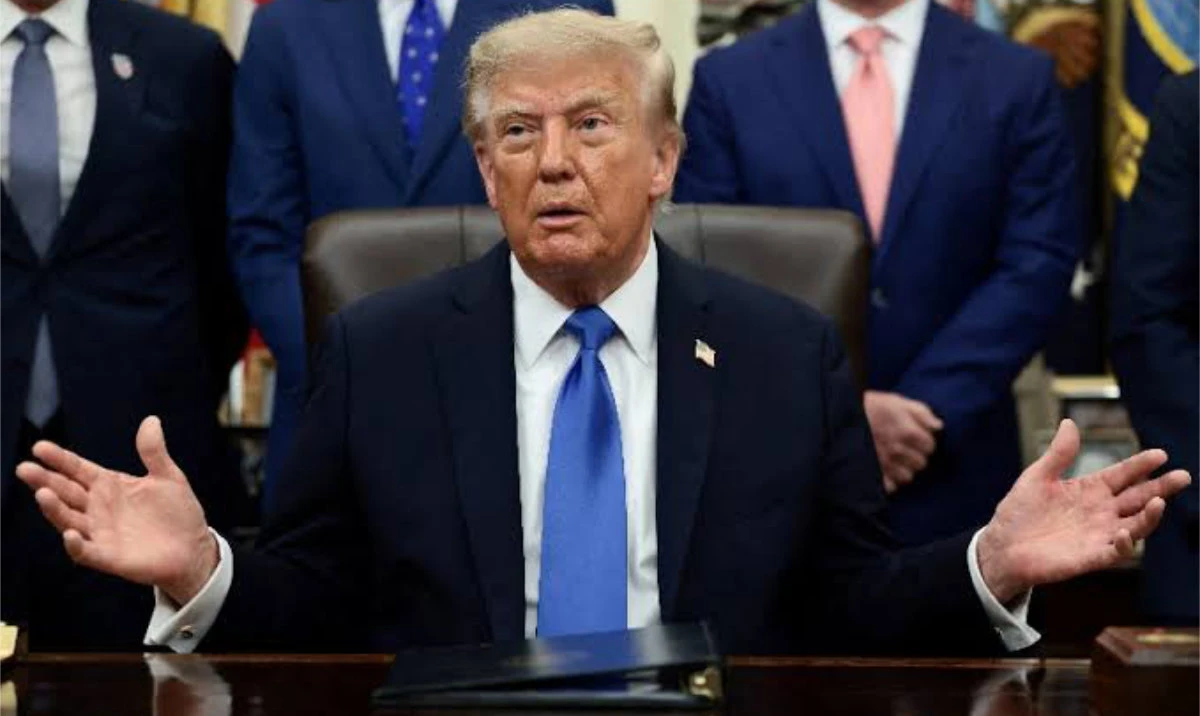
WASHINGTON: President Donald Trump said on Monday that the US already has guardrails in place to regulate and prosecute AI companies, appearing to play down concerns expressed by industry leaders over the weekend about the misuse of artificial intelligence harming people.
Public alarm about the potential danger posed by AI is growing, after Anthropic researcher Jacob Coxon said last week he had resigned, in part because the “people building AI earnestly believe that it could kill us all by the end of the decade.” AI-related stocks fell worldwide on Monday after leaders of some of the industry’s largest companies called for slowing the pace of the technology’s development.
“The only control or ‘guardrails’ that AI needs is a STRONG AND SMART (High IQ!) PRESIDENT, and the USA. has that, in spades!” Trump wrote on Truth Social, adding that China would benefit from the doubt being cast on AI development. Trump is scheduled to meet with Chinese President Xi Jinping next week in Washington.
Reuters previously reported that the two countries were planning a separate meeting in mid-September to discuss the risks of AI, led by lower-level government officials.
US House Speaker Mike Johnson told reporters on Monday that he expects Trump to meet with AI executives this week or “early next week.” The meeting would focus on “the responsibilities of the companies to maintain safety and what role, if any, the government has to play in that.”
Vice President JD Vance separately told reporters on Monday he is skeptical of the AI executives calling on the US government to regulate the sector.
“I feel a little bit weird about the fact that you have so many frontier AI tech companies kind of coming to the government and begging the government to regulate them,” Vance said.
Trump on social media said the AI industry’s call for regulation is a “hoax.”
AMODEI’S ESSAY
Anthropic CEO Dario Amodei wrote in an essay published on Saturday that the US government should write regulations requiring independent audits of the most advanced AI tools, known as “frontier” models. Reuters reported on Monday that three US senators are working on a bill that would require AI companies to demonstrate they are taking reasonable precautions to keep their tools from causing harm, with the specifics still being debated.
In his essay, Amodei outlined a three-step framework he said was intended to slow the pace of AI development and create more time to manage its risks. The proposal was immediately endorsed by several other executives at major AI companies, including Elon Musk, who runs xAI, and OpenAI CEO Sam Altman.
US Senator Mark Warner, a Virginia Democrat and a leader on technology legislation, spoke with Amodei and Altman about AI safety concerns over the weekend, his spokesperson said.
Nvidia CEO Jensen Huang addressed the AI safety concerns during the All-In Summit in Los Angeles on Monday.
“There’s just a whole bunch of stuff: pausing, pacing. Those are all voluntary things that they could do if they feel that their company is out of control,” according to a transcript of Huang’s remarks provided by a person in attendance.
Trump has so far resisted concerns about AI and has largely embraced tech companies in his second term. The tools intended to keep AI safe had already been used on Amodei’s Anthropic, he added without elaborating.
“The Trump Administration has stopped AI ‘people’ from doing bad, or potentially bad, ‘things,’ like Dario (Anthropic!), who is now pretending to be a ‘perfect little angel’ — and we will continue to do so,” Trump wrote on social media.
Anthropic’s media team did not immediately respond to a request for comment from Reuters about Trump’s statement.
The Trump administration is in a dispute with Anthropic over AI safety and the battlefield. US Defense Secretary Pete Hegseth blocked the company from certain military contracts because the company refused to allow the US to use its Claude AI models for domestic surveillance or autonomous weapons.
Anthropic sued in a California court, and a US judge sided with Anthropic in one lawsuit on August 27.
Latest NewsPakistan
Pakistan approves $271 million fuel subsidy amid US-Iran war energy shockTrump dismisses AI safety alarm, says US already has tools to police industry