

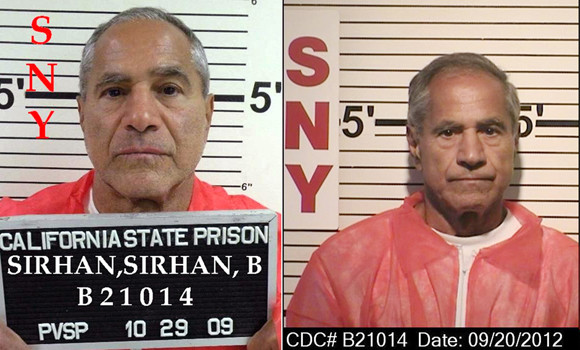
Parole hearing set for Robert Kennedy killer

Updated 11 February 2016
Follow

Parole hearing set for Robert Kennedy killer

SAN DIEGO, California: For nearly 50 years, Sirhan Sirhan has been consistent: He says he doesn’t remember fatally shooting Sen. Robert F. Kennedy in a crowded kitchen pantry of the Ambassador Hotel in Los Angeles.
The Jerusalem native, now 71, has given no inkling that he will change his version of events at his 15th parole hearing on Wednesday in San Diego. He is serving a life sentence that was commuted from death when the California Supreme Court briefly outlawed capital punishment in 1972.
During his previous parole hearing in 2011, Sirhan told officials about his regret but again said he could not remember the events of June 5, 1968. The parole board ruled that Sirhan hadn’t shown sufficient remorse and didn’t understand the enormity of the crime less than five years after the killing of President John F. Kennedy — the senator’s older brother — and two months after the assassination of Martin Luther King Jr.
His memory will be tested this time in front of Paul Schrade, 91, a Kennedy confidante who was one of five people injured in the shooting. Schrade will appear for the first time at a Sirhan parole hearing.
Schrade, who declined in a brief interview to preview his planned remarks to the parole board, has steadfastly advanced the view that there was more than one gunman.
Sirhan initially refused to appear at the parole hearing at the Richard J. Donovan Correctional Facility, where he has been held since 2013, said Laurie Dusek one of his attorneys. Memories of the 2011 hearing made him physically ill, but Sirhan relented after Dusek begged him to come and said Schrade would be there.
Sirhan, who skipped earlier parole hearings, sent word through his brother, Munir, that he would appear, but Dusek said she didn’t know what he will say, if anything.
“If you don’t show, you’ve got nothing to gain,” Dusek said she wrote to Sirhan.
Schrade, who was western regional director of the United Auto Workers Union when he was shot in the head, was labor chair of Kennedy’s presidential campaign and was at the senator’s side the night he was gunned down moments after delivering a victory speech in California’s pivotal Democratic primary.
Schrade has devoted the second half of his life to preserving Kennedy’s legacy and trying to unravel questions surrounding the assassination. He proposed the Robert F. Kennedy Community Schools at the site of the former Ambassador Hotel and has a library named for him there.
Schrade, who has kept a low profile in recent years, “is a family friend of the Kennedy’s, he’s very much in touch with the senator’s children,” Dusek said. “He feels that justice has not been served.”
Author Dan Moldea said Schrade was instrumental in arranging 14 hours of interviews with Sirhan for Moldea’s 1995 book, “The Killing of Robert F. Kennedy,” which concluded Sirhan acted alone. Moldea began his research believing there was more than one gunman.
“Paul is a great man of honorable intentions at all times, but Paul has grabbed at every thread of conspiracy in this case,” Moldea said. “When I concluded that Sirhan did it and did it alone, basically Paul cut me out of his life.”
Sirhan’s lack of memory of the attack makes expressions of remorse and accepting responsibility difficult.
In one of many emotional outbursts during his 1969 trial, he blurted out that he had committed the crime “with 20 years of malice aforethought.”
That and his declaration when arrested, “I did it for my country,” were his only relevant comments before he said he didn’t remember shooting Kennedy.
Last year, a federal judge in Los Angeles rejected arguments by Sirhan’s lawyers that their client was not in position to fire the fatal shot and that a second shooter may have been responsible.
Some claim 13 shots were fired while Sirhan’s gun held only eight bullets, and that the fatal shot appeared to come from behind Kennedy while Sirhan faced him.
___
Linda Deutsch, retired AP special correspondent, contributed to this report.

What is Trump’s ‘Board of Peace’?

Updated 10 sec ago
Follow

What is Trump’s ‘Board of Peace’?

  • Countries asked to pay $1 billion for a permanent spot on the board
  • The board was originally conceived to oversee the rebuilding of Gaza

BRUSSELS: US President Donald Trump’s government has asked countries to pay $1 billion for a permanent spot on his “Board of Peace” aimed at resolving conflicts, according to its charter seen by AFP.

The board was originally conceived to oversee the rebuilding of Gaza, but the charter does not appear to limit its role to the occupied Palestinian territory.

WHAT WILL IT DO?

The Board of Peace will be chaired by Trump, according to its founding charter.

It is “an international organization that seeks to promote stability, restore dependable and lawful governance, and secure enduring peace in areas affected or threatened by conflict,” reads the preamble of the charter sent to countries invited to participate.

It will “undertake such peace-building functions in accordance with international law,” it adds.

WHO WILL RUN IT?

Trump will be chairman but also “separately serve as inaugural representative” of the US.

“The chairman shall have exclusive authority to create, modify, or dissolve subsidiary entities as necessary or appropriate to fulfil the Board of Peace’s mission,” the document states.

He will pick members of an executive board to be “leaders of global stature” to “serve two-year terms, subject to removal by the chairman.”

He may also, “acting on behalf of the Board of Peace,” “adopt resolutions or other directives.”

The chairman can be replaced only in case of “voluntary resignation or as a result of incapacity.”

WHO CAN BE A MEMBER?

Member states must be invited by the US president, and will be represented by their head of state or government.

Each member “shall serve a term of no more than three years,” the charter says.

But “the three-year membership term shall not apply to member states that contribute more than USD $1,000,000,000 in cash funds to the Board of Peace within the first year of the charter’s entry into force,” it adds.

The board will “convene voting meetings at least annually,” and “each member state shall have one vote.”

But while all decisions require “a majority of member states present and voting,” they will also be “subject to the approval of the chairman, who may also cast a vote in his capacity as chairman in the event of a tie.”

WHO’S ON THE EXECUTIVE BOARD?

The executive board will “operationalize” the organization’s mission, according to the White House, which said it would be chaired by Trump and include seven members:

US Secretary of State Marco Rubio

Steve Witkoff, Trump’s special negotiator

Jared Kushner, Trump’s son-in-law

Tony Blair, former UK prime minister

Marc Rowan, billionaire US financier

Ajay Banga, World Bank president

Robert Gabriel, loyal Trump aide on the National Security Council

WHICH COUNTRIES ARE INVITED?

Dozens of countries and leaders have said they have received an invitation.

They include China, India, Russia’s President Vladimir Putin, Ukraine’s Volodymyr Zelensky and Canada’s Prime Minister Mark Carney.

Egypt’s President Abdel Fattah El-Sisi and Argentina’s President Javier Milei have also confirmed an invite.

Other countries to confirm invites include Jordan, Brazil, Paraguay, Pakistan and a host of nations from Europe, Central Asia and the Middle East.

WHO WILL JOIN?

Countries from Albania to Vietnam have indicated a willingness to join the board.

Hungarian Prime Minister Viktor Orban, Trump’s most ardent supporter in the European Union, is also in.

Canada said it would take part, but explicitly ruled out paying the $1-billion fee for permanent membership.

It is unclear whether others who have responded positively — Armenia, Belarus, Kazakhstan, Morocco and Vietnam among them — would be willing to pay the $1 billion.

WHO WON’T BE INVOLVED?

Long-time US ally France has indicated it will not join. The response sparked an immediate threat from Trump to slap sky-high tariffs on French wine.

Zelensky said it would be “very hard” to be a member of a council alongside Russia, and diplomats were “working on it.”

WHEN DOES IT START?

The charter says it enters into force “upon expression of consent to be bound by three States.”