- India’s first industry-manufactured Polar Satellite Launch Vehicle to launch early next year: ISRO chief
- Industry currently valued at $9 billion, with 440 space startups operating in the country
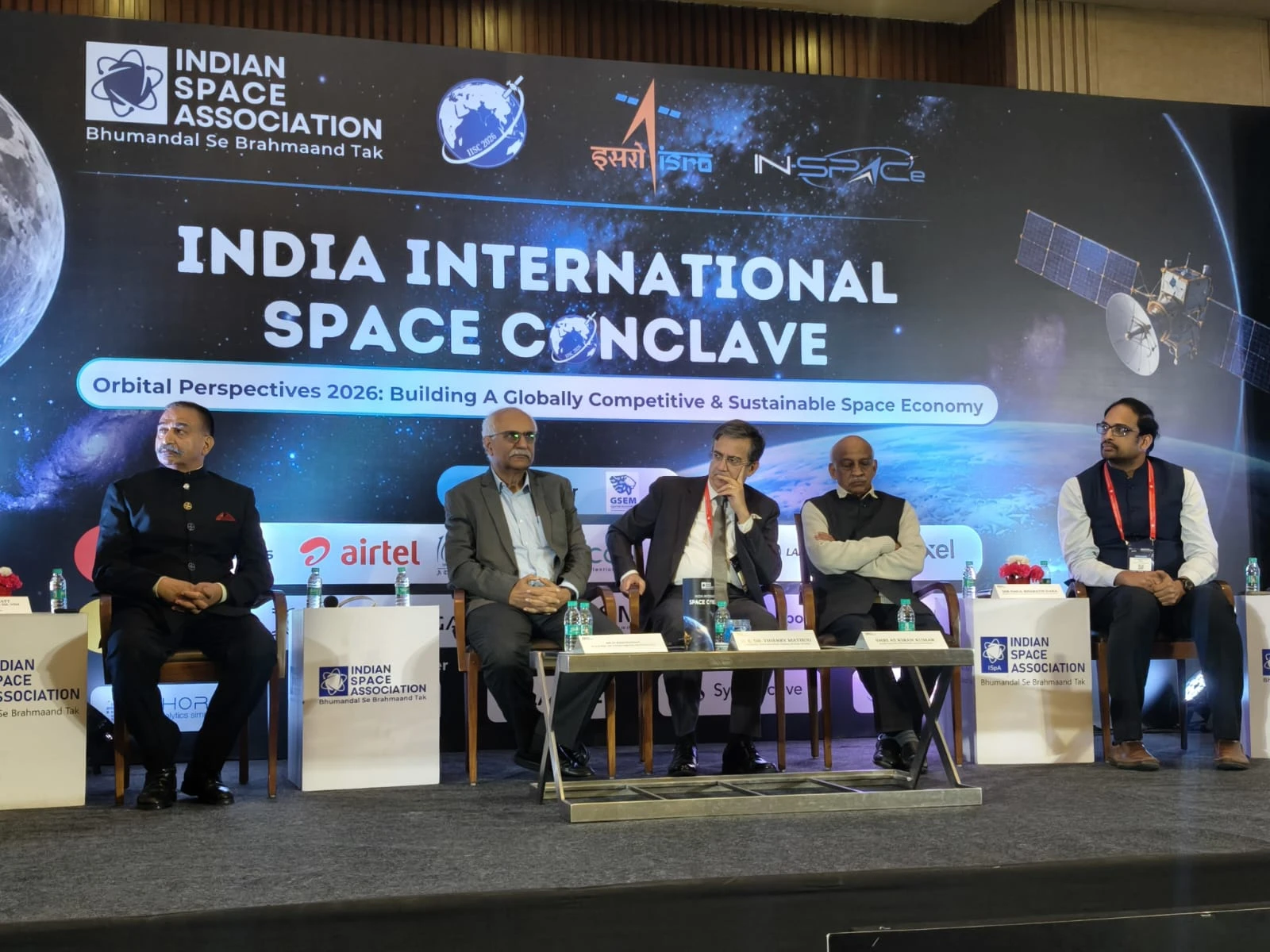
NEW DELHI: Space agencies, industry leaders and investors gathered in New Delhi on Tuesday for the India International Space Conclave, a conference focused on business, policy and strategic partnerships related to India’s evolving space ecosystem.
The two-day forum, which started on Monday, is part of India’s strategy for greater private-sector participation and international investment into its space economy. It saw international participation from stakeholders across Japan, France, the US, Luxembourg, South Korea, Indonesia, Oman, Australia and Russia.
Organized by the Indian Space Association, Indian Space Research Organisation and Indian National Space Promotion and Authorization Centre, it focuses on the commercial and policy dimensions of the space sector.
“India’s space sector is entering a defining phase, with growing private sector participation, expanding technological capabilities and increasing global interest in partnerships with Indian companies,” Lt. Gen. AK Bhatt (retd.), director-general of the ISpA, said.
“As the sector evolves, strengthening international cooperation, enabling innovation, facilitating investment and building a robust regulatory ecosystem will be critical. Through this platform, we aim to foster meaningful dialogue and collaborations that can help position India as a globally competitive and sustainable space economy.”
Initiatives to modernize and liberalize India’s space sector have been underway for the past few years. The ISpA, which is the apex industry body representing private companies and startups operating in the country’s space and satellite ecosystem, was launched by Prime Minister Narendra Modi in 2021 amid broader space-sector reforms to open the traditionally government-dominated sector to private enterprises.
Until then, Indian private space companies had largely operated as suppliers and contractors to ISRO-led space programs, not as independent commercial players.
The Indian Space Policy 2023 enabled private companies to undertake end-to-end space activities, including satellite manufacturing, rocket launches and commercial space services, with the goal to build a $44 billion space economy by 2033.
According to the latest official government figures published last week, the industry is currently valued at approximately $9 billion, and the number of active space startups in the country is 440.
They operate in rocket launches, satellites, Earth observation, satellite communications, propulsion, electronics, space monitoring, and data analytics.
A breakthrough in the sector’s commercialization was in July, when Hyderabad-based space technology startup Skyroot Aerospace successfully launched Vikram-1, India’s first privately developed orbital rocket, from the Satish Dhawan Space Centre in Sriharikota. The mission placed two satellites into low Earth orbit, making India the third country after the US and China to achieve orbital launch capability through private enterprise.
Another milestone is expected early next year with the launch of PSLV-N1, India’s first industry-manufactured Polar Satellite Launch Vehicle. It will be the first flight of an ISRO-designed PSLV rocket whose end-to-end manufacturing and integration have been entrusted to a consortium of state-owned Hindustan Aeronautics Limited and private-sector Indian engineering conglomerate Larsen and Toubro.
“The rocket is getting ready,” ISRO chief V. Narayanan told reporters. “We are targeting the first launch in the first quarter of next year.”