LONDON: The leaders of Afghanistan and Pakistan said yesterday they would work to reach a peace deal within six months, while throwing their weight behind moves for the Taleban to open an office in Doha.
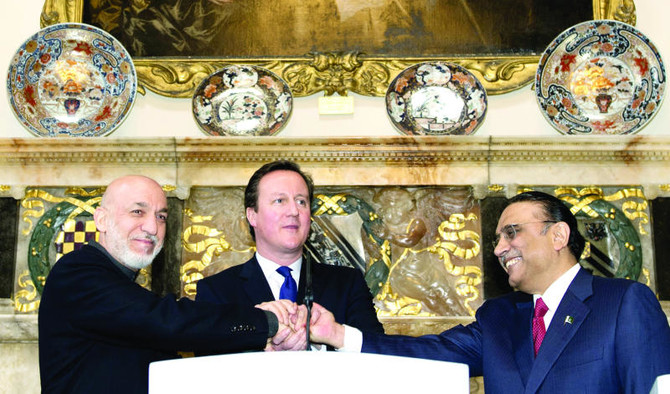
Following talks hosted by British Prime Minister David Cameron, Afghan President Hamid Karzai and his Pakistani counterpart Asif Ali Zardari also urged the hardliners to join the reconciliation process in Afghanistan.
But with no Taleban representative at the tripartite talks and with the militants still refusing to talk to Kabul, analysts said the commitment by the three leaders risked being one-sided.
They had a private dinner on Sunday and then full talks on Monday at Cameron’s Chequers country retreat near London, amid growing fears that a civil war could erupt when international troops leave Afghanistan in 2014.
“All sides agreed on the urgency of this work and committed themselves to take all necessary measures to achieve the goal of a peace settlement over the next six months,” they said in a joint statement issued by Cameron’s office.
“They supported the opening of an office in Doha for the purpose of negotiations between the Taleban and the High Peace Council of Afghanistan as part of an Afghan-led peace process,” the statement said.
Karzai had previously shunned the idea of a Taleban office in Doha because of fears that it would lead to the Kabul government being frozen out of talks between the United States and the Taleban.
The joint statement also said that the Afghan and Pakistani leaders had agreed arrangements to “strengthen co-ordination” of the release of Taleban detainees from Pakistani custody.
Afghan peace negotiators have welcomed Pakistan’s release of dozens of Taleban prisoners in recent months, a move they believe could help bring militants to the negotiating table. There was no immediate reaction from the Taleban.
The summit was the third trilateral meeting in a year following meetings in Kabul in July and New York last September — but the first in which Pakistani and Afghan army and intelligence chiefs took part.
Cameron, whose country is the second biggest contributor of troops to Afghanistan with 9,000 troops still in the country, appealed directly to the Taleban to join the reconciliation process.
“Now is the time for everyone to participate in a peaceful, political process in Afghanistan,” he told a press conference after the talks.
Karzai told the press conference he hoped in future to have “very close, brotherly and good neighborly” relations with Pakistan, which has been regularly accused by both Kabul and Washington of helping to destabilize Afghanistan.
Support from Pakistan, which backed Afghanistan’s 1996-2001 Taleban regime, is seen as crucial to peace after NATO troops depart — but relations between the neighbors remain uneasy despite some recent improvements.
Zardari said it was in Islamabad’s interests to support the initiative.
“Peace in Afghanistan is peace in Pakistan. We feel that we can only survive together,” he said. “We cannot change our neighborhood or our neighbors.” Pakistani political and security analyst Hasan Askari dismissed as “too ambitious” the prospect of securing in six months a settlement to end more than 11 years of war.
The lack of Taleban involvement in the talks was a particular problem, he said.
The Taleban in March 2012 suspended contacts with American representatives in Qatar over a potential prisoner exchange and opening a liaison office in the Gulf state, and publicly refuses to negotiate with Kabul.
Askari said the most realistic achievement in London would be better cooperation between Afghanistan and Pakistan, whose relations for years have been clouded by mutual blame for violence plaguing both countries.
Asked whether there could be a peace deal in six months, Askari said: “I don’t expect that, it would be a major upset of the calculation.”


Afghan-Pak peace deal in six months
Afghan-Pak peace deal in six months

Italian police fire tear gas as protesters clash near Winter Olympics hockey venue
- Police vans behind a temporary metal fence secured the road to the athletes’ village, but the protest veered away, continuing on a trajectory toward the Santagiulia venue
MILAN: Italian police fired tear gas and a water cannon at dozens of protesters who threw firecrackers and tried to access a highway near a Winter Olympics venue on Saturday.
The brief confrontation came at the end of a peaceful march by thousands against the environmental impact of the Games and the presence of US agents in Italy.
Police held off the violent demonstrators, who appeared to be trying to reach the Santagiulia Olympic ice hockey rink, after the skirmish. By then, the larger peaceful protest, including families with small children and students, had dispersed.
Earlier, a group of masked protesters had set off smoke bombs and firecrackers on a bridge overlooking a construction site about 800 meters (a half-mile) from the Olympic Village that’s housing around 1,500 athletes.
Police vans behind a temporary metal fence secured the road to the athletes’ village, but the protest veered away, continuing on a trajectory toward the Santagiulia venue. A heavy police presence guarded the entire route.
There was no indication that the protest and resulting road closure interfered with athletes’ transfers to their events, all on the outskirts of Milan.
The demonstration coincided with US Vice President JD Vance’s visit to Milan as head of the American delegation that attended the opening ceremony on Friday.
He and his family visited Leonardo da Vinci’s “The Last Supper” closer to the city center, far from the protest, which also was against the deployment of US Immigration and Customs Enforcement agents to provide security to the US delegation.
US Homeland Security Investigations, an ICE unit that focuses on cross-border crimes, frequently sends its officers to overseas events like the Olympics to assist with security. The ICE arm at the forefront of the immigration crackdown in the US is known as Enforcement and Removal Operations, and there is no indication its officers are being sent to Italy.
At the larger, peaceful demonstration, which police said numbered 10,000, people carried cardboard cutouts to represent trees felled to build the new bobsled run in Cortina. A group of dancers performed to beating drums. Music blasted from a truck leading the march, one a profanity-laced anti-ICE anthem.
“Let’s take back the cities and free the mountains,” read a banner by a group calling itself the Unsustainable Olympic Committee. Another group called the Association of Proletariat Excursionists organized the cutout trees.
“They bypassed the laws that usually are needed for major infrastructure project, citing urgency for the Games,” said protester Guido Maffioli, who expressed concern that the private entity organizing the Games would eventually pass on debt to Italian taxpayers.
Homemade signs read “Get out of the Games: Genocide States, Fascist Police and Polluting Sponsors,” the final one a reference to fossil fuel companies that are sponsors of the Games. One woman carried an artificial tree on her back decorated with the sign: “Infernal Olympics.”
The demonstration followed another last week when hundreds protested the deployment of ICE agents.
Like last week, demonstrators Saturday said they were opposed to ICE agents’ presence, despite official statements that a small number of agents from an investigative arm would be present in US diplomatic territory, and not operational on the streets.


