Navas, Wambach win CONCACAF Players of Year awards

Updated 23 December 2014
Follow

Navas, Wambach win CONCACAF Players of Year awards

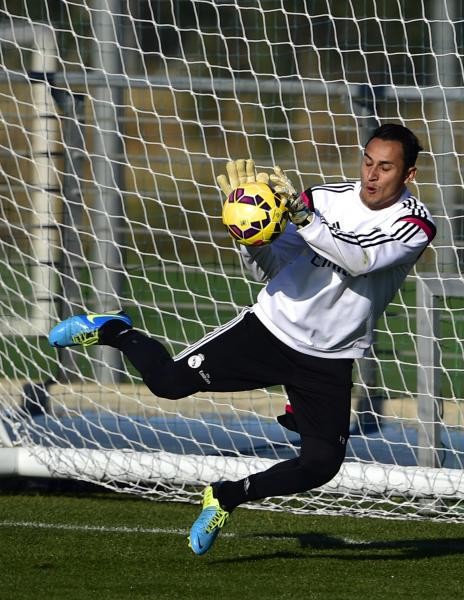
MIAMI: Costa Rica’s World Cup goalkeeper Keylor Navas and United States women’s team striker Abby Wambach were named CONCACAF’s Players of the Year for 2014 on Tuesday.
The governing body for the sport in North and Central America and the Caribbean also named Jorge Luis Pinto Coach of the Year after he led Costa Rica to the last eight at the World Cup for the first time.
Navas, 28, produced some outstanding displays for Costa Rica in the World Cup with three clean sheets from five matches and winning three Man of the Match Awards.
Following the World Cup, Navas completed a move to Spanish giants Real Madrid.
Wambach, the 34-year-old striker, who has scored more goals in international football than any male or female with 177 in 228 games, had another fine season including scoring four goals in the final of the CONCACAF Women’s Championship in 2014 in which the United States beat Costa Rica 6-0.
Pinto was rewarded for Costa Rica’s memorable World Cup campaign where they finished top of their group ahead of Uruguay, Italy and England and then beat Greece on penalties before losing to the Netherlands in a shootout after a goalless draw.
Pinto became head coach of the Honduran national team earlier this month.
United States and Everton keeper Tim Howard won CONCACAF Goalkeeper of the year for the second year while Costa Rica’s Bryan Ruiz’s strike against Italy in the World Cup was voted Goal of the Year.
American Mark Geiger was voted Referee of the Year.
The awards are voted on by three constituencies — national team coaches and captains, media and fans.


‘20 years of engagement’ — inaugural Formula 4 championship success signals bright future for motorsport in Saudi Arabia

Updated 03 February 2026
Follow

‘20 years of engagement’ — inaugural Formula 4 championship success signals bright future for motorsport in Saudi Arabia

  • Peter Thompson, founder of the Formula 4 Saudi Arabian Championship and Meritus.GP team principal, spoke about the Kingdom’s first motorsport academy and his hopes for the future

RIYADH: Last year welcomed the inaugural season of the FIA-certified Aramco Formula 4 Saudi Arabian Championship.

The series, which aims to provide the first step on the ladder towards Formula 1, was the culmination of years of collaboration between various investors and partners, led by the Kingdom’s first motorsport academy, Meritus.GP.

The championship’s mission?

To produce local driving talent, strengthen Saudi national race engineering capabilities and advance motorsport in alignment with the objectives of Saudi Vision 2030.

Five Saudi drivers emerged, with standout victories by Omar Al-Dereyaan and Faisal Al-Kabbani, both from Riyadh. Other graduates included race winner Oscar Wurz, who has since won the 2025 Central European Formula 4 Championship.

Arab News spoke with Peter Thompson, founder of Formula 4 Saudi Arabia and Meritus.GP, about the season’s success and his hopes for the future.

How did Meritus.GP build the Formula 4 Saudi Arabian Championship?

The Formula 4 Saudi Arabian Championship was the result of more than 20 years of engagement, exploration and groundwork in Saudi Arabia, in anticipation of a potential FIA-certified junior single-seater championship in the Kingdom.

Long before the first Formula 1 Saudi Arabian Grand Prix, we were on the ground exploring circuit development opportunities, assessing infrastructure readiness and evaluating whether Saudi Arabia could host a round of one of the Asian championships operated by the team. Throughout this period, we maintained long-standing relationships within Saudi motorsport circles including former Meritus.GP driver Raad Abduljawad and his brother Mohammed Abduljawad.

A defining moment came with the introduction of Formula 1 to Saudi Arabia. The Jeddah Corniche Circuit quickly became a visible symbol of this ambition, providing confidence that Saudi Arabia could support not only Formula One, but also a structured ladder of junior single-seater racing.

When did Meritus.GP receive formal institutional approval to begin Formula 4 Saudi Arabia?

More than three years of focused groundwork preceded the first race. During this period there was no formal government mandate, no guaranteed institutional backing and no commercial certainty that the project would proceed or be viable.

Then, in December 2022, a formal No-Objection Letter was issued by the Saudi Automobile and Motorcycle Federation, under the leadership of its then-CEO Sattam Al-Hozami, which allowed the project to progress from concept to reality.

Recognizing the benefits F4 would bring to the Kingdom, Mohammed Abduljawad became an investor in June 2023, and Formula 4 Saudi Arabia moved into full delivery mode.

What were the objectives of the proposal presented to Saudi Aramco?

The proposal positioned Aramco Formula 4 Saudi Arabia as a long-term national development platform aligned with Vision 2030.

Its objectives included creating a structured FIA driver pathway from grassroots to Formula One, as well as developing Saudi engineers, mechanics and officials in motorsports.

How did the championship support Saudi drivers, and what was the impact on local talent?

A core objective of Formula 4 Saudi Arabia was to create a genuine, fair and internationally credible environment in which Saudi racers could develop.

Saudi drivers competed alongside international peers under identical technical and sporting conditions, allowing performance and development to be measured objectively.

They ended up achieving race wins, podium finishes and measurable progress across the season, demonstrating that when provided with the right structure, Saudi talent can compete at international level. 

How has Formula 4 Saudi Arabia engaged with Saudi education and skills development?

Education and skills transfer formed an important part of the championship’s wider mission.

During the season, Meritus.GP engineers and senior staff visited Saudi education and research institutions such as KAUST, Alfaisal University, University of Tabuk and the Japanese College in Jeddah to discuss career pathways in motorsport engineering, data analysis, and systems integration. These engagements were designed to connect academic study with real-world high-performance engineering environments.

What level of investment was required and how did you ensure equality of performance?

Approximately $6.5 million was invested prior to the first event.

Was there any pre-season training to help Saudi drivers prepare?

During August and September 2023 Saudi drivers participated in a structured pre-season academy program at Meritus.GP’s training facility in Sepang, Malaysia.

What role did sports psychology and driver well-being play in the championship?

Driver well-being and mental performance were treated as integral components of driver development.

Formula 4 Saudi Arabia appointed a dedicated sports psychologist to support drivers throughout the season, focusing on mental preparation, confidence building, coping strategies, performance consistency and adaptation to high-pressure racing environments.