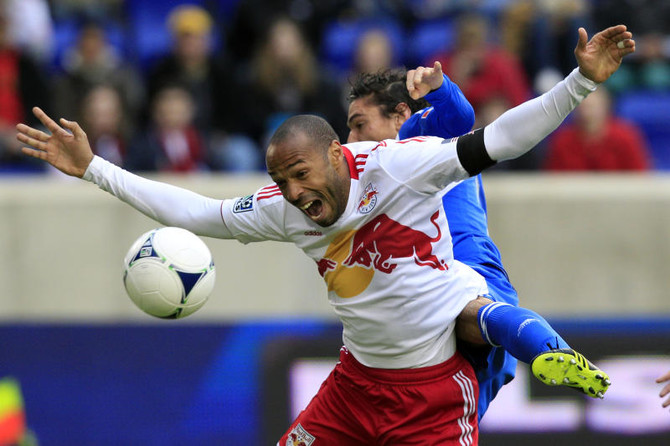
Thierry Henry leaving New York Red Bulls

Updated 01 December 2014
Follow

Thierry Henry leaving New York Red Bulls

HARRISON, N.J.: Thierry Henry is leaving Major League Soccer after 4½ seasons, unable to lead the New York Red Bulls to the team’s first championship.
The 37-year-old French star made the announcement Monday, two days after the Red Bulls lost the Eastern Conference final to the New England Revolution. And he said he made the decision back in 2010 to leave when his contract expired.
“I am taking this opportunity to announce that unfortunately Saturday was my last game for the New York Red Bulls,” Henry said in a statement released by the team Monday. “The decision has always been that I would leave after the duration of my contract, and although that was never going to change, I didn’t want it to distract from the progress of the team.”
With Landon Donovan retiring after the Los Angeles Galaxy play New England in the MLS Cup final Sunday, the league is losing arguably its two biggest stars.
A former Arsenal and Barcelona standout, Henry did not say whether he’s retiring or intends to play elsewhere. He plans to take a few weeks to decide what to do next.
He speaks English, French and Spanish, also could turn his career to television and be a soccer analyst.
Henry joined the Red Bulls from Barcelona after the 2010 World Cup. He had a $3.75 million salary this year and $4.35 million in overall compensation,
“Thierry Henry, an icon of the world’s game, has been a wonderful player for the New York Red Bulls and a major influence on the development of MLS,” Red Bulls sporting director Andy Roxburgh said..
Henry played in 122 matches for the Red Bulls, scoring 51 goals and adding 42 assists, tops in franchise history. His goals total was second to Juan Pablo Ángel’s 58, 14 of his goals were winners and 11 of his assists set up winning goals, also tops in club history.
Henry also scored some of the league’s most spectacular goals, including one that went directly into the net on a corner kick against Columbus in 2012.
Former Liverpool defender Jamie Carragher was quick to react to the on news.
“What a player!” he tweeted. “The best I faced without a doubt and yes I still have nightmares about him running past me at Anfield!! “
Henry was an MLS All-Star four times (2011-2014), a finalist for the league’s MVP award in 2012 and picked for MLS Best XI in 2011 and 2012.
In announcing his departure, Henry said he enjoyed his time playing in the MLS and living in the area.
“A special mention must go to the Red Bull fans who have supported this team through the good, the bad and the ugly times in the sun, rain and snow. You guys have really meant a lot to me and thank you for all your wonderful support,” he said.


Arab Cup 2025 attendance surpasses recent AFCON and AFC Asian Cup

Updated 5 sec ago
Follow

Arab Cup 2025 attendance surpasses recent AFCON and AFC Asian Cup

  • The tournament, held under FIFA jurisdiction for the second time, achieved a record average attendance of 38,644 fans per match
  • Total attendance more than doubled since 2021, with Algeria vs. UAE quarter-final pushing it past one million spectators

RIYADH: For a tournament often dismissed by critics as little more than a friendly or “B-team” competition, the 2025 Arab Cup delivered a compelling response.

A total of 1,236,600 people attended the 32 matches across the tournament, an average of 38,644 spectators per game, as the Arab Cup returned to Qatar for a second consecutive time after its successful staging in 2021. That earlier tournament, initially launched as a Confederations Cup-like test event ahead of the World Cup, drew 571,605 spectators in total.

Despite those figures, the Arab Cup has faced persistent criticism. Questions have been raised around the quality of play and refereeing standards, with some supporters – both within and beyond the Arab world – branding the tournament “meaningless.”

Yet when placed alongside recent continental competitions, the attendance figures tell a different story.

The 2023 African Cup of Nations in Ivory Coast attracted 1,109,593 fans across 52 matches, an average of 21,338 per game. Meanwhile, the 2023 AFC Asian Cup, also hosted in Qatar, recorded 1,507,790 spectators over 51 matches — roughly 29,565 per game, the highest average in the competition’s history.

Direct comparisons, however, require context. Continental — as opposed to regional — competitions draw support from across vast geographies, while the Arab Cup benefits from strong expatriate communities based in the host nation. Expecting the same travel patterns from fans in East Asia or West Asia would be, to say the least, unrealistic.

Even so, the attendance of more than 38,000 fans per game is significant. The Arab Cup was not always popular, with the attendance in 2021 struggling to rise above an average of 17,000 per game. Only four games at the 2025 edition fell below the 20,000 mark.

Historical context further underlines this shift. The 2011 AFC Asian Cup in Qatar, along with multiple editions of the West Asian Football Federation Championship held across the region, struggled to surpass a figure of 13,000 fans per game.

While Morocco will bask in the glory of the 2025 Arab Cup, the tournament itself has shown a broader shift in football engagement across the Arab World — one no longer driven solely by interest in European leagues, but by growing confidence in domestic teams, national projects and regional competitions.

From Saudi Arabia’s ambitions in club football to Morocco’s recent international success and Qatar’s continued role as a host, momentum continues to build across the Middle East and North Africa, with the Arab Cup one of the latest competitions offering tangible evidence of that change.