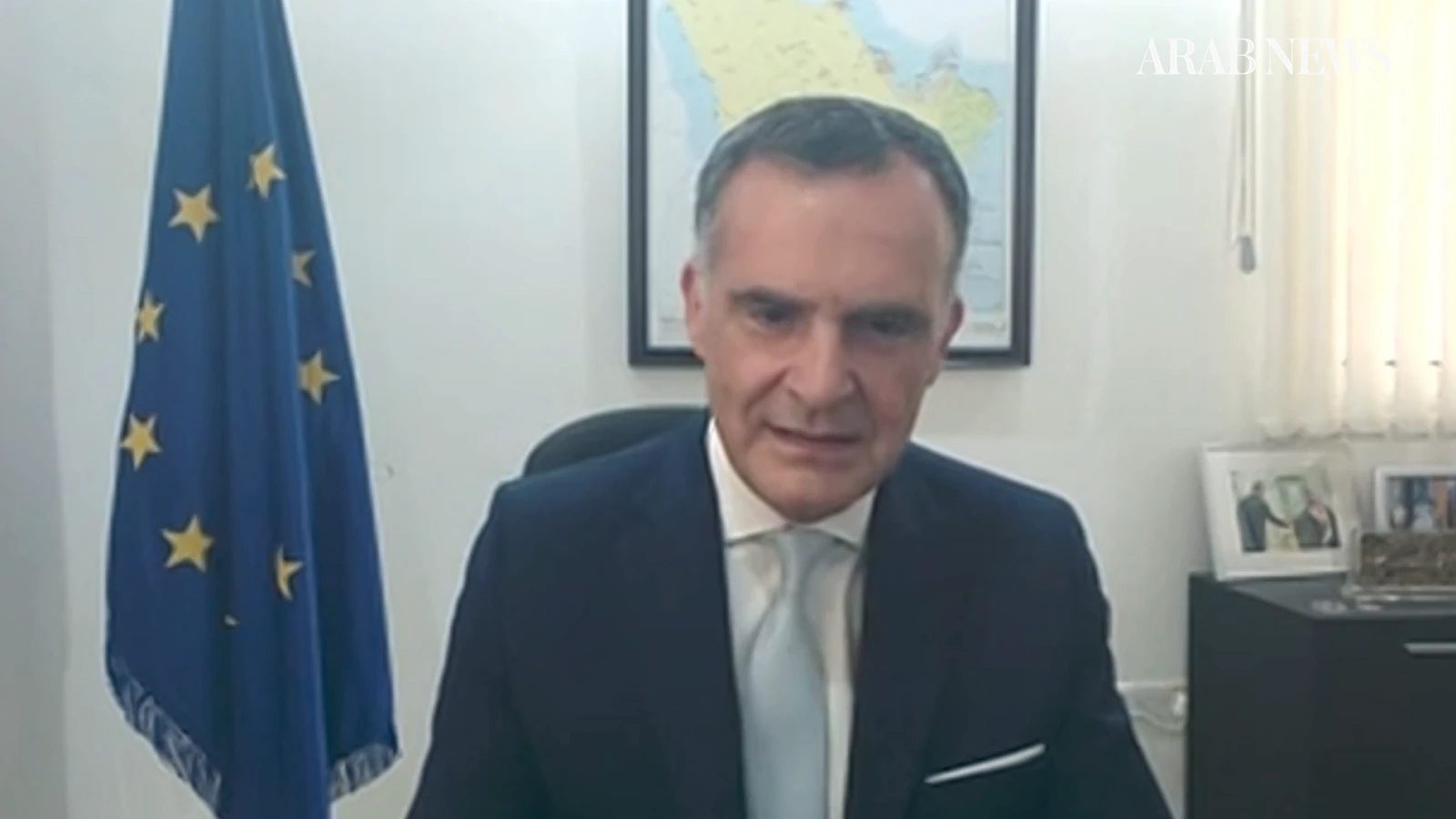
- Christophe Farnaud affirms bloc’s full solidarity with Saudi Arabia after Saturday’s airport attack by Houthis kills 12 and injures 309
- Tells Arab News the EU is working to reinforce its Red Sea naval mission as threats to trade routes endanger European interests too
RIYADH: The European Union ambassador to Saudi Arabia has conveyed the bloc’s strong condemnation of Saturday’s deadly attack on King Khalid International Airport in Riyadh which the Coalition to Restore Legitimacy in Yemen blamed on the Houthi militia.
“The EU strongly condemns the deadly attack on Riyadh international airport,” Christophe Farnaud told Arab News on Sunday, referring to the attack that killed 12 people and injured 309 others, some critically.
The dead included four Saudis and eight foreign nationals, according to Saudi Arabia’s General Authority of Civil Aviation.
“We offer our deepest condolences to the families of those killed, and we wish the injured a swift recovery. There can be no justification for indiscriminate attacks on civilians and civilian infrastructure.”
He added: “This dangerous escalation threatens regional stability and global security. We stand in full solidarity with Saudi Arabia and its people.”
Operations at King Khalid International Airport were temporarily suspended while officials assessed damage and checked the safety of facilities.
The coalition separately reported that a projectile fell near King Fahd International Airport in Dammam, Saudi Arabia’s main eastern airport, later on Saturday.
The Iran-backed Houthis have intensified attacks on Saudi civilian infrastructure in recent weeks. Attacks by the group on King Khalid International Airport on Thursday killed three Saudi citizens, GACA said. Saudia, the Kingdom’s flag carrier, confirmed one of its pilots, Captain Hamoud Ali Al-Kalthami, was among the dead.
Earlier, Farnaud told “Frankly Speaking,” the flagship talkshow of Arab News, that Europe’s condemnation of Houthi attacks reflected a consistent position, extending back to its support for Gulf countries during Iranian attacks earlier this year.
He pointed to statements by European Commission President Ursula von der Leyen and EU foreign policy chief Kaja Kallas, as well as support from individual member states, including France, Italy and Greece.
He said disruption around the Strait of Hormuz and Bab Al-Mandab threatened economies far beyond the Gulf. Europe’s interests and those of regional countries were closely connected, he said, making an active response essential.
To this end, Farnaud said, Europe was working to reinforce its maritime security presence, and cited Operation Aspides, the EU naval mission launched in February 2024 to protect Red Sea shipping under a defensive mandate.
“We are working on reinforcing Aspides currently. So, this is a very concrete example of what we’re doing,” he said.
European representatives had attended meetings of the Multinational Maritime Defense Alliance, spearheaded by Saudi Arabia, and were working toward an observer role, he said.
Reinforcing the naval mission required agreement among the EU’s 27 members, he said, adding that naval operations could improve security without resolving the underlying conflict.