RIYADH: Over 376,000 people visited Riyadh International Book Fair 2016, which concluded Saturday, of whom two-thirds were females and children, according to sources at the fair media center.
Among top visitors were President of Saudi Council for Tourism and National Heritage Prince Sultan bin Salman, British Ambassador Simon Collis, Chinese Ambassador Li Chengwen and Deputy Chief of the US Mission Timothy Lenderking.
Around 500 local, Arab, Islamic, and international publishers, and countries participated in the fair, displaying around 1.2 million titles in science, technology, history, literature, politics, religion, languages, geography, medicine, engineering, education and communication.
Countries participated with national booths of different sizes with Greece the guest of honor country for this year.
The attendant of the Greece booth, Haris Pappis, told Arab News, “We did not want to impress visitors with the size and commercial appearance, but rather with the sensitivity, value and originality of our culture,” he said.
The booth displayed around 100 hundred titles on Greek history, archaeology, literature and philosophy. Around 70 percent of the books were in English while the remaining 30 percent were translations of Greek into Arabic.
He said that the booth received around 800 people daily. While some has asked for books on Greek history and philosophers, others asked for information on travel and tourism in Greece.
“I think our participation has contributed in promoting tourism among Saudis, though it was not meant to. I think we will have more Saudi tourists this summer,” said Pappis.
A visitor to to the booth, Rasha Al-Fawaz, a Saudi graduate student at King Saud University in Riyadh, told Arab that she came to the booth searching for literature on Greek artifacts “because archaeologists say that there are Greek influences on Arabian Peninsula artifacts and this falls within my academic interest.”
The US also had also a booth with books displayed on American culture, history and biographies of prominent Americans. “The fair is a good opportunity for us and all participants and visitors to exchange ideas and information freely,” US Cultural Attaché, and supervisor of the booth, David Edginton, told Arab News.
The fair was not only a place for displaying books, but also became business venue. Books worth over SR60 million were sold during the ten days of the fair.
No visitor would miss the scene of men, women and children carrying their purchases of books in big bags or on wheels. One single purchase reached SR60,000. “Therefore, we very much care about participating in this fair. We time printing some of our books close to the opening of the fair. It a season for us,” an Arab publisher told Arab News.
There was almost a total lack of books on the Muslim Brotherhood and Daesh, or books which could cause misunderstanding or controversy between Sunnis and Shiites.
In addition, there were some books withdrawn, such as the books of controversial Egyptian writer Nawal Al-Sadawi, an extremist advocate of women’s rights, due to a demands by visitors to the fair.


![]()
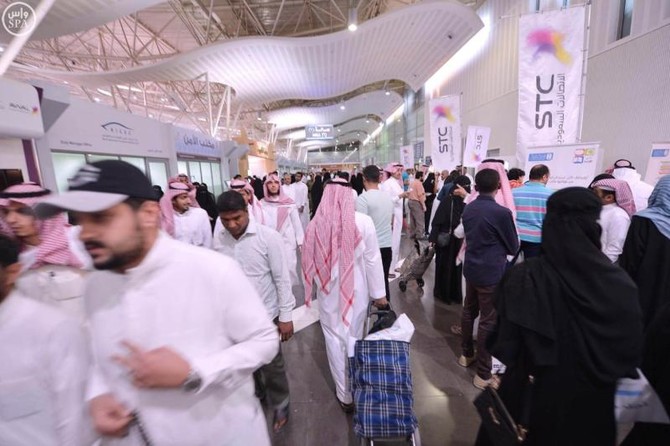
Riyadh Book Fair ‘received more than 376,000 visitors’
Riyadh Book Fair ‘received more than 376,000 visitors’
Latest updates


Recommended


© 2026 SAUDI RESEARCH & PUBLISHING COMPANY, All Rights Reserved And subject to Terms of Use Agreement.