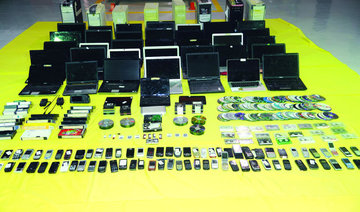
RIYADH: Saudi Arabia announced Saturday it has broken up a cluster of Daesh cells, members of which planned strikes in the Kingdom, and arrested over 400 suspects, mostly Saudis, in an anti-terrorism sweep.
The detainees include suspects in recent attacks on security patrols in Riyadh and suicide bombings in the Eastern Province.
The operatives had planned attacks on diplomatic missions and conducted a reconnaissance on one of them. They were also working to identify the houses of a number of security men in a plot to assassinate them. Security and government installations in Sharourah were also in their crosshairs.
The startling revelations were made at a Ministry of Interior press conference on Saturday.
“Security authorities have, over the past few weeks, worked to dismantle a network of cluster cells linked to Daesh. They were following a scheme managed from troubled spots abroad with the aim of inciting sectarian strife and chaos in the Kingdom,” said Gen. Mansour Al-Turki, the ministry’s spokesman.
He added that 431 people have been arrested so far. The foreigners in the cells are from Yemen, Egypt, Syria, Jordan, Algeria, Nigeria and Chad. Some of the operatives are yet to be identified, he pointed out.
The task of five members of a cell was to prepare suicide bombers while another five-member cell had the mission of manufacturing explosive belts.
Of the 431 arrested, 190 made up the four cells suspected to be behind Al-Qadeeh and Al-Anoud bombings in the Eastern Province.
“What combines these cells — not allowed to make direct contacts with each other due to security restrictions — is their ties with Daesh in terms of the adoption of thought, division of society and bloodshed and then exchanging roles to implement the plans and objectives dictated from abroad,” Al-Turki added.
The ministry accused those arrested of involvement in several attacks, including a suicide bombing in May that killed 22 people in the eastern village of Al-Qadeeh.
It also blamed them for the November shooting and killing of eight worshippers in the eastern village of Al-Ahsa, and the Al-Anoud Mosque attack in Dammam where a suicide bomber disguised as a woman blew himself up during Friday prayers, killing four.
Those arrested included suspects behind a number of militant websites used in recruitment, the ministry said.
The ministry said that authorities foiled attacks plotted during Ramadan, including a bombing at a mosque belonging to security forces in Riyadh and Shiite mosques in Eastern Province.
Among those detained are 144 people accused of supporting the network by “spreading the deviant ideology on the Internet and recruiting new members.”


Massive sweep foils Daesh plot to sow chaos in KSA

Massive sweep foils Daesh plot to sow chaos in KSA

The founding economy: A blueprint for stability in the First Saudi State
- The establishment of the First Saudi State created a secure environment that facilitated the arrival of caravans, secured vast trade routes, and revived commerce across the Arabian Peninsula
RIYADH: The economy during the founding stage of the First Saudi State served as a fundamental pillar in building the nation, consolidating its influence, and ensuring its stability. This early economic growth was inextricably linked to achieving security, unifying regions, and organizing society—factors that directly stimulated trade, stabilized markets, and enhanced the foundations of daily life in Diriyah and its surrounding areas.
According to Dr. Abdullah Al-Saleh Al-Othaimeen's "Diriyah: Origins and Development during the First Saudi State," published by the King Abdulaziz Foundation for Research and Archives (Darah), the founding economy stands as a historical model reflecting the reciprocal relationship between political stability and early economic prosperity.

The establishment of the First Saudi State created a secure environment that facilitated the arrival of caravans, secured vast trade routes, and revived commerce across the Arabian Peninsula.
Beyond its political and intellectual prominence, Diriyah emerged as a vibrant economic hub. Its active markets attracted merchants and students from across the region, all of whom benefited from the state-provided stability. The local society relied on diverse activities for its livelihood, including trade, agriculture, and livestock breeding, with horses and camels playing crucial roles in transportation, commerce, and securing roads.
The social and administrative organization upon which the state was founded ensured the continuous availability of goods and sustained market stability. Ultimately, the close relationship between public security and economic growth during this founding phase solidified Diriyah's position as a premier political and commercial center in the Arabian Peninsula.


