In a further boost to Saudi-Polish relations, Prince Khaled bin Saud bin Khaled, assistant foreign minister, on Monday inaugurated the new headquarters of the Saudi Embassy in Warsaw.
Polish Foreign Minister Grzegorz Schetyna, Senate head Bogdan Borisovich and Saudi Ambassador to Poland Waleed Taher bin Radwan were present on the occasion.
According to an official from the Saudi Embassy in Poland, the prince unfurled the Saudi national flag to mark the opening of the spacious brand new complex.
Schetyna congratulated the Kingdom on the opening of the new mission and appreciated the age-old relationship between two countries.
Diplomatic relations between the two countries were established on May 3, 1995, followed by the opening of the Polish Embassy in Riyadh in June 1998.
On Oct. 29, 2001, Osama bin Ahmad Al-Sanusi submitted his credentials as the first Saudi ambassador to Polish President Aleksander Kwasniewski.
Relations between Poland and Saudi Arabia are two centuries old. In 1817, Polish nobleman Count Waclaw Rzewuski made his famous exploratory journey into the heartland of what is today Kingdom of Saudi Arabia.
In 1844, Count Jerzy Dzieduszycki visited Hail and bought eight horses from the Al-Rashid family. The journey is documented in his memoirs.
In 1929 Poland recognized King Abdulaziz bin Abdulrahman Al-Saud as the ruler of Hijaz, Najd and dependencies, becoming the ninth country in the world to begin official relations with the Kingdom. In 1930 King Abdulaziz received in Jeddah the official Polish delegation headed by Count Edward Raczynski, deputy head of the ME section in the Poland’s Foreign Ministry and Jakub Szynkiewicz, the then grand mufti of Poland.
A new chapter in Saudi-Polish bilateral relations was opened by the official visit of President Aleksander Kwasniewski to the Kingdom in March 2004.


KSA mission’s new complex inaugurated in Warsaw
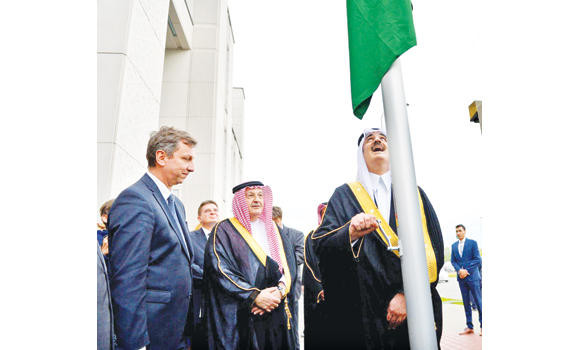
KSA mission’s new complex inaugurated in Warsaw

Saudi Arabia expresses regret over damage to Qatar’s embassy building in Ukraine
- Qatar said that its embassy in the Ukrainian capital was damaged during Russian strikes the night before but that its staff were unharmed
RIYADH: Saudi Arabia has expressed regret over damages sustained by the building of Qatar’s embassy in the Ukrainian capital during a Russian attack.
Qatar said that its embassy in the Ukrainian capital was damaged during Russian strikes the night before but that its staff were unharmed.
The Saudi foreign ministry said in a statement shared on X that the kingdom “expresses its profound regret over the damage sustained by the embassy building of the fraternal State of Qatar due to shelling in the Ukrainian capital, Kyiv.”
Saudi Arabia also “renews its supporting position for diplomatic efforts aimed at resolving the Russian-Ukrainian crisis by peaceful means,” it added.
The ministry also affirmed the need to provide protection for members of diplomatic missions, and their premises, in accordance with the Vienna Convention on Diplomatic Relations.
#بيان | تعرب وزارة الخارجية عن بالغ أسف المملكة العربية السعودية لما تعرض له مبنى سفارة دولة قطر الشقيقة من أضرار نتيجة القصف في العاصمة الأوكرانية كييف. pic.twitter.com/xw6Ct3bPbb
— وزارة الخارجية (@KSAMOFA) January 9, 2026