Indian expats remember Babri Mosque tragedy

Updated 08 December 2014
Follow

Indian expats remember Babri Mosque tragedy

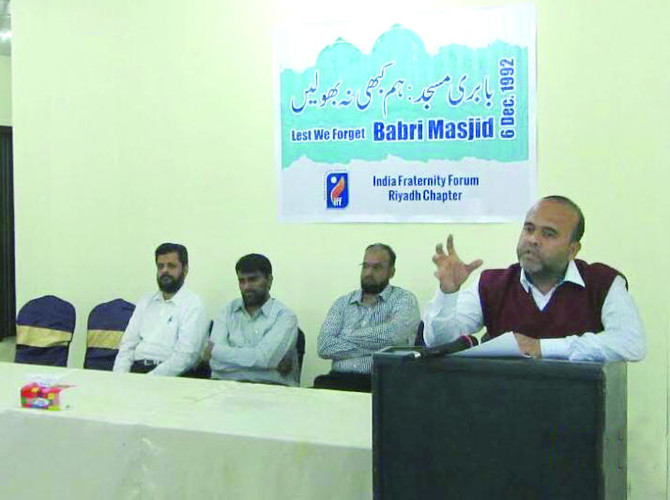
The Indian community living in the Kingdom observed the 22nd annual “Black Day” on Saturday, Dec. 6, which marks the anniversary of the demolition of the Babri Mosque in 1992 by a group of Hindu extremists.
The India Fraternity Forum (IFF) organized a public program entitled, “Lest We Forget Babri Masjid” to mark the anniversary of the tragic event.
Speaking at the event, Anwar Khan, secretary of the IFF Andhra Pradesh chapter in Riyadh said: “It was not an assault on a mosque but Indian democracy. The crime was committed by a fanatic mob led by some political leaders. The day reminds us of the gross injustice committed against the minority community of India.”
Syed Ali, IFF president for northern states, said: “The matter has remained difficult for a long time and this is an example of denied justice in the secular republic of India,” adding that the then Premier Narshimha Rao described Dec. 6, 1992, as “a shameful day for India” and promised that his government would rebuild the Babri Mosque on the same site where it was located, but this has never happened.
Meanwhile, Mohammed Quaiser, president of “Tanzeem Hum Hindustani” said: “The demolition of Babri Mosque is largely responsible for dividing India on religious grounds for the purpose of voting politics by the Bharatiya Janata Party (BJP), as the event was followed by communal violence that involved the killing of hundreds of Muslims across India.”
Akhtaru Islam, president of the Middle East NRI association, termed the demolition of Babri Mosque as “an assault on the secular democracy of India by a fundamentalist mob, which were allowed by the government of the time to go on a rampage.”
“The communal riots that erupted after the demolition of the historic mosque was an assault on the secular fabric of modern India that was thrown into jeopardy by fundamentalists,” he said.
Mohammad Javid, central region secretary of the Indian Social Forum (ISF) said: “Only the rebuilding of the mosque on the same site would serve justice and restore faith of millions of Indians, including both Muslims and non-Muslims.”


Economic growth and resilience at heart of 2nd AlUla Emerging Market Economies Conference

Updated 03 February 2026
Follow

Economic growth and resilience at heart of 2nd AlUla Emerging Market Economies Conference

  • Event on Feb. 8 and 9 will bring together ministers, governors of central banks, policymakers, economic experts and international financial institutions
  • Emerging-market economies a ‘pivotal element’ in global economic system due to effect they have on growth and stability, says Saudi Finance Minister Mohammed Al-Jadaan

RIYADH: The second annual AlUla Conference for Emerging Market Economies, which Saudi Arabia will host next week, offers a platform to exchange views on global developments and discuss policies and reforms that support inclusive growth and strengthen economic resilience, the Kingdom’s finance minister said.

The event on Feb. 8 and 9 will bring together finance ministers, governors of central banks and policymakers, alongside economic experts and representatives of international financial institutions.

Organized by the Saudi Ministry of Finance in partnership with the International Monetary Fund, it takes place as emerging-market economies face mounting challenges amid rapid global economic change.

Finance Minister Mohammed Al-Jadaan said the decision to host the conference reflects Saudi Arabia’s ongoing commitment to efforts that support global financial and economic stability, and highlights the growing influence of emerging economies on worldwide growth.

Emerging-market economies represent a “pivotal element” in the global economic system due to the direct impact they have on economic growth and stability, he added.

“The AlUla Conference for Emerging Market Economies provides a unique platform for exchanging views on global economic developments, and discussing policies and reforms that will support inclusive growth and enhance economic resilience, in light of broader international cooperation that contributes to confronting common challenges,” Al-Jadaan said.

Kristalina Georgieva, managing director of the IMF, said the event would help emerging economies deal with growing uncertainty driven by technological change, demographic shifts and geopolitical tensions.

“The AlUla conference provides a vital platform for emerging economies to discuss how they can navigate the risks and embrace the opportunities ahead,” she said.

“In these times of sweeping transformations in the global economy, policymakers face a more challenging and uncertain environment. Countries should work together to strengthen resilience through sound macroeconomic and financial policies.”