Turkiye again blocks aid convoy for Kurds in Syria: NGO

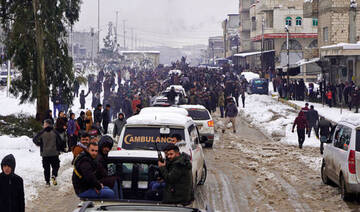
The aid convoy had been assembled in Turkiye’s southeastern Kurdish city of Diyarbakir, above, by the Diyarbakir Solidarity and Protection Platform. (AFP)
Short Url
Updated 04 February 2026
Follow

Turkiye again blocks aid convoy for Kurds in Syria: NGO

  • Last week, Turkish authorities prevented a convoy carrying humanitarian supplies destined for Kobani
  • The convoy had been assembled in Turkiye’s southeastern Kurdish city of Diyarbakir

DIYARBAKIR, Turkiye: Turkish authorities have blocked for a second time an aid convoy from reaching the Syrian Kurdish town of Kobani that’s been overwhelmed by people fleeing fighting, a local NGO said on Wednesday.
As the Syrian army and Kurdish forces clash in Syria, Kobani has been inundated by people trying to escape the hostilities.
Last week, Turkish authorities prevented a convoy of 25 trucks carrying humanitarian supplies destined for Kobani from reaching the Turkiye-Syria border.
The convoy, which included water, milk, baby formula and blankets, had been assembled in Turkiye’s southeastern Kurdish city of Diyarbakir by the Diyarbakir Solidarity and Protection Platform, the NGO that organized the aid drive.
After it was blocked last week, it had initially been authorized to travel via Azaz, a city in northern Syria, with its own delegation overseeing the handover.
But “the delegation was again denied permission,” the group said in a statement on Wednesday.
The trucks “were not allowed to cross into Kobani despite all efforts,” it said, adding that “the aid was brought back to Diyarbakir.”
Last week, residents of Kobani said they were running out of food, water and electricity because the city was overwhelmed with people fleeing the advance of the Syrian army.
Kurdish forces accused the Syrian army of imposing a siege on Kobani, also known as Ain Al-Arab in Arabic.
After months of deadlock and fighting, Damascus and the Syrian Kurds announced an agreement on Friday.
The deal “seeks to unify Syrian territory,” including Kurdish areas, while also maintaining an ongoing ceasefire and introducing the “gradual integration” of Kurdish forces and administrative institutions, according to the text of the agreement.
Kurdish forces liberated Kobani from a lengthy siege by the Daesh group in 2015, their first major victory against the jihadists.
Turkiye views Syrian Kurdish fighters as a terror group affiliated with Turkiye’s outlawed Kurdistan Workers’ Party (PKK).


The UN says Al-Hol camp population has dropped sharply as Syria moves to relocate remaining families

Updated 15 February 2026
Follow

The UN says Al-Hol camp population has dropped sharply as Syria moves to relocate remaining families

  • Forces of Syria’s central government captured the Al-Hol camp on Jan. 21 during a weekslong offensive against the SDF, which had been running the camp near the border with Iraq for a decade

DAMASCUS: The UN refugee agency said Sunday that a large number of residents of a camp housing family members of suspected Daesh group militants have left and the Syrian government plans to relocate those who remain.
Gonzalo Vargas Llosa, UNHCR’s representative in Syria, said in a statement that the agency “has observed a significant decrease in the number of residents in Al-Hol camp in recent weeks.”
“Syrian authorities have informed UNHCR of their plan to relocate the remaining families to Akhtarin camp in Aleppo Governorate (province) and have requested UNHCR’s support to assist the population in the new camp, which we stand ready to provide,” he said.
He added that UNHCR “will continue to support the return and reintegration of Syrians who have departed Al-Hol, as well as those who remain.”
The statement did not say how residents had left the camp or how many remain. Many families are believed to have escaped either during the chaos when government forces captured the camp from the Kurdish-led Syrian Democratic Forces last month or afterward.
There was no immediate statement from the Syrian government and a government spokesperson did not respond to a request for comment.
At its peak after the defeat of IS in Syria in 2019, around 73,000 people were living at Al-Hol. Since then, the number has declined with some countries repatriating their citizens. The camp’s residents are mostly children and women, including many wives or widows of IS members.
The camp’s residents are not technically prisoners and most have not been accused of crimes, but they have been held in de facto detention at the heavily guarded facility.
Forces of Syria’s central government captured the Al-Hol camp on Jan. 21 during a weekslong offensive against the SDF, which had been running the camp near the border with Iraq for a decade. A ceasefire deal has since ended the fighting.
Separately, thousands of accused IS militants who were held in detention centers in northeastern Syria have been transferred to Iraq to stand trial under an agreement with the US
The US military said Friday that it had completed the transfer of more than 5,700 adult male IS suspects from detention facilities in Syria to Iraqi custody.
Iraq’s National Center for International Judicial Cooperation said a total of 5,704 suspects from 61 countries who were affiliated with IS — most of them Syrian and Iraqi — were transferred from prisons in Syria. They are now being interrogated in Iraq.