Deputy Defense Minister Prince Khaled bin Sultan yesterday expressed confidence that Saudi Arabia will soon achieve self-sufficiency in military equipment and spare parts.
“We look forward to exporting some of our products,” he said while opening an armed forces exhibition for materials and spare parts.
“The efforts being made by different government departments including the armed forces as well as the private sector, companies involved in the Economic Offset Program and research centers reflect the desire to achieve self-sufficiency and reduce expenditure,” the minister told the gathering of prominent businessmen, defense officials, and government representatives at the Dhahran International Exhibition Center.
Eastern Province Deputy Gov. Prince Jelawi bin Abdul Aziz bin Musaed and Saudi Royal Air Force Commander Gen. Mohammed Abdullah Al-Ayesh were among those who were present at the event.
The exhibition, which will run until Dec. 13, has been organized by the Department of Defense in strategic partnership with the Asharqia Chamber. The exhibition aims to promote communication between the armed forces and national factories to set up industry for manufacturing spare parts for armed forces’ materials.
Asharqia Chamber chief Abdul Rahman Al-Rashed said the Kingdom has a fantastic industrial base. “Our total investment in the industrial sector exceeds SR 1.8 trillion, and this gives our industries the added advantage of exporting their stuff,” he said.
According to Al-Rashed, Saudi firms are already exporting spare parts that may be used in military equipment. “For instance, our firms are exporting heavy equipment, radiators, silencers … all these spare parts can also be used in military equipment,” he told Arab News.
Prince Khaled said new military industries would help generate job opportunities for young men and women. He commended local efforts in the field of military engineering to ensure efficiency of high-tech equipment and devices. Prince Khaled urged Saudi researchers and producers not to violate intellectual property rights and industrialization rights. “We should not steal others thoughts and efforts. Honesty is the basis of success,” he added.
Prince Khaled commended the efforts made by relevant authorities to classify and number national military industries and for registering them at national and international levels. He praised the contributions made by Prince Sultan Institute for Advanced Research and Military Engineering Department at King Saud University. A working team of various military sectors has been formed to coordinate with the Central Industrialization Committee and the private sector to achieve the Defense Ministry’s strategic goals. “All these efforts will lead to achieving self-sufficiency and then strengthening our capability to export,” he said. Prince Khaled emphasized the importance of upholding quality. Authorities have rejected 120 industries and refused to accept 170 spare parts as they failed to fulfill quality conditions. Prince Khaled praised the late Prince Sultan, former defense minister, for promoting cooperation between the various defense sectors and the private sector and encouraging national industries to support the armed forces and transfer of technology.
“Prince Sultan was confident in the capabilities of Saudi civilians and military officers in confronting challenges and overcoming difficulties,” he said, adding that he had given priority to national interests.
Gen. Al-Ayesh, who is chairman of the central committee for industrialization, highlighted the importance of transfer of technology for achieving sustainable development.
On the sidelines of the exhibition, lectures and seminars are being held for the exchange of information, opinions, ideas, suggestions and experiences to serve the local manufacturing industry with the participation of government agencies, universities, research centers and the private sector and other stakeholders.
The exhibition is set to open channels of a joint cooperation between the armed forces, businesses and local factories and the private sector. It will inform the private sector on the needs and requirements of the armed forces such as materials and spare parts which can be manufactured locally.


Kingdom’s military industries geared toward self-sufficiency

Kingdom’s military industries geared toward self-sufficiency

‘Cake not hate’ campaign becomes ‘Dates not hate’ in Madinah
- Dan said he was very impressed by Saudi hospitality and that his family was warmly welcomed
- He said being in Madinah exposed him to the true diversity of Islam
LONDON: A British autistic and non-verbal boy who has been visiting UK mosques and distributing cakes to promote solidarity amid an increase in far-right support in the country has taken his message of love to Madinah.
Joshua Harris, or “The Joshie-Man” as the 12-year-old is known to his social media fans, has handed out hundreds of his baked goods to worshipers at mosques in major British cities over the last few months.
The “Cake not hate” campaign came about after an Islamophobic attack on a mosque in his home city of Peterborough in October 2025.
Harris and his father visited Masjid Darassalaam, the mosque that was targeted, with cakes that the boy had baked and distributed them to the congregation soon after the attack. Since then, Harris has visited dozens of mosques in the UK.
On a recent trip to the Middle East, he and his father visited Madinah. In a local twist that pays tribute to the holy city’s famous date varieties including ajwa and ambar, Harris handed out dates to people in the courtyard of the Prophet’s Mosque. The “Cake not hate” campaign became “Dates not hate” for Saudi Arabia.
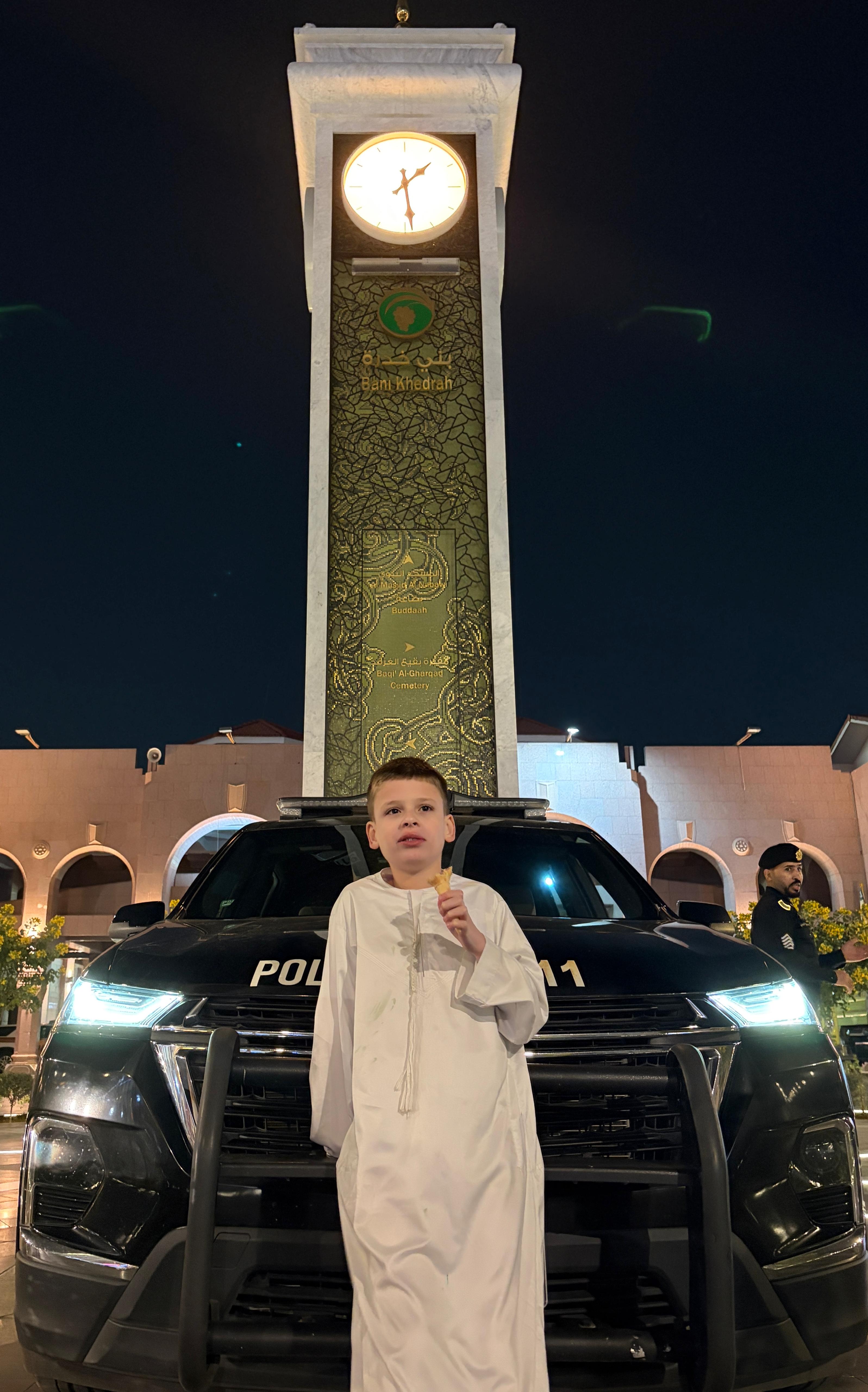
“He was greeted really, really warmly. There were some really touching moments where people were kissing his hands and his head. It was really lovely,” his father, Dan Harris, said.
Dan, the founder of global charity Neurodiversity in Business, said being in Madinah exposed him to the true diversity of Islam.
“We met people from all around the world. It was amazing. It’s like the United Nations there, you get people from different countries and it just goes to show you that the Muslim community, or the Ummah more generally, is not a homogeneous group,” he said.
“We saw people from Tajikistan and Uzbekistan and it was really interesting for us.”

Dan said his visit to Madinah, considered the second holiest city in Islam after Makkah for Muslims, was “profound and life-changing.”
He added: “I would say it’s my favourite city in the world due to the peace and tranquillity I felt there.”
Dan added that he was very impressed by Saudi hospitality: “Everywhere we went, people were taking down my number and insisting that we come for dinner, insisting they pick us up from the location. They were extremely attentive to Joshie as well, making sure his needs were met. We felt a great sense of welcome, something Saudi Arabia is known for.”


