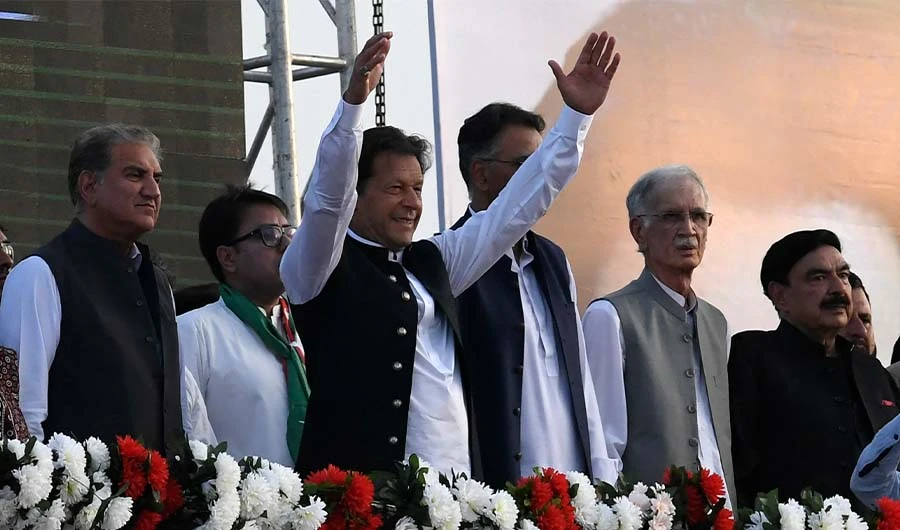
- Abandoned by coalition partners, Imran Khan is facing a no-confidence vote on Sunday
- On Thursday, Khan named the US as he spoke of a conspiracy to topple his government
ISLAMABAD: Fighting for his political survival, Pakistani Prime Minister Imran Khan has taken up anti-American rhetoric and doubled down on allegations of a foreign conspiracy against him. Expert opinions are divided on whether the last-ditch effort could save him.
As the cricketing legend turned prime minister is facing his toughest political challenge since assuming office in 2018, abandoned by coalition partners and with a no-confidence vote against him to be held on Sunday, a scandal transpired last week over a purported letter that contained foreign threats to his government.
Pakistani officials have since said the letter was a cable written by a former Pakistani ambassador to the US, who conveyed threats by a “senior foreign official.”
While Khan himself for days did not mention the country, during a televised address to the nation on Thursday he named the US. Then he tied the allegations to his visit to Moscow in late February, saying that a “powerful” country was angered by him meeting with Russian President Vladimir Putin on the day Russia began its invasion of Ukraine.
As the US State Department and the White House have denied the allegations, saying there was “absolutely no truth” to them, foreign policy experts and analysts are divided over the impact of Khan’s anti-America rhetoric might have on both the prime minister and Pakistan.
“It is important for a country not to appear antagonist to any other country. We can follow and pursue our interests without showing antagonism to other countries,” Pakistan’s former foreign minister, Hina Rabbani Khar, told Arab News.
Referring to the cable, she said that using internal diplomatic documents as a political tool would have an impact on “how seriously people take your diplomats abroad in future.”
“Here, anti-Western sentiment is being used as a tool,” she added. “It’s a dangerous trend which isn’t healthy for Pakistan.”
But another former Pakistani diplomat, Javed Hafeez, downplayed the impact of the controversy, saying it could affect Pakistan’s relations with the US only in the short term.
“If a new government comes after the no-trust vote, it can review Pakistan’s foreign policy toward the US or any other country,” he told Arab News. “The foreign policy and diplomatic relations of each state are based on interests, and they aren’t held hostage to individuals’ choices.”
For Michael Kugelman, a senior associate for South Asia at the Washington-based Wilson Center, Khan’s “anti-Americanism” may make him “face challenges galore if he loses the no-confidence vote.”
“The military — which had supported Khan for many years — values relations with the US,” he said. “So, Khan certainly doesn’t do himself any favors by taking this position, beyond rallying his hard-core supporters, and especially when he’s in such a vulnerable political position and needs all the help he can get from key actors at home, including the military.”
Khan had campaigned against the US before.
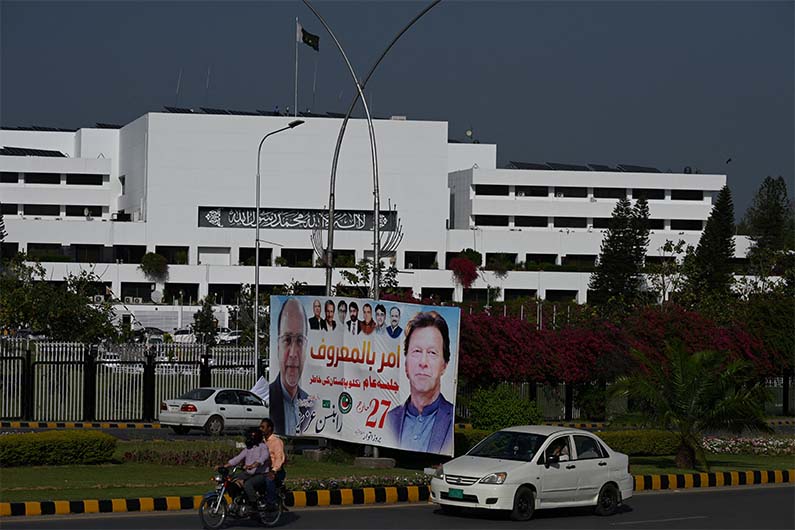
His Pakistan Tehreek-e-Insaf (PTI) party rose to prominence in 2011, after it blocked roads for NATO supply shipments to Afghanistan to demand the US stop firing missiles in Pakistan’s northwest.
The anti-US narrative may be now repeated to galvanize voters and supporters in case a new election is held if does not complete his term in office.
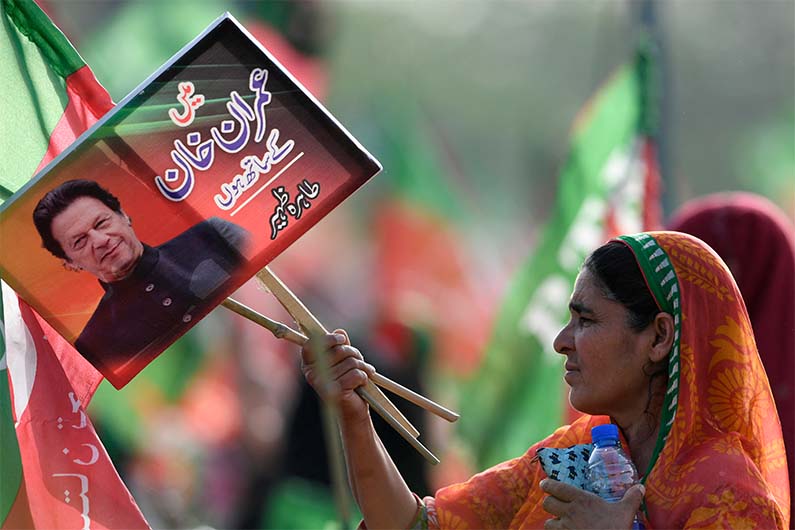
“Imran Khan’s narrative is very strong at this point in time that resonates with sentiments of general public,” political analyst Dr. Rasul Bakhsh Rais said.
“Khan is definitely going to contest next election on this narrative of national integrity and country’s sovereignty, hoping people will respond him as they did in the past.”