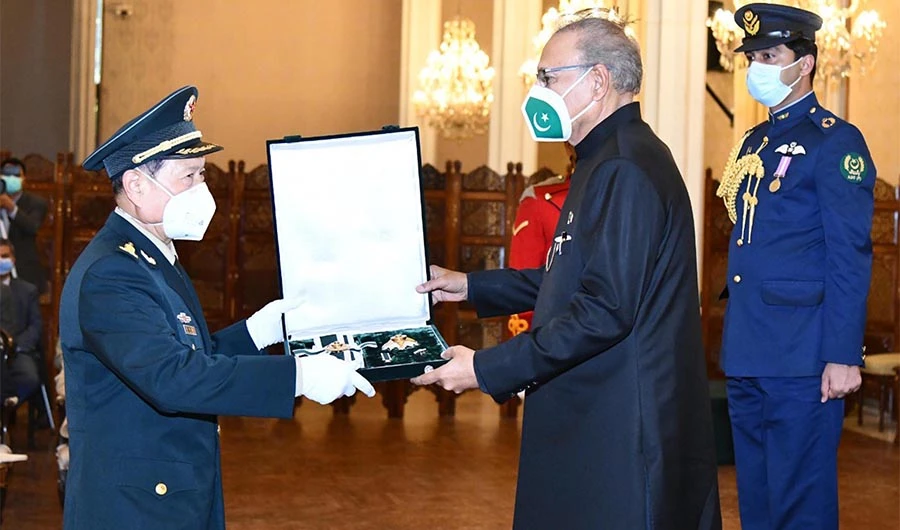
- Minister of National Defense of China, General Wei Fenghe, is in Pakistan on a high-profile three-day visit
- Signs defense cooperation enhancement MoU with army chief, president and prime minister reaffirm commitment to ‘One China’ policy
ISLAMABAD: Expediting work on the over $60 billion China-Pakistan Economic Corridor (CPEC) and enhancing defense cooperation were main items on the agenda of meetings this week between top Pakistani leaders and Chinese defense minister General Wei Fenghe, who is in Pakistan for a three-day visit.
On Monday, Pakistan and China inked a memorandum of understanding (MoU) to enhance defense cooperation between the two nations’ armies during a meeting between Wei and General Qamar Javed Bajwa, the Pakistani army chief.
On Tuesday, Wei met Pakistani Prime Minister Imran Khan and President Dr. Arif Alvi.
“The Prime Minister emphasized that Pakistan-China ties remain an anchor for peace and stability in the region and beyond, and that both countries may further deepen strategic communication and coordination to deal with the emerging challenges and threats,” Khan’s office said in a statement.
The Pakistani president underlined the “huge scope of bilateral defense cooperation that needed to be further expanded for the mutual advantage of the two countries,” his office said in a separate statement, adding: “General Wei Fenghe stated that military relations between the two all-weather friends had made significant progress and expressed the hope that his visit would further strengthen the defense cooperation.”
Pakistan in recent months has been scrambling to expedite work on projects under CPEC, the Pakistan leg of China’s Belt and Road Initiative that includes recreating the old Silk Road trading route.
Pakistan’s federal government set up the CPEC Authority late last year to expedite work on CPEC projects that have stalled since the government of PM Khan came to power in 2018. Asim Saleem Bajwa, a retired military general, was appointed to head the body.
Since June 6, Pakistan and China have signed projects worth more than $12 billion, including for two hydropower projects in Pakistan-administered Kashmir, and the rehabilitation and upgrade of a 1,872 KM long colonial-era railway track at an estimated cost of $8.17 billion.
Travel restrictions to prevent the spread of the coronavirus have idled much of the world’s second-largest economy, China, and choked key elements of its signature Belt and Road Initiative.
But batches of Chinese staff have been arriving in Pakistan in recent months to kickstart work on projects.
“Prime Minister underscored that the China-Pakistan Economic Corridor (CPEC) ... was transformational and stressed that the economic and social impact of CPEC on the region will be substantial and beneficial,” Khan’s office said about his meeting with the Chinese defense minister.
The Pakistani army chief had also committed during his meeting with Wei to providing a secure environment for CPEC projects to be built.
The Pakistani prime minister and president also reaffirmed commitment to the ‘One China’ policy, the diplomatic acknowledgement of China’s position that there is only one Chinese government, and said Islamabad would continue to support Beijing on disputes related to the South China Sea, Tibet, Taiwan and Xinjiang.
This week Pakistan and China have also agreed to sign a power purchase agreement next month for a 300-megawatts coal power plant to be set up at an estimated cost of $360 million in Gwadar, in the southwestern province of Baluchistan, the crown jewel of China’s $60 billion investment in Belt and Road Initiative projects in Pakistan.
The plan is to turn Gwadar into a trans-shipment hub and megaport to be built alongside special economic zones from which export-focused industries will ship goods worldwide. A web of energy pipelines, roads and rail links will connect Gwadar to China’s western regions.
Officials told The News, a Pakistani daily, on Monday that the signing of the power purchase agreement for a coal plant at Gwadar would take place at the upcoming joint cooperation committee meeting expected to be held in December virtually.
The decision to sign the pact was taken during a meeting of the joint working group on Gwadar.