- Shehbaz Sharif says the constitution demarcates powers of state institutions, requires them to stay within their ambit
- National Assembly passes resolution to uphold supremacy of parliament, constitutes committee for judicial reforms
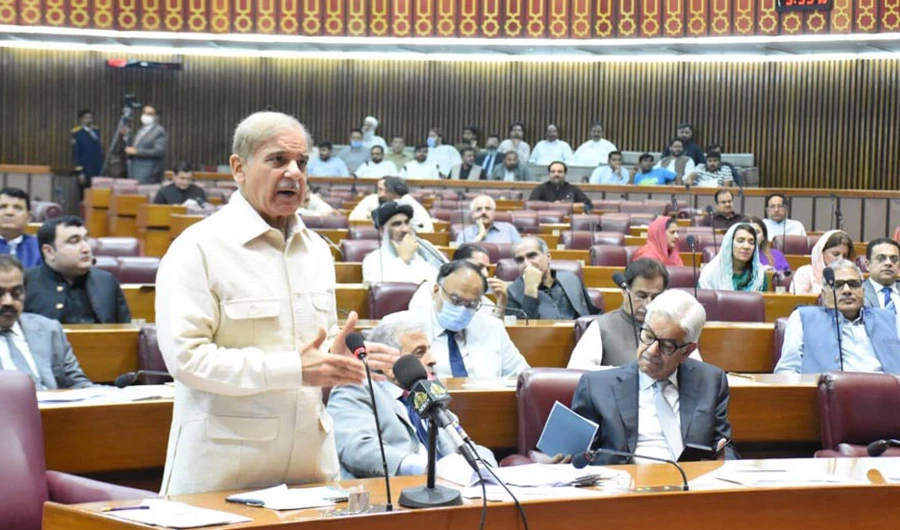
ISLAMABAD: Prime Minister Shehbaz Sharif on Wednesday criticized the country’s judiciary for practicing “double standards” of justice while adjudicating cases related to different political leaders.
The prime minister issued the statement in the National Assembly only a day after a three-member Supreme Court bench, headed by Chief Justice Umar Ata Bandial, declared that Sharif’s son, Hamza Shehbaz, was not the legal and constitutional chief minister of Punjab.
Prior to the court proceeding, the ruling coalition had requested the court to constitute a full bench to hear the case, though its demand was turned down.
Later, the government and its allies had boycotted the court hearing.
“The courts should ensure equal treatment [to all political leaders],” the prime minister said. “They should not discriminate.”
“If we fail to promote sanctity, equity, law and justice, history won’t remember us,” he continued. “I am talking about the double standards.”
The ruling coalition toppled former prime minister Imran Khan’s government in April by bringing a no-confidence motion against him in parliament, though Khan later maintained his removal from power was part of a US-backed foreign conspiracy.
The US and the coalition government have repeatedly rejected the accusation.
“We changed the government through a vote of confidence and accepted the challenge [to rule the country] amid a deteriorating economy,” Sharif said while reiterating his administration’s resolve to address Pakistan’s financial woes.
He pointed out that the country’s 1973 constitution was unanimously accepted by everyone and clearly demarcated the powers of state institutions.
“The constitution tells these institutions to work within their respective ambits,” he said, adding the document was subverted many times in the past which had also led to the breakup of the country.
Speaking about the judiciary’s attitude toward different political leaders, Sharif wondered why courts did not take notice of ex-PM Khan’s “wrongdoings.”
“No matter what, I want to say that we will make Pakistan a great country despite all challenges and tough conditions,” he added.
Later, the National Assembly passed a resolution to uphold supremacy of parliament and constitute special committee for judicial reforms.
The resolution was presented by law minister Azam Nazir Tarar and mentioned the “trichotomy of powers among three organs of the State.” It mentioned the legislature was responsible for lawmaking while judiciary was mandated to interpret those laws.
The resolution added that parliament “shall not allow any other institution to transgress and encroach on its powers.”
“Hence, this house RESOLVES that to ensure the supremacy of the parliament and the Constitution in letter and spirit, it hereby constitutes a joint special committee of both houses to institute the requisite judicial reforms, which are the need of the hour,” it said.
Earlier, interior minister Rana Sanaullah informed the media the federal cabinet had decided to withdraw a curative review petition against a Supreme Court judge, Justice Qazi Faez Isa.
“There is no precedent of any such curative review,” he told reporters after the cabinet meeting. “It was filed [by the previous government] to keep Qazi Faez Isa under pressure.”
Sanaullah said a cabinet sub-committee had also been constituted to take action against all those involved in the filing of a “fake reference” against the Supreme Court judge.
On the advice of Khan’s government, President Dr. Arif Alvi filed the reference against Justice Isa in May 2019, accusing him of acquiring three properties in London on lease in the name of his wife and children between 2011 and 2015. The reference maintained the judge had not disclose the properties in his wealth returns.
Justice Isa contested the allegation, saying he was neither the direct nor indirect beneficial owner of the flats.
In June 2020, the Supreme Court rejected the reference against the judge by calling it “invalid.”