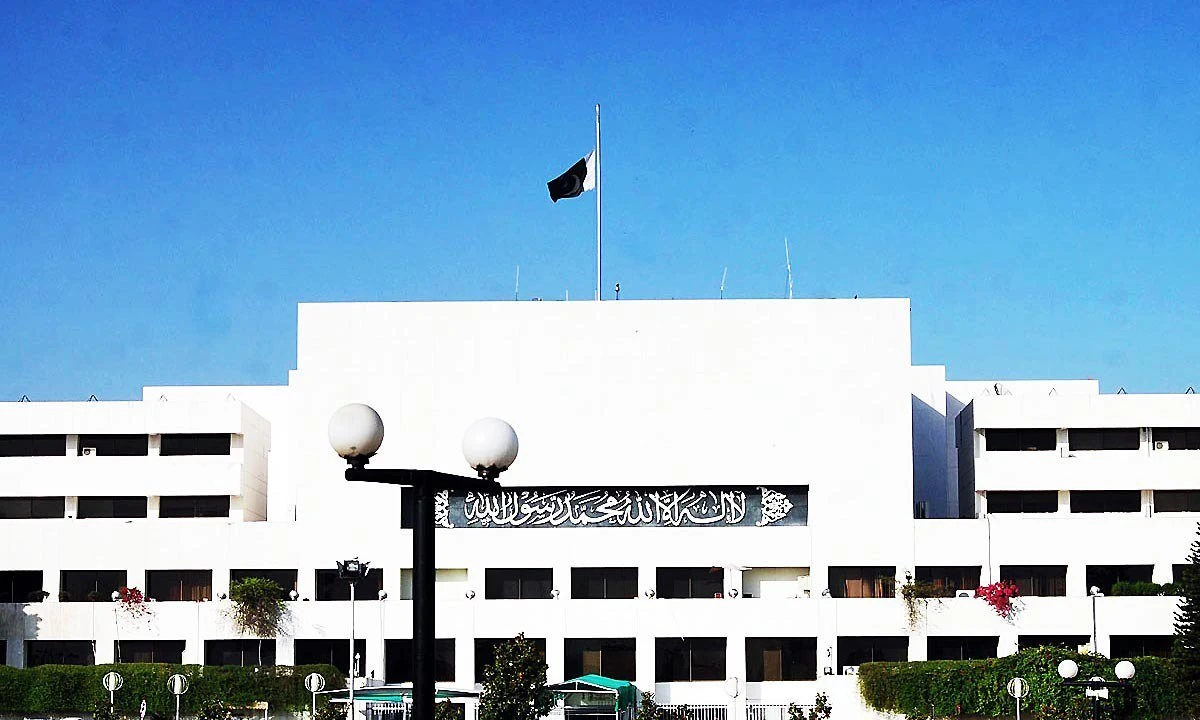
- The president is empowered to promulgate an ordinance when parliament is not in session
- The government says it is doing public interest legislation through ordinances due to a lack of majority in Senate
ISLAMABAD: Pakistani opposition parties have sought an amendment to a law dealing with the president’s power to promulgate ordinances, in order to strengthen the parliament’s role in legislation, some leading politicians said.
The opposition parties have accused the government of relying on presidential ordinances to seek legal cover on significant matters instead of getting the legislation done after thorough debate and discussion in parliament.
The opposition seeks a constitutional amendment to ensure that the government brings for approval every ordinance in the “first sitting of either House of Parliament” or lose it completely through its automatic annulment.
Experts say the bill is highly unlikely to be passed as it would require two-third majority in both the houses of parliament separately.
“The Pakistan Tehreek-e-Insaf government has been intentionally delaying parliamentary debate on ordinances which is in contravention to the constitution. We want to put an end to this practice,” Senator Mian Raza Rabbani, Pakistan Peoples Party’s lawmaker and former chairman Senate who has moved the bill in the upper house of parliament, told Arab News on Saturday.
The president under the constitution is empowered to promulgate ordinances on the advice of the government when parliament – the National Assembly and Senate – are not in session, though the legislation is imperative to deal with any emergency or urgent matter. An ordinance is initially promulgated for 120 days and can be extended by parliament for the same period.
Ahmed Bilal Mehboob, executive-director Pakistan Institute of Legislative Development and Transparency (PILDAT), said the president’s powers of promulgating ordinances should be repealed.
“This is a colonial law and against democratic norms,” he said.
“The government is relying on presidential ordinances for legislation because it lacks majority in the Senate,” Mehboob told Arab News. “But it must take the opposition on board for legislation and to develop consensus instead of bulldozing the democratic process through the ordinances.”
Besides the PPP, other opposition factions in the 104 member Senate have also been critical of the government for running all its affairs through presidential ordinances instead of introducing proper bills in parliament for legislation.
“The government has been trying to make the parliament toothless and useless, but we won’t let this happen,” Senator Javed Abbasi of the Pakistan Muslim League-Nawaz told Arab News.
Under the constitution, the government is required to lay a presidential ordinance in parliament for the information of the lawmakers but opposition members say the ruling party has been delaying it intentionally, fearing the opposition may disapprove an ordinance through a resolution.
Accepting its lack of majority in the Senate, the government says it is left with no option but to get the presidential ordinances promulgated for necessary legislation.
“We have been doing this to ensure public interest legislation since we lack majority in the Senate,” Shibli Faraz, a ruling party lawmaker and leader of the house in the Senate, told Arab News.
He criticized the opposition parties for ‘point scoring’ and not cooperating with the government to get the public interest legislation passed through parliament.
“They [the opposition] should cooperate with the government to legislate on matters of public good instead of resorting to antics,” Faraz said.
But PILDAT’s Mehboob said it was the responsibility of the government to take the opposition along on important national matters to ensure the smooth functioning of the Parliament.
“It is imperative for democracy, that legislative issues are discussed in the Parliament and approved with input from lawmakers across the aisle,” he said.