- Dr. Moeed Yusuf criticizes New Delhi for not agreeing to a joint probe and refusing to share the findings of its internal inquiry
- The NSA hopes the world community will hold India accountable after OIC nations agreed with Pakistan's concerns over the incident
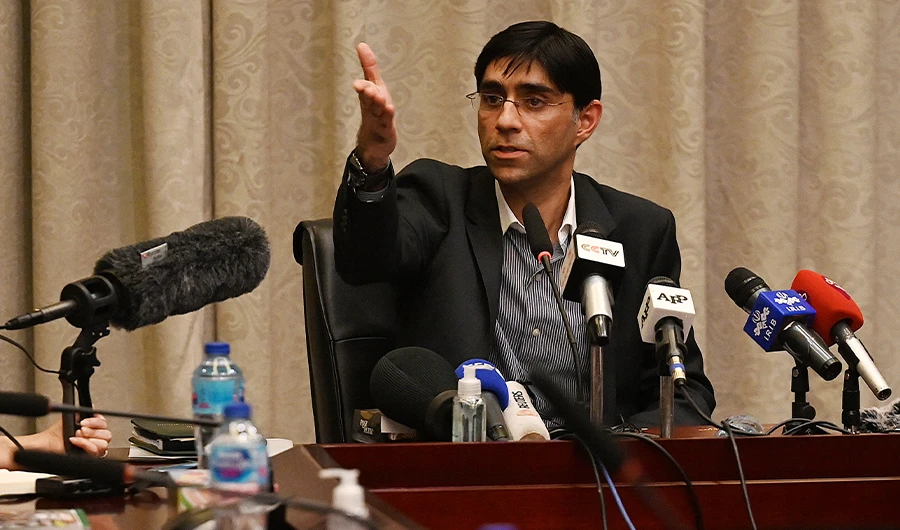
ISLAMABAD: Pakistan's national security advisor (NSA) Dr. Moeed Yusuf on Thursday described India as an "irresponsible state with nuclear weapons" after its recent missile launch into Pakistan, adding that the international community agreed with his country's concerns in this regard.
The Pakistani military held a news conference on March 10 to inform that an unarmed Indian missile had violated the country's airspace a day before and crashed into its densely populated eastern Punjab province. The missile did not cause any casualties but damaged a wall in a residential neighborhood.
India also acknowledged the "accidental" firing after the news briefing, saying the incident was caused due to a technical malfunction during its routine maintenance.
"Make no mistake, India has become an irresponsible state with nuclear weapons and the world is beginning to recognise Pakistan's longstanding concern on this count," Yusuf said in a Twitter thread.
He hoped the recent meeting of the Council of Foreign Ministers (CFM) of the Organization of Islamic Cooperation (OIC) in Islamabad would increase international calls for India's accountability to ensure a "transparent joint investigation."
He was referring to Pakistan's demand for a joint probe with India to prevent the possibility of similar incidents in the future.
Previously, Yusuf criticized India for not informing his country immediately about the "accidental" missile launch, saying it could have led to serious consequences amid the region's nuclear environment.
Pakistan's foreign minister Shah Mahmood Qureshi also raised the issue during the OIC conference and criticized India for jeopardizing civilian lives on both sides of the border.
"The accidental fire could have led to an accidental war in South Asia," he said while addressing a joint news conference with OIC Secretary General Hissein Brahim Taha on Wednesday. "It is as serious as that."
Yusuf highlighted India's lack of cooperation in response to Pakistan's calls for a joint investigation into the episode, saying New Delhi was even refusing to share detailed information about its internal inquiry which should be treated as a "wake-up call" by the world.
"This reflects the mindset of the Modi regime and the character of the Indian state today," he added.
"On our part, we will continue to sensitise international opinion on the dangers of India's nuclear program," he maintained while noting that Pakistan would continue its efforts to ensure strategic stability in the region.
India and Pakistan, both nuclear-armed countries, have fought three wars and have engaged in numerous military clashes, most recently in 2019 when the air forces of the two countries engaged in a short but serious combat.