- PM Imran Khan says uplift of underprivileged segments is critical to national security
- Adds country can’t be safe with small class becoming rich and underprivileged left behind
ISLAMABAD: Pakistani Prime Minister Imran Khan on Monday urged for “inclusive growth” in the country, saying national security was more than focusing merely on strengthening the nation militarily.
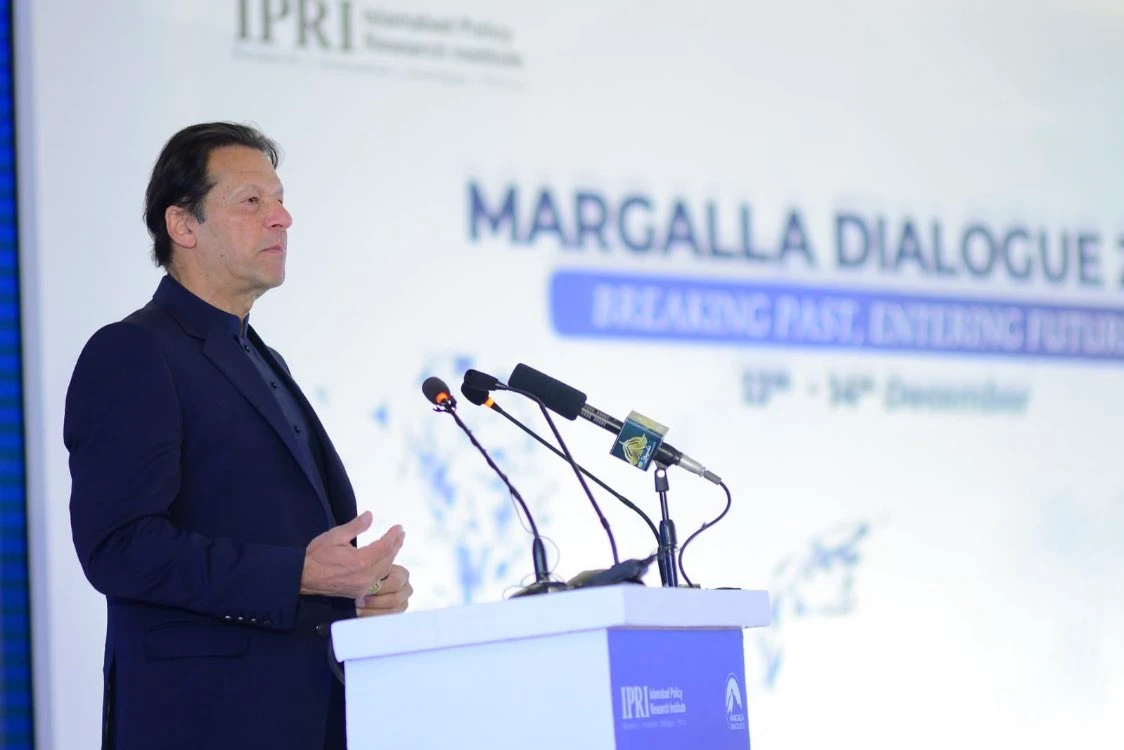
He made these remarks while opening the Margalla Dialogue 2021 to underscore the need for innovation and reality in research to put forward a progressive and realistic face of Pakistan.
A local think tank, the Islamabad Policy Research Institute (IPRI), organized the dialogue, themed as “Breaking Past, Entering Future,” to generate new ideas and articulate the future in the fast-changing political and technological world.
PM Khan said that national security could not be ensured without inclusive development and equitable growth of all segments of society, provinces and people. He underlined that it was all about human security in the changing environment.
“So far our focus has been on [strengthening] military, but in reality national security is an all-encompassing thing,” the prime minister said in his speech.
“There can be no national security unless there is inclusive growth. No country can be safe where a small class becomes rich and underprivileged [people] are left behind.”
He said that unequal distribution of resources led to lawlessness among people, adding that uplift of the underprivileged segment of the society was critical to ensure across-the-board national security.
“It is a very important issue of national security that how can we have equitable, inclusive development,” he said.
PM Khan said his country had suffered inequality due to three simultaneous educational systems, English- and Urdu-medium schools, and madrassas. He highlighted that differences in educational standards of these systems resulted in three different kinds of generations with discrimination in jobs.
Emphasizing the importance of research by think tanks, he said it was necessary to counter negative propaganda in the world.
Pakistan, which had suffered the most collateral damage after joining United States (US) war on terror, was now facing criticism that the US did not succeed in Afghanistan because of it, the prime minister noted.
He said Pakistan was the biggest victim in the decades-long civil strife and had to bear the collateral damage. “Yet we were blamed for double standards and this is all owing to our policy of appeasement.”
The minuscule aid that came their way was nothing as compared to the sacrifices and services that Pakistan had rendered, PM Khan said.
“More than 80,000 casualties, 40 million people displaced and a loss of around $100 billion, this is what we had to pay and yet Pakistan was blamed for all that went wrong,” he lamented.
“In fact, they [West] were making all the mistakes and Pakistan became a scapegoat.”
The Pakistani premier also criticized the pro- and anti-US lobbies in Pakistan for doing a “great injustice” to the country and defacing its narrative.
Speaking about Islamophobia, he said it was quite unfortunate that the great religion was “maligned,” despite the fact that every society and religion had radical elements. “This demeaning propaganda has an adverse impact on overseas Pakistanis too,” he added.
The need of the hour was to “define ourselves” and undertake genuine research to portray the true and real face of an enterprising and emerging Pakistan, he said.