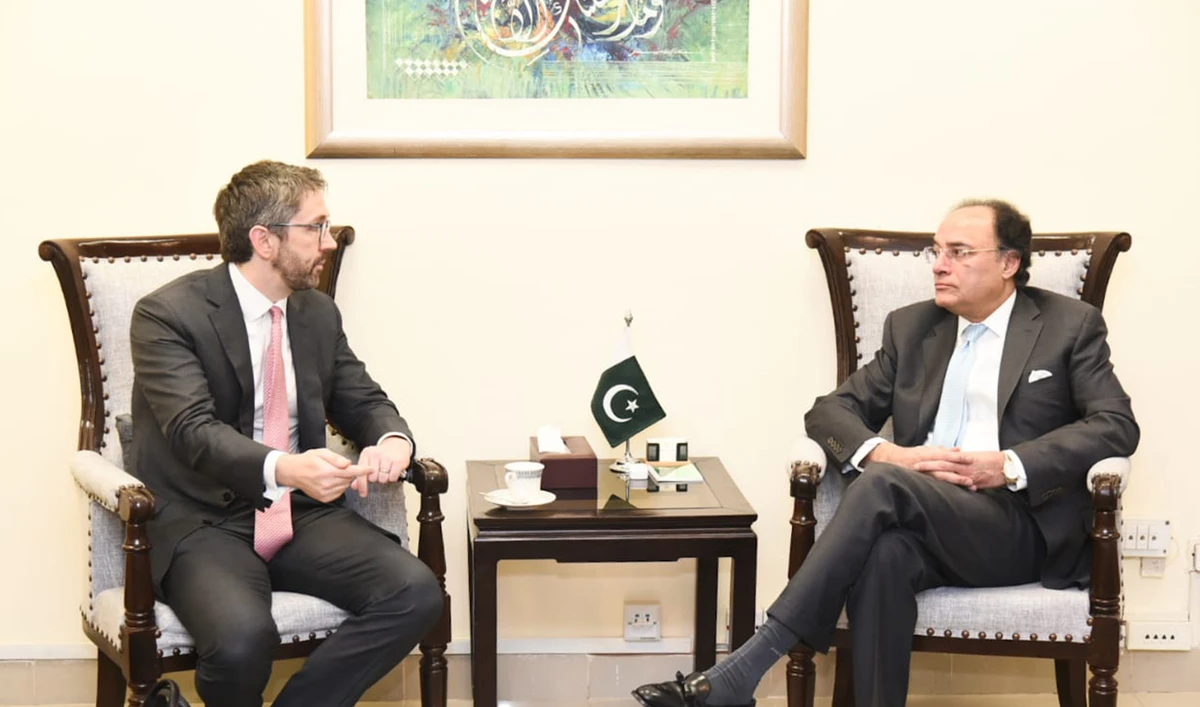
- The statement came after Finance Minister Muhammad Aurangzeb’s meeting with officials of McKinsey global management consultancy firm
- The two sides discussed ways to achieve quick wins by leveraging data and implementing daily reporting to monitor real-time progress
ISLAMABAD: Pakistan’s finance minister, Muhammad Aurangzeb, has underscored the need for directing investment in technology during a meeting with an official of the McKinsey global management consultancy firm, the Pakistani finance ministry said on Monday, instigating a cultural transition toward digital governance that would aid the government’s tax collection efforts.
In May, Pakistan signed an agreement with McKinsey and Company for the digitalization of its tax system as the South Asian nation strives to introduce reforms amid talks with the International Monetary Fund (IMF) for a new bailout program.
Pakistan’s Federal Board of Revenue (FBR) last year said the country had a “very narrow tax base” of around 5.2 million people in 2022, out of a population of 240 million people. The FBR had said it planned to add 1.5 million new taxpayers to the existing base during the current fiscal year.
On Monday, the finance minister held a meeting with McKinsey & Co’s Regional Head of Technology and Tax, Tom Isherwood, and other officials in Islamabad, wherein he emphasized the government’s commitment to improve tax collection.
“The finance minister emphasized the need for investment in technology and fostering a cultural shift toward digital governance,” the finance ministry said in a statement.
The discussions centered around the possibility of achieving quick wins by leveraging data and implementing daily reporting to monitor real-time progress. The finance minister also shared the Pakistan Revenue Automation Limited and the Revenue Mobilization Investment and Trade’s (REMIT) data that could be utilized in digitizing the FBR tax system, according to the statement.
Pakistan’s State Minister for Finance Ali Malik, who was also present at the meeting, discussed ways to enhance the ongoing exercise by efficiently generating, organizing and analyzing data. He stressed the importance of a data-driven approach for improving the project outcomes.
The McKinsey team thanked the finance minister for ensuring the completion of the exercise within the given time frame, the statement said.
Pakistan needs $24 billion in payments for debt and interest servicing in the next fiscal year starting July 1 — three times more than its central bank’s foreign currency reserves.
The South Asian nation is seeking yet another long-term, larger IMF loan, with the finance minister saying Islamabad could secure a staff-level agreement on the new program by early July. If successful, this would be the 25th IMF bailout for Pakistan.
The IMF-led structural reforms require Pakistan to raise its tax-to-GDP ratio, stop losses in state-owned enterprises and manage its energy sector losses which run into trillions of rupees.
Pakistan’s finance ministry expects the economy to grow by 2.6 percent in the current fiscal year ending June, while average inflation is projected to stand at 24 percent, down from 29.2 percent in the outgoing fiscal year.