- Nowshera artist says her canvases have reached buyers in more than 13 countries
- Self-taught craftswoman sells pieces for up to $722 through social media platforms
NOWSHERA: A Pakistani religious scholar who taught herself gilded calligraphy online has built an international business creating artwork inspired by the Kiswa, the richly decorated black silk covering of the Kaaba in Makkah.
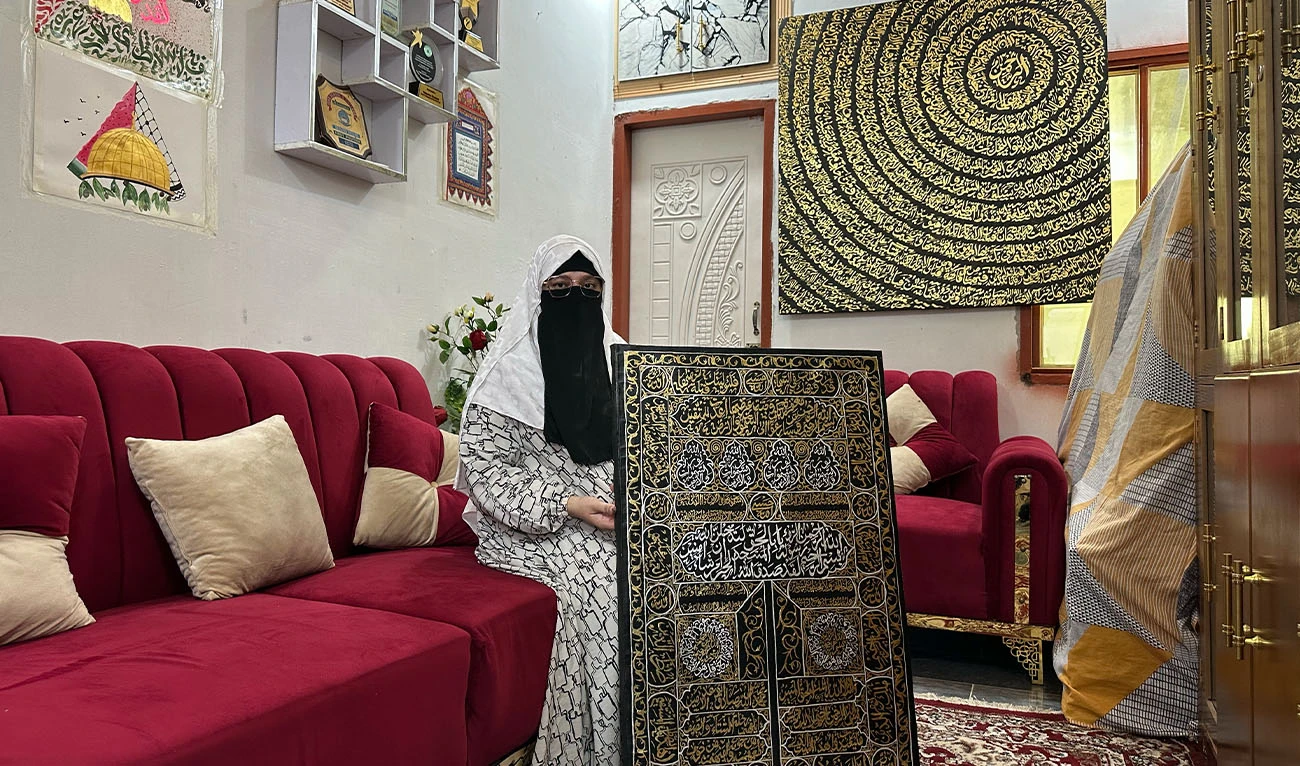
Working from Nowshera in Pakistan’s northwestern Khyber Pakhtunkhwa province, 30-year-old Haleema Khattak says she has produced more than 100 Kiswa-inspired canvases and sold them to customers in over 13 countries since taking up the craft in 2022.
The original Kiswa covers the Kaaba, Islam’s holiest shrine and the direction toward which Muslims pray. It is produced annually at the King Abdulaziz Complex in Makkah from black silk adorned with Qur’anic verses and Islamic motifs embroidered in silver thread plated with 24-karat gold.
Sitting before a black canvas at her home, Khattak carefully applies small sheets of gold leaf along Arabic calligraphic designs, recreating in paint and gilding the visual character of the Kiswa’s embroidered inscriptions.
“There are 13-plus countries in which my artwork has been sold so far and it has been displayed in different houses there,” she told Arab News.
Her customers are spread across Saudi Arabia and other Gulf states, Europe and the United States, she said, with most orders placed through her pages on Instagram, Facebook, WhatsApp and LinkedIn.
Khattak’s path to becoming an artist began with religious study rather than formal art training. She spent six years completing the Dars-e-Nizami through Wifaq ul Madaris, one of Pakistan’s principal boards of Islamic seminaries.
The curriculum traditionally covers the Qur’an and its interpretation, Hadith, Islamic jurisprudence, Arabic grammar and other religious disciplines.
“I am an Islamic scholar,” she said. “I was drawn to calligraphy from the beginning, especially the writing in the Qur’an.”
Khattak started experimenting with calligraphy using pens and markers in 2019. Her work changed direction three years later when, while planning a painting of the Kaaba, she began studying the Kiswa’s calligraphic designs.
“I researched, searched for online courses and began work after completing them,” she said.
Unlike the original Kiswa, whose inscriptions are embroidered by Saudi craftspeople using gold-plated silver and pure silver thread, Khattak creates her designs using acrylic paint and gold leaf applied to canvas.
“Many people do it with thread,” she said. “I use acrylic colors on canvas and gold leaf.”
Her process begins with selecting and preparing a canvas. She marks the design in thin white paint, applies adhesive and carefully lays gold leaf over the lettering before brushing away the excess and varnishing the finished work.
Although similar materials are available locally, Khattak said she imports most of hers from China because she believes the available Pakistani leaf deteriorates too quickly:
“People buy expensive artwork and I do not want it to be bad.”
Her earliest pieces took more than two weeks to finish, but repeated work has made the process significantly faster.
“I made my first Kiswa in 17-18 days, and I sketched each and every thing,” she said. “But now, Alhamdulillah, I have completed 100, so I don’t need to sketch, and I just make it directly on the canvas. And now, I make an artwork in a day.”
Khattak sold her first commission for $7. Her pieces now range from $30 to $722, depending on their size and complexity.
She attributes much of the overseas demand to Muslim communities seeking Islamic artwork for their homes, particularly in the Gulf and Europe, where she believes relatively few artists produce comparable work.
For Khattak, however, the paintings are more than a commercial enterprise.
“Being a religious person, it is a matter of great honor for me,” she said. “It is a benefit for me in this world and in the hereafter. I hope that I will get a great reward for it from Allah.”
She now hopes to enter international calligraphy competitions and exhibit her work outside Pakistan.
“My future goal is to write the name of Allah so beautifully that no one else in the world can write it,” she said. “My second goal is to do exhibitions at an international level so that I can make my country, Pakistan, proud.”