- Pakistan’s central bank held key policy rate at 11.5 percent in July amid US-Iran conflict
- Firm says central bank could raise policy rate in December if geopolitical tensions persist
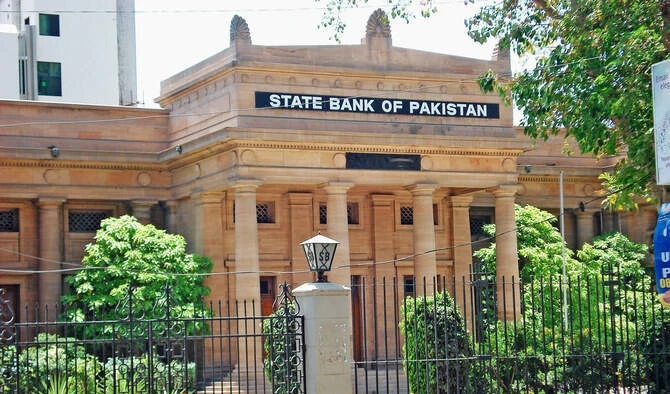
ISLAMABAD: A top Pakistani brokerage firm has said that it expects the central bank to hold the policy rate at 11.5 percent on Monday, warning that prevailing geopolitical tensions in the Middle East region is likely to cause adverse economic repercussions for the country in a few months.
The State Bank of Pakistan (SBP) held the key policy rate at 11.5 percent after the last meeting of the Monetary Policy Committee (MPC) on July 27. The MPC is scheduled to hold its second meeting of the current fiscal year on Monday.
Renewed fighting between the United States and Iran in the Middle East, as well as the attacks by Iran-backed Houthi rebels against Saudi Arabia threaten to push energy costs and inflation even higher in the days ahead.
“We expect the MPC to hold the policy rate at 11.5 percent on Monday; however, if geopolitical tensions persist into the December quarter, the next move would be an increase in PR,” Muhammad Waqas Ghani, head of research at JS Global Capital Limited, said in a statement on Sunday.
He said one-third of the respondents in a recent JS Global survey said they were expecting a hike in the interest rate by December if regional tensions persisted.
Ghani warned that fresh tensions in the region and disruptions to critical energy routes have pushed the firm to raise its FY27 inflation forecast by 0.8 percent to around 9.1 percent, driven primarily by the expectation that oil prices will take longer to normalize.
“For Pakistan, a big risk is the import bill, not just the CPI print,” Ghani said, referring to the Consumer Prince Index. “Petroleum remains the country’s largest import component, and a prolonged period of elevated oil prices could push the current account deep in the red zone.”
The analyst said that the monthly trade deficit has averaged $3.3 billion over the April-July period against $2.6 billion over the first nine months of FY26. It said the surge is driven by imports, which were up by 15 percent to $6 billion per month.
“Given the dynamics, we remain biased toward a rate hike over the medium term and stress-test cyclicals for a 50 basis points increase in the policy rate, highlighting where earnings are most vulnerable and where balance sheets can provide a hedge,” Ghani added.
The SBP has raised the policy rate once this year by 100 basis points to 11.5 percent in April after holding the rates steady since October 2025.
The MPC meeting takes place with no immediate signs of a diplomatic breakthrough between the US and Iran, with both sides exchanging attacks at intervals.