- Pakistani foreign minister rejects idea of building refugee camps, resettlement processing facilities for Afghans on Pakistani soil
- Says “no rush” on Pakistan’s borders, no need for people to flee Afghanistan as the country was “peaceful and stable”
ISLAMABAD: The UK and its Western allies are not doing enough to engage with the Taliban administration or to avert a burgeoning humanitarian crisis, the Pakistani foreign minister said in comments published on Wednesday, urging them to provide aid to a Taliban-run Afghanistan with “no political conditions attached”.
Last week, foreign secretary Dominic Raab said the UK would not recognize the new militant cabinet but that he did recognize the need for “direct engagement.”
Afghanistan is almost entirely reliant on international donations, which have abruptly halted since the Taliban takeover. The situation is so grave the United Nations warned this week the country was on the verge of collapse, and food supplies could run out by the end of this month. The World Food Programme has said 14 million people were on the brink of starvation.
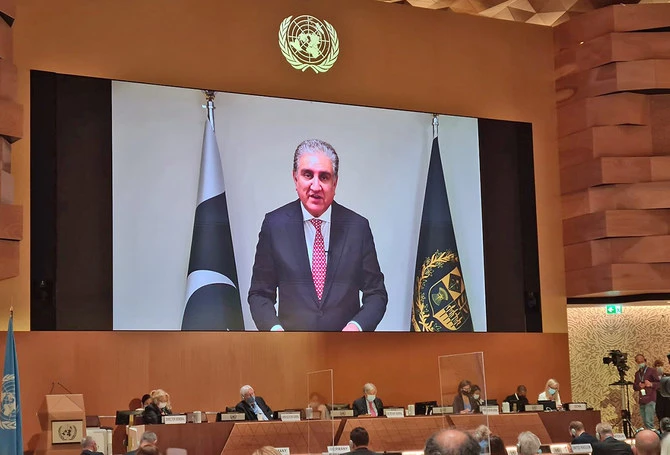
“My message [to the UK] is that there is a new reality in Afghanistan. Accept the new reality and let us work to achieve our objectives,” Shah Mahmood Qureshi, who has twice been Pakistan’s foreign minister, told The Independent in an interview in Islamabad.
“Isolation will not help. It will lead to a humanitarian crisis, it will lead to an economic collapse, and it will create space for elements who have not been helpful for you, me or anyone.
“Anarchy, chaos will facilitate their presence there. Don’t do that. Engagement, we feel, is a better option. If [the Taliban] are saying positive things, nudge them in that direction. Do not push them into a corner.”
One of the first steps, Qureshi said, was delivering immediate aid: “There should be no strings attached, there should be no political conditions attached to humanitarian assistance.”
The Taliban ruled Afghanistan with an iron fist from the mid-1990s to 2001, and according to a strict interpretation of Islamic law, which saw minority groups persecuted and women barred from education and work. They were toppled in an invasion led by the United States, which accused them of sheltering the militants who had planned and carried out the 9/11 terror attacks.
Twenty years on, the group stormed back to power in a lightning advance amid the chaotic withdrawal of US-led allied forces last month. After promising an inclusive government, they formed a new interim cabinet made up exclusively of Taliban figures, including those who are on UN blacklists or wanted by the FBI.
Meanwhile Pakistan, which shares a 2,500km-long border as well as cultural, ethnic and religious ties with Afghanistan, is positioning itself as a potentially powerful regional mediator.
It is also fighting a major domestic security threat in the form of local Taliban offshoot the Tehrik-i-Taliban Pakistan, or the TTP, as well as Al-Qaeda and factions of Daesh, complicating its relationship with the new administration next door.
Qureshi told The Independent that Pakistan had received verbal assurances from the Afghan Taliban that they would not allow any group to stage terror attacks on Pakistan from Afghanistan, but added that Islamabad was waiting to see “if they act on what they’ve said”.
Pakistan has not formally recognized the new Taliban cabinet, but senior Pakistani officials, including the country’s spy chief, have visited Kabul, where Pakistan’s embassy remains open, providing a potential gateway into and out of the country.
In the days before the full withdrawal, western forces scrambled to evacuate their citizens, along with at-risk Afghans who had worked with them, via Kabul airport. Hundreds of British nationals and thousands of eligible Afghans were left behind in the chaos.
Qureshi said Pakistan would continue to facilitate the departure of those with valid documents who wished to exit Afghanistan via Pakistan, but drew the line at allowing an influx of refugees. He also rejected the notion of building refugee camps or resettlement processing facilities on Pakistani soil, in light of reports that the UN was exploring the idea.
Qureshi claimed there had been “no rush” on Pakistan’s borders ,and said there was no need for people to flee Afghanistan as he said the country was “peaceful and stable”.
He cited Taliban statements on a general amnesty, as well as the group’s promises not to prohibit women from going to school, university or work, as reasons why people should stay put.
“We have our limitations. [Pakistan has] been hosting now over 3 million, almost close to 4 million refugees for so many decades without any international help or assistance. We do not have the capacity to absorb more, honestly,” he told The Independent.
“Our preference is that [Afghans] stay within Afghanistan and they are provided security and safety within Afghanistan. As things stand at the moment, I see no reason why they can’t stay in Afghanistan.”
He added that any processing facility where Afghan citizens can apply for asylum should be in Afghanistan. “It has to be over there – that is where they belong, that is their country,” he added.
He did say that the Pakistani authorities would consider “on merit” formal requests from the UK for British representation in their embassy in Kabul to help with applications – an idea senior Tory MP Tobias Ellwood told The Independent the government should pursue with its allies, such as Qatar and Turkey.
But Qureshi maintained that the behavior of the new Taliban leadership was “quite distinct and different” from that seen in the 1990s, saying that, for example, protests in Kabul had “by and large been tolerated”.
“These are initial signs which are not discouraging,” the top diplomat said. “Let’s see if this is the direction that they follow.”