- The trial of ex-PM Bhutto is still considered one of the most controversial milestones in Pakistan’s political history
- His family and political supporters allege judges came under pressure from General Zia to sentence Bhutto to death
KARACHI: Pakistan’s top court is set to begin hearing today, Tuesday, a presidential reference filed in 2011, seeking to revisit the death sentence awarded to former Pakistani Prime Minister Zulfikar Ali Bhutto over four decades ago, with a member of the late premier’s party and experts saying the proceedings could lead to a “rewriting of history.”
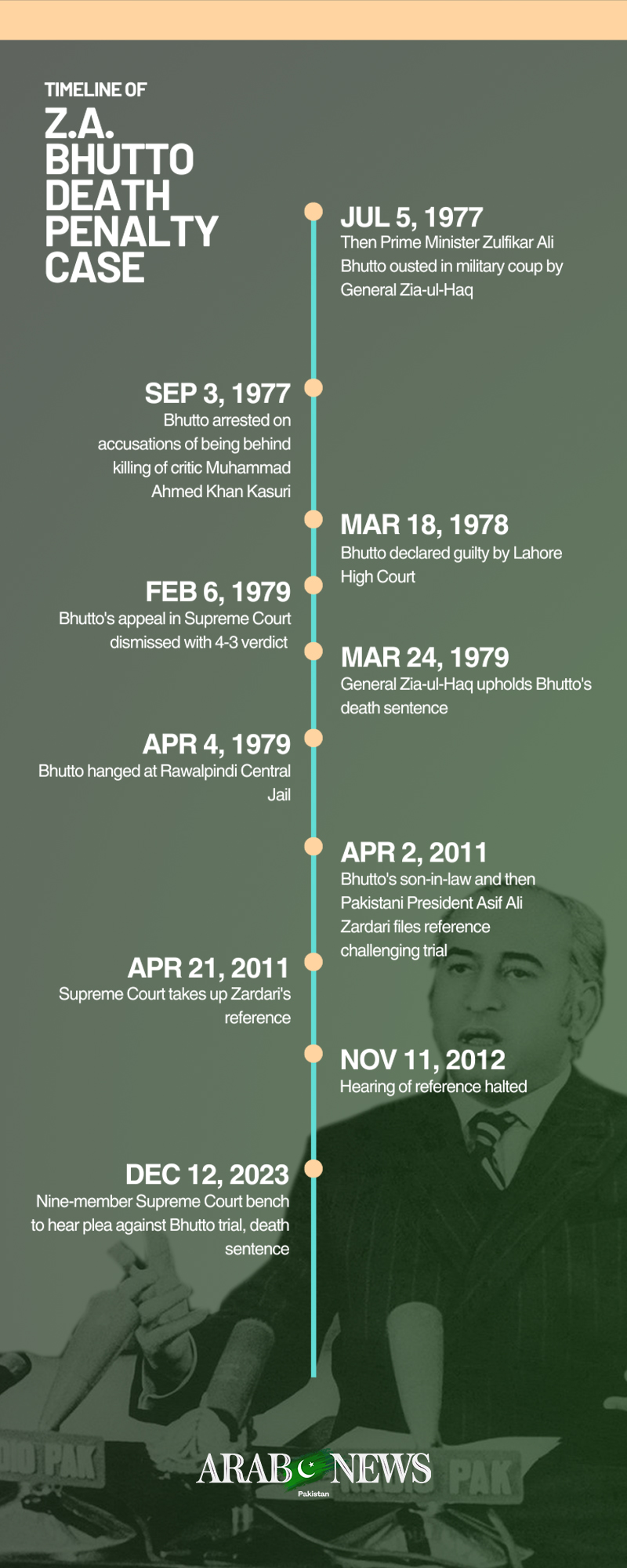
Bhutto was hanged on April 4, 1979, in Rawalpindi District Jail, where he had been confined since his conviction on charges of conspiring to murder a political opponent. The charismatic, Western-educated leader who founded the Pakistan Peoples Party (PPP) served as the fourth president of Pakistan from 1971 to 1973, and later as the country’s ninth prime minister from 1973 to 1977. He was ousted in a military coup by General Mohammad Zia-ul-Haq on July 5, 1977, following an election in which Bhutto is widely charged with having rigged the vote.
The guilty verdict against Bhutto is still considered one of the most controversial milestones in Pakistan’s history. His family and political supporters allege the judges came under pressure from Zia to sentence Bhutto to death.
Decades later, then Pakistani President Asif Ali Zardari, Bhutto’s son-in-law, filed a presidential reference in 2011 to review the 44-year-old death sentence. Only six hearings were conducted, the last of which took place in November 2012.
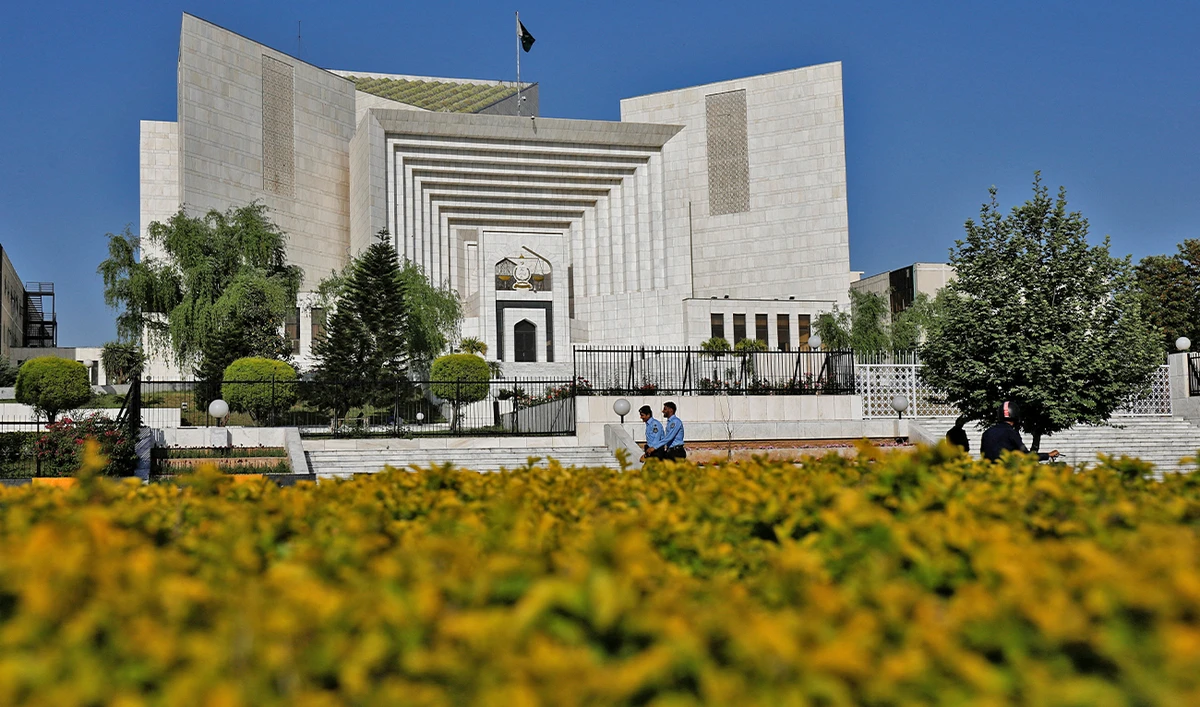
A nine-member larger bench of the Supreme Court will now start hearing the reference today, Tuesday.
“This is a rewriting of history, the Supreme Court will correct the history and rewrite it,” Raheel Kamran Cheema, a PPP leader and member of the legal team representing the party in the reference, told Arab News.
“We appeal that culprits [behind the flawed judgment] should be determined so that the nation may know them.”
Before his hanging, Bhutto was first declared guilty in 1978 by the Lahore High Court. His appeal in the Supreme Court was then dismissed with a 4-3 verdict.
The decision to hang Bhutto was made by General Zia despite a flood of petitions for executive clemency from dozens of world leaders, including US President Jimmy Carter, Russia’s Leonid I. Brezhnev, Chinese PM Hua Guofeng and Pope John Paul II, besides thousands of Bhutto’s Pakistani supporters.
Legal experts have for years questioned the trial both in the Lahore High Court and the Supreme Court, and raised questions on the conduct and procedure of the hearings, as well as on the fact that they took place while Pakistan was under military rule. Analysts argue this is the reason Bhutto’s death penalty judgment has never been cited as a precedent in any subsequent case in Pakistan’s judicial history.
Speaking to Arab News, Hussain Naqi, a journalist who covered Bhutto’s trial in Lahore, recalled the attitude of the judge hearing the case as being very “rude” and “indifferent.”
“He would behave very rudely with Bhutto, he would pass rough comments,” Naqi said. “From the proceedings, it was clearly evident that it was not a fair trial.”
Asked about the presidential reference, Mazhar Abbas, a journalist who has covered Pakistani politics for three decades, said its outcome could have both legal and political implications.
“This is a case of correcting history. From within and outside the judiciary, there had been voices calling it a judicial murder,” Abbas said, adding that a judgment in favor of the PPP would help the party win favor in the upcoming general elections by creating a narrative that it had been “wronged” historically. Bhutto’s laughter Benazir Bhutto, two-time prime minister, was also assassinated in a gun and bomb attack after holding an election rally in the city of Rawalpindi.
“It will be a landmark decision and halt external pressure on the judiciary,” Abbas said, responding to the widely-held belief that the judges hearing Bhutto’s case in Lahore and the Supreme Court had been pressured to deliver the guilty verdict by the then top military leadership.
Bhutto’s hanging is the only instance in Pakistan’s history when a former prime minister was executed.
A barrister by education, Bhutto served as foreign minister, president and prime minister of Pakistan from 1963 till 1977.
As president, he brought back more than 90,000 Pakistani prisoners of war and signed the Simla Agreement, a peace treaty, with India.
Bhutto is also credited with strengthening Pakistan’s ties with China and Saudi Arabia, recognizing the newly created nation of Bangladesh, and hosting the second Organization of the Islamic Conference (OIC) summit in Lahore in 1974.
Bhutto’s government drafted the first constitution of Pakistan in 1973, after which he switched to taking over the newly empowered office of the prime minister. He also played a central role in launching Pakistan’s nuclear program.