- QatarEnergy, a major supplier under Pakistan’s long-term agreements, has extended force majeure on deliveries till Nov. 5
- Islamabad also using diplomatic channels with Qatar, Iran and US to facilitate Qatari shipments through Hormuz, official says
ISLAMABAD: Pakistan is seeking alternative liquefied natural gas (LNG) shipments and preparing to curtail supplies to some sectors after Qatar extended force majeure notices on deliveries to Islamabad until Nov. 5, Pakistani officials said on Wednesday, amid concerns about possible winter gas shortages in the South Asian nation.
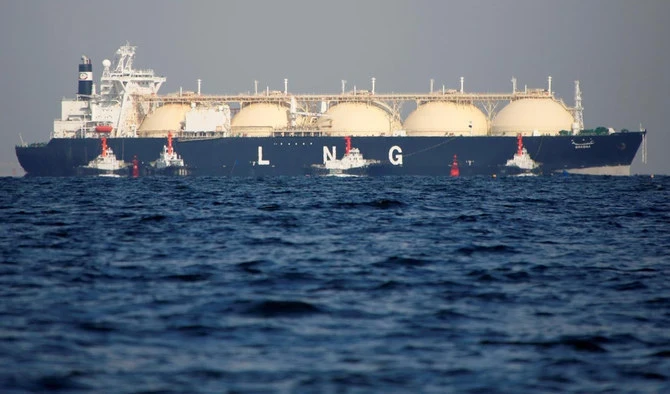
QatarEnergy halted production and declared force majeure in March, following attacks on its facilities during the United States-Iran conflict in the Middle East. The provision allows a supplier to suspend obligations when events beyond its control prevent deliveries. QatarEnergy last month extended the suspension till Nov. 5.
Pakistan is particularly exposed to disruptions in Qatari supplies. Last winter, the country imported 36 LNG cargoes, of which 35 came from Qatar, according to official data. Islamabad imported six LNG cargoes in November 2025, 10 in December 2025, 12 in January 2026 and eight in February.
With uncertainty surrounding Qatari deliveries, the Ministry of Petroleum has prepared a plan requiring state-owned Pakistan LNG Limited (PLL) to explore alternative LNG supplies from the US, the Middle East and Azerbaijan. One option is Azerbaijan state-owned firm SOCAR, which supplied two deliveries to Pakistan in 2023 and 2024 under an agreement signed in July 2023.
“The government has given a threshold of $27 per MMBtu for purchase of spot LNG cargoes,” a Petroleum Division official told Arab News, referring to cargoes purchased from the international market for near-term delivery rather than under a long-term supply contract.
A top government functionary, who attended a recent meeting chaired by Prime Minister Shehbaz Sharif to review the situation, said spot cargo prices could rise to around $29 per million British thermal units (MMBtu), making additional purchases increasingly expensive for the government.
“This is why alternate sources of LNG are being explored with friendly countries in the Middle East and Central Asia,” he said.
The government is also using diplomatic channels with Qatar, Iran and the US to facilitate the passage of Qatari LNG shipments under Pakistan’s long-term supply agreement through the Strait of Hormuz, according to both officials familiar with the government’s contingency plan who spoke on condition of anonymity.
“We will try our best to get maximum cargos from Qatar under the long-term agreement and since we have been able to import two cargos a month after the war broke out, we hope around 8-10 cargos can be imported if the current situation prevails,” the Petroleum Division official told Arab News, adding that Islamabad would need to use its diplomatic influence with Iran, the US and Qatar to facilitate the passage of the LNG shipments through the strait.
“But there are other issues apart from diplomacy. In order to get an LNG cargo, the ship captain, his crew and the insurance companies all need to agree to transport the shipment. So it’s not as easy as it appears,” he added.
The Strait of Hormuz, a narrow waterway between Iran and Oman, is one of the world’s most important energy routes, carrying a significant share of global oil and gas shipments.
Pakistan imports LNG to supplement domestic production, supplying homes, factories, power stations and fertilizer plants. Imported LNG accounted for about one-fifth of gas consumption in July 2025–March 2026, according to Pakistan’s latest economic survey.
WINTER GAS MANAGEMENT
Pakistan’s government is also preparing to manage gas demand during the winter months, when household consumption typically rises because of increased use of gas for heating purposes.
“There will be load management and curtailment of supplies,” the Petroleum Division official said, referring to measures that would restrict or reduce gas supply to selected sectors if demand exceeds available gas.
PM Sharif this week directed authorities formulate a comprehensive gas load-management plan and take advance measures, according to a statement issued by his office, following a meeting attended by Petroleum Minister Ali Pervez Malik and other officials on Tuesday.
“In view of the prevailing regional situation, the Prime Minister directed that all necessary measures be taken to ensure uninterrupted gas imports,” the statement said.
The participants were told that domestic consumers would get priority for locally produced gas, while re-gasified LNG (RLNG) would be prioritized for power generation and industry.
RLNG is LNG that has been converted back into gas after being delivered to Pakistan in liquid form.
The government also plans to launch a public awareness campaign encouraging households to use alternative energy sources instead of locally supplied gas.
“A proposal is also under consideration to introduce bank financing facilities for appliances that run on electricity for water and space heating,” the prime minister’s office said.
PRIVATE SECTOR IMPORTS
The government is also considering allowing private companies to utilize its unused import capacity at two LNG terminals to bring additional supplies into the system.
The Petroleum Ministry has submitted a proposal to the Economic Coordination Committee (ECC), the government’s economic decision-making body, seeking permission for the terminals to auction operationally available unused capacity to private-sector companies for specified periods.
The Oil and Gas Regulatory Authority (OGRA), Pakistan’s petroleum regulator, would determine the quota and duration of such access.
The proposal would effectively expand third-party access, allowing companies other than existing terminal users to use LNG import and related infrastructure by paying regulated or negotiated charges.
However, a third official privy to the discussions said the arrangement was unlikely to substantially increase LNG availability because private companies would face the same international market conditions as the government.
“This won’t change much when it comes to the availability of LNG in the country as third parties can’t import LNG at cheaper rates than those available to the government-owned PLL,” the official said.
QATAR REMAINS KEY
Despite efforts to diversify supplies, officials said Qatar would remain central to Pakistan’s winter LNG strategy because of Islamabad’s long-term agreements with the Gulf producer for cheaper gas supplies.
Pakistan has traditionally relied on imported LNG to supplement declining domestic gas production, with Qatar emerging as its major supplier under long-term agreements. The government’s immediate challenge is therefore to secure as many Qatari cargoes as possible, while trying to find alternative supplies and preparing demand-management measures in case international prices remain high or shipping through Hormuz remains disrupted.
The officials Arab News spoke to did not specify which sectors could face gas curtailment or how much LNG Pakistan expected to secure from alternative suppliers. Arab News contacted the spokesperson of Petroleum Minister Zafar Abbas but did not receive a response till the publication of this report.