- Military spokesman declines to detail how collective defense commitments would be implemented
- Chaudhry says alliance with Saudi Arabia and Türkiye does not complicate US-Iran mediation efforts
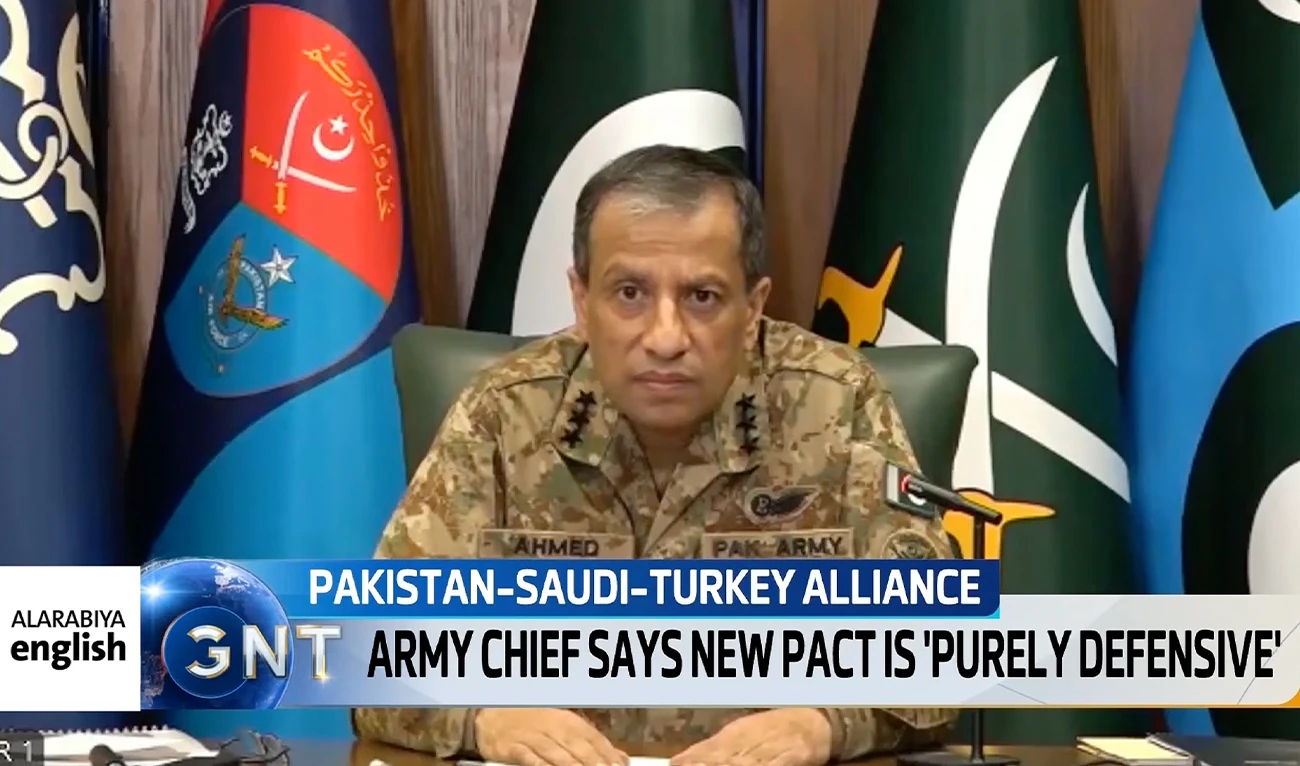
ISLAMABAD: A new defense pact between Pakistan, Saudi Arabia and Türkiye is purely defensive and could eventually expand to include other countries, Pakistan’s military spokesman said on Monday in an interview with an international channel, as the deal comes under scrutiny amid escalating hostilities in the Middle East.
The Makkah Joint Defense Agreement, signed last month, commits the three countries to treat an armed attack against one as an attack against all, but Islamabad has not specified how that obligation would be implemented. The question has gained urgency amid a surge in attacks by Iran-aligned Houthis on Saudi Arabia while Pakistan seeks to mediate between Tehran and Washington.
“It has got no offensive ... and no aggressive element about it,” Lt. Gen. Ahmed Sharif Chaudhry, director-general of the Pakistani military’s media wing, told Al Arabiya English in an interview.
“It is purely defensive in nature,” he added.
Chaudhry said the pact formalized decades-old strategic relationships among the three countries and was based on “collective deterrence,” rejecting suggestions it represented an alliance directed against another state.
Asked how Pakistan would respond if one of the pact’s members came under attack, Chaudhry declined to provide details, saying the “operationalization of the defensive commitments” was not something countries made public.
“The how part of how we are going to defend Pakistan against any aggression, I think that is always part of the operational classification and security,” he said. “It is for the three countries to decide and it is for them to know and for them to actualize it.”
The agreement was signed in Makkah on Aug. 7 amid heightened regional tensions from the US-Iran war and has since taken on greater significance as Houthi forces in Yemen have stepped up missile and drone attacks on Saudi Arabia and threatened shipping around the strategic Bab Al-Mandab Strait.
Chaudhry also left open the possibility that the alliance could eventually expand beyond its three founding members, while saying any such decision rested with their political and military leadership.
“This agreement and alliance can always encompass new willing partners who also believe in regional peace, stability, and security, and who have a shared vision of non-aggression, non-interference and collective deterrence,” he said.
Pakistan’s Foreign Office said last week that expansion was “not on the cards” at present because Pakistan, Saudi Arabia and Türkiye first needed to consolidate the new grouping, but said it could subsequently be opened to countries with similar positions and security requirements.
The three countries have already agreed to establish a permanent secretariat in Saudi Arabia, initially headed by a Pakistani secretary-general, and to deepen military cooperation through joint activities, defense production and technology development.
Chaudhry rejected suggestions the pact was intended to form a broader Islamic military bloc, saying there was “nothing in this agreement which says that it’s a Muslim alliance.”
“It is not a club that is being made for Muslim countries only,” he said.
The alliance also does not complicate Pakistan’s relationship with neighboring Iran, Chaudhry added, arguing that Islamabad’s ties with individual countries were not pursued at the expense of others.
Pakistan has sought to position itself as an intermediary between Washington and Tehran since the US-Iran war began in February, while maintaining close strategic ties with Saudi Arabia and condemning recent Houthi attacks on the Kingdom.
Chaudhry said Pakistan’s relationships with both the US and Iran put it in a position to act as an “objective arbiter of peace and an honest broker,” but declined to discuss progress in the mediation efforts, saying neutrality required Islamabad to avoid publicly commenting on developments in the negotiations.
He said Pakistan would continue those efforts even if progress remained difficult, adding that there was no alternative to a negotiated settlement.
“The only objective that Pakistan is pursuing is that the conflict doesn’t spiral horizontally as well as vertically,” he said, adding that Islamabad did not want the differences among the warring countries to be resolved through military means.