- Stronger reserves, remittances help absorb pressure from Pakistan’s growing import bill
- Pakistani exporters favor currency stability, warn against sharp exchange rate swings
KARACHI: Pakistan’s rupee has remained resilient against the US dollar despite a sharp rise in oil prices and a growing import bill, economists and currency dealers said on Saturday, though a prolonged Middle East conflict could begin to erode the factors supporting the currency.
The rupee stood at Rs277.1 per dollar on Sept. 29, up 1.5 percent from Rs281.4 a year earlier, according to the finance ministry’s Monthly Economic Update & Outlook released on Sept. 30, even as higher energy prices put increased pressure on Pakistan’s external account.
Economist Muhammad Waqas Ghani said dollar inflows had so far been sufficient to absorb the pressure from a higher import bill and keep the currency broadly stable.
“A prolonged conflict in the Gulf and sustained oil prices above $100 per barrel could materially widen the import bill, pressure the current account and increase demand for dollars,” Ghani, head of research at JS Global Capital Pakistan Ltd., told Arab News.
“In such a scenario, I expect gradual depreciation.”
Brent crude ended the week at $102.25 a barrel, while West Texas Intermediate settled at $91.11 a barrel, Reuters reported on Friday.
Pakistan, which relies heavily on imported energy, is already seeing the impact of higher prices on its import bill.
Petroleum imports rose more than eight percent to $2.75 billion in the first two months of the current fiscal year, which began in July, compared with the same period last year. Crude oil imports increased nearly 40 percent in value over the same period, according to official data.
Overall imports have also risen sharply, adding to pressure on the country’s external payments.
The finance ministry in its latest monthly economic update identified oil as the country’s main external vulnerability.
“The oil market remains the principal source of external risk,” the ministry said.
It added that the situation had remained under control due to stronger reserves, remittance inflows and targeted fuel relief.
Finance adviser Khurram Schehzad did not respond to Arab News questions about the factors underpinning the rupee’s resilience despite the rising import bill and pressures from the regional conflict.
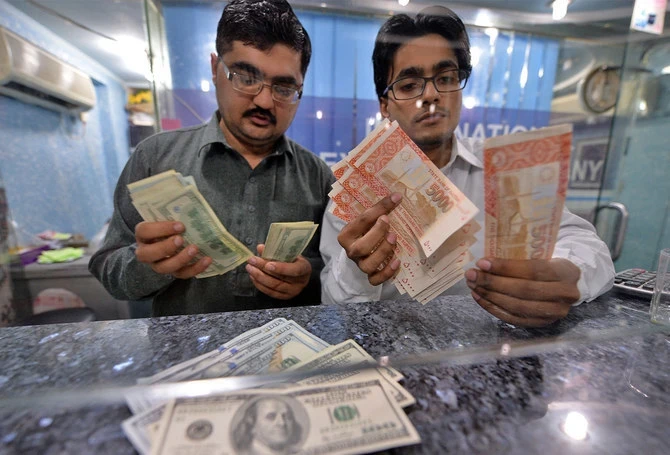
Malik Muhammad Bostan, chairman of the Exchange Companies Association of Pakistan, also pointed to rising reserves and remittances as key factors supporting the currency.
“Your foreign exchange reserves have gone up to $26 billion,” Bostan told Arab News, referring to reserves held by the central bank and commercial banks. “Worker remittances are increasing day by day.”
Workers’ remittances rose 15 percent to $7.3 billion in July and August from a year earlier, according to the State Bank of Pakistan, while the current account deficit narrowed to $543 million from $853 million over the same period.
Bostan said increasing numbers of Pakistanis working overseas were helping sustain remittance flows, particularly from the Middle East.
“The number of Pakistanis going overseas is increasing,” he said. “There is a lot of demand in the Middle East.”
But Bostan said higher energy costs could begin to offset those gains if they persisted.
“Earlier, our monthly energy import bill was around $1 billion,” he said. “Now it has increased to around $1.5 billion.”
“The rate of the dollar will increase if this war spreads more.”
Exporters, meanwhile, said currency stability itself was not a problem, but sharp exchange-rate movements could hurt trade if Pakistan’s balance of payments deteriorated.
“If oil prices continue to rise, then our balance of payments will become worse, and eventually the Pakistani rupee will have to depreciate,” said Muhammad Raza, chairman of the Rice Exporters Association of Pakistan. “Unless remittances and exports rise at a better rate than the increase in the import bill.”
Raza said currency stability itself was not hurting exporters, and that a weaker rupee was not necessarily preferable for export competitiveness.
“A stable rupee is not detrimental,” he said. “Markets adjust. Big shifts are detrimental to exports when they go either way.”
What exporters wanted, he said, was for any exchange rate adjustment to be gradual and reflect broader economic conditions.
“As an exporter we don’t want any major shifts of revaluation or devaluation,” Raza said. “If there is any change it should always be gradual and based on macroeconomic factors.”