- Shehbaz Sharif says Pakistan still playing its role for regional stability, building on Islamabad MoU
- Pakistan PM calls for enhanced international financing to achieve climate goals at the conference
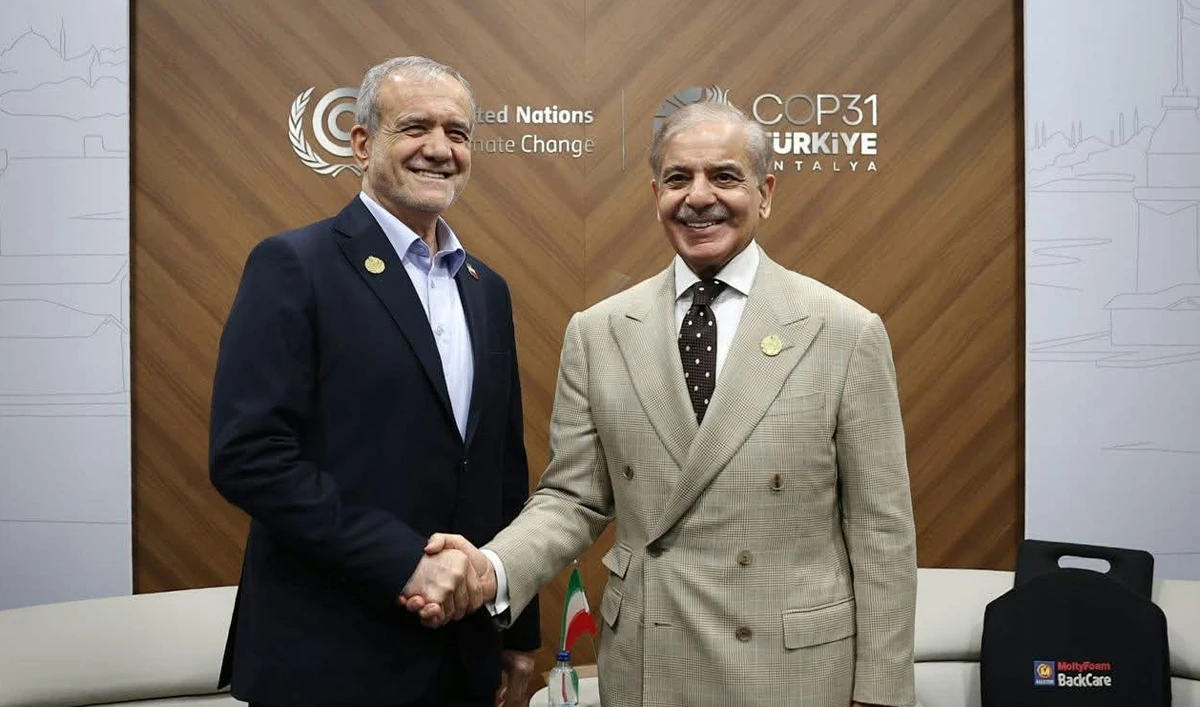
ISLAMABAD: Prime Minister Shehbaz Sharif said on Wednesday that dialogue, restraint and sustained diplomacy were the only path to lasting peace after meeting Iranian President Masoud Pezeshkian on the sidelines of the COP31 climate summit, as tensions in the Middle East continue to fuel regional instability.
The meeting came against the backdrop of persisting tensions in the Middle East, following months of confrontation between the United States and Iran. In response to US attacks, Tehran and its allied Houthi militia in Yemen have launched missile and drone attacks targeting regional countries and commercial shipping.
Pakistan, which has played the role of a key mediator in the US-Iran conflict, has urged all sides to resolve the issue through dialogue, with Islamabad repeatedly condemning attacks against Saudi Arabia and other regional countries.
“I conveyed Pakistan’s deep concern over the prolonged conflict in our region,” Sharif wrote on X, referring to his meeting with Pezeshkian. “Dialogue, restraint, de-escalation and sustained diplomacy are the only path to lasting peace.”
Pakistan helped broker an interim peace deal between the US and Iran in June, which included a 60-day ceasefire, the reopening of the blockaded Strait of Hormuz, a timetable for a final deal on the war and Iran’s nuclear program. However, the deal, also known as the Islamabad Memorandum of Understanding (MoU), did not last long and both sides began attacking the other days later.
Sharif said that Pakistan was still playing a “sincere and constructive role for peace and stability in the region and beyond,” building on the understandings reached under the Islamabad MoU.
“Together, we will keep working for a peaceful, secure and prosperous future for our peoples and our region,” he said.
Sharif joined world leaders at the 31st Conference of the Parties (COP31) in Türkiye on Wednesday.
The Pakistan prime minister met Saudi Energy Minister Prince Abdulaziz bin Salman, Bangladesh PM Tarique Rahman and the Secretary-General of the Organization of Islamic Cooperation (OIC), Ismail Ould Cheikh Ahmed, according to Sharif’s office.
In his meeting with Palestinian PM Mohammad Mustafa, Sharif expressed Pakistan’s full solidarity with the Palestinian people on behalf of the government and the people of Pakistan. He also held meetings with the First Lady of Türkiye, Emine Erdoğan; the President of Syria, Ahmad Al-Sharaa; and the President of the World Bank, Ajay Banga.
“During these meetings, which took place in a cordial atmosphere, the Prime Minister and the world leaders discussed the strengthening of bilateral relations and the regional situation,” Sharif’s office said.
“The discussions also touched upon the importance of highlighting— on a global platform— the challenges faced by countries most severely affected by the adverse impacts of climate change.”
The conference, taking place in Antalya from November 9-20, comes amid growing pressure on governments to turn climate commitments into concrete action and mobilize funding for countries struggling to adapt to rising temperatures and extreme weather.
Pakistan has played an active role in international climate negotiations, including efforts that contributed to the establishment of a fund for climate-related loss and damage at COP27 in 2022.
CONCESSIONAL FINANCING FOR CLEAN ENERGY TRANSITION
Separately on Wednesday, Sharif addressed a high-level session titled “Clean Energy Transition by 2035: Powering the Future” on the sidelines of the COP31 summit, outlining Pakistan’s ambitious roadmap for transitioning toward clean energy and calling for enhanced international financing to achieve climate goals, according to Pakistani state media.
He informed the gathering that before traveling to Antalya, he had inaugurated a key section of Pakistan’s seventh nuclear power plant, a state-of-the-art project that would add 1,200 megawatts of clean electricity to the national grid. Pakistan’s recently launched auto policy envisaged making 30 percent of new vehicles electric by 2030, he added.
The prime minister said the transition toward clean energy was gaining momentum, but stressed that sustained financing was essential to achieve the desired targets. He pointed out that Pakistan required approximately $138 billion by 2035 for low-carbon power generation, in addition to another $50 billion to replace coal-based power with solar energy.
Emphasizing the financial constraints confronting developing countries, he said expanding power grids, ensuring reliable energy storage and making emerging technologies affordable required substantial investment, a burden that heavily indebted economies could not shoulder alone.
“35 by 35 will be achieved only if finance flows at the speed of ambition through concessional capital and the transfer of affordable technology,” the prime minister was quoted as saying by the APP news agency.
Sharif called for international partners to ensure the flow of concessional financing and facilitate the transfer of affordable technologies, stressing that the ambitious clean energy targets could only be achieved through collective efforts and timely financial support.