- Governor pledges ‘constitutional role’ if government deems emergency measures necessary in KP
- PTI says its march will continue, emergency measures would only give party political advantage
ISLAMABAD: Pakistan’s opposition launched the first phase of a long march on Sunday after overnight negotiations with the government collapsed, as Interior Minister Mohsin Naqvi met the governor of the opposition-run Khyber Pakhtunkhwa province to discuss the political standoff and possible emergency measures.
The Pakistan Tehreek-e-Insaf march, led by Khyber Pakhtunkhwa Chief Minister Sohail Afridi, began in the southern district of Lakki Marwat and is expected to travel through several districts before reaching the provincial border with Punjab on Thursday, where the party says it will announce the next phase of its movement.
Hours after Afridi joined supporters in Lakki Marwat, Naqvi met Khyber Pakhtunkhwa Governor Faisal Karim Kundi in Peshawar, with the two discussing rising insecurity, the political situation and developments arising from the march, according to a statement from the Governor House.
“It was agreed at the meeting that whenever the president and prime minister of Pakistan consider it necessary to impose governor’s rule or an emergency to save the province from terrorism and destruction, the Governor House will play its full constitutional role,” the statement said.
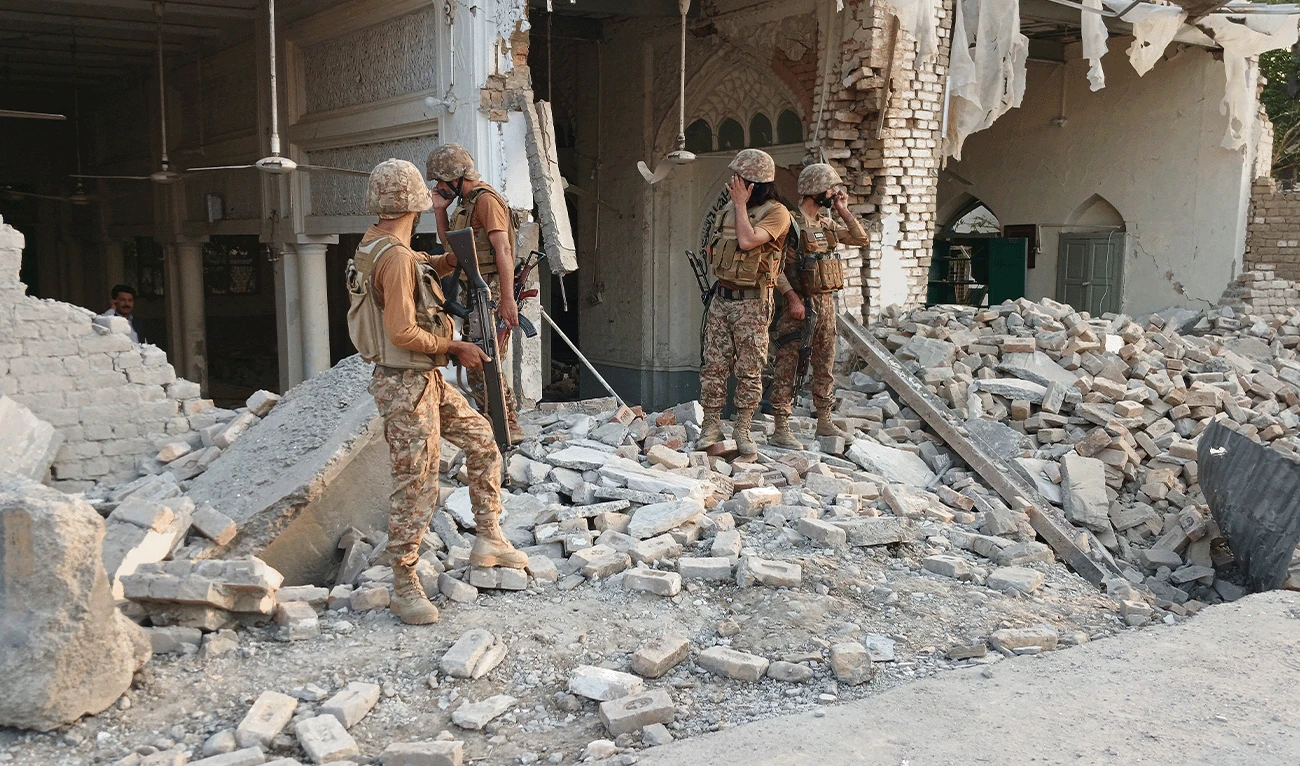
It also said the two officials expressed concern that “terrorists could be facilitated in safely crossing security checkpoints during the long march.”
The developments marked a rapid escalation of a political confrontation that government and opposition negotiators had spent hours trying to defuse from Saturday afternoon until early Sunday, before failing to reach agreement over PTI demands concerning jailed former prime minister Imran Khan and differences over counterterrorism policy.
“The negotiations are now over,” Naqvi told reporters in Lahore before traveling to Peshawar. “We had clearly informed them that once the long march begins, there will be no further talks, because once you launch the long march, what is left to negotiate?”
Naqvi accused Afridi of “sabotaging” the negotiations and said political issues had largely been resolved before the provincial government backed away from commitments on joint counterterrorism measures.
A senior PTI official offered a sharply different account, saying the principal obstacle was the government’s refusal to guarantee its leadership access to Khan, who has been imprisoned since August 2023 and is serving a 14-year sentence in a corruption case. Khan denies wrongdoing in the cases against him and says they are politically motivated.
Asad Qaisar, who was part of the opposition negotiating team, rejected the government’s characterization of the deadlock as a dispute over counterterrorism policy.
“We said that we withdraw all our demands and have only one demand: that our political leadership be allowed to meet Imran Khan,” Qaisar said in a video statement.
He said PTI needed to consult Khan before agreeing on major political decisions and described access to him as the party’s “biggest issue.”
“Framing this as terrorism or making other excuses is completely untrue,” Qaisar said.
However, PTI Secretary-General Salman Akram Raja offered a different emphasis in his account of the talks, saying the “primary reason” for their failure was the opposition’s insistence that counterterrorism actions in Khyber Pakhtunkhwa be agreed between the federal and provincial governments and framed in consultation with political parties represented in the provincial assembly.
Raja said PTI had “zero tolerance for terrorism” but opposed civilian casualties and displacement, adding that counterterrorism measures should have the support of the local population and be based on ground intelligence.
Naqvi, said cooperation against militancy had emerged as the key obstacle in the negotiations.
Describing what the government had told the opposition during the talks, Naqvi said: “Our only request to you is to get on board with us on this entire matter, and we will engage in a political dialogue with you to accommodate what you need as well. But right now, the most crucial priority for the country is that we work together to curb the terrorism spreading rapidly in your province.”
The dispute reflects a longstanding disagreement between the federal government and PTI over how to confront militancy in Khyber Pakhtunkhwa, where violence has surged in recent months. PTI has opposed large-scale military operations and advocated political consultation and engagement, while Islamabad has pressed the provincial government to cooperate more closely with federal counterterrorism measures.
‘MARCH WILL CONTINUE’
The march is the latest PTI campaign seeking the release of Khan, who faces dozens of legal cases that he says are politically motivated.
“Sohail Afridi has already arrived in Lakki Marwat to lead the march from there while Junaid Akbar, the party’s KP president, is leading marchers at Malakand,” Sher Ali Arbab, a PTI member of the National Assembly from Peshawar, told Arab News by phone.
“The march will continue until the PTI’s demands are fulfilled,” he said.
Addressing supporters in Lakki Marwat, Afridi said the opposition negotiating team had gone to Islamabad to reduce political tensions but accused the government of seeking to impose another security policy on the province.
“We are a political force and a political party,” Afridi said. “The negotiating committee that went to Islamabad yesterday went there to lower the political temperature.”
Afridi also rejected the prospect of federal intervention in his government.
“We will accept neither governor’s rule nor an emergency,” he said.
According to a schedule issued by Afridi on X, the convoy will travel through Karak, Kohat, Peshawar and Charsadda before converging at Khairabad on the Khyber Pakhtunkhwa-Punjab border on Oct. 8.
Supporters from Tank, Dera Ismail Khan, South Waziristan, North Waziristan, Bannu, Lakki Marwat, Kohat, Hangu, Kurram, Orakzai, Khyber, Charsadda and Mohmand are expected to join the procession along the route.
PTI has not announced when protesters will proceed toward Islamabad, saying Afridi will unveil the next phase of the movement at Khairabad.
Asked whether PTI was prepared for the possibility of emergency measures, Arbab said such a move would benefit the party politically.
“I think if an emergency is imposed, it gives us a political advantage,” he said.
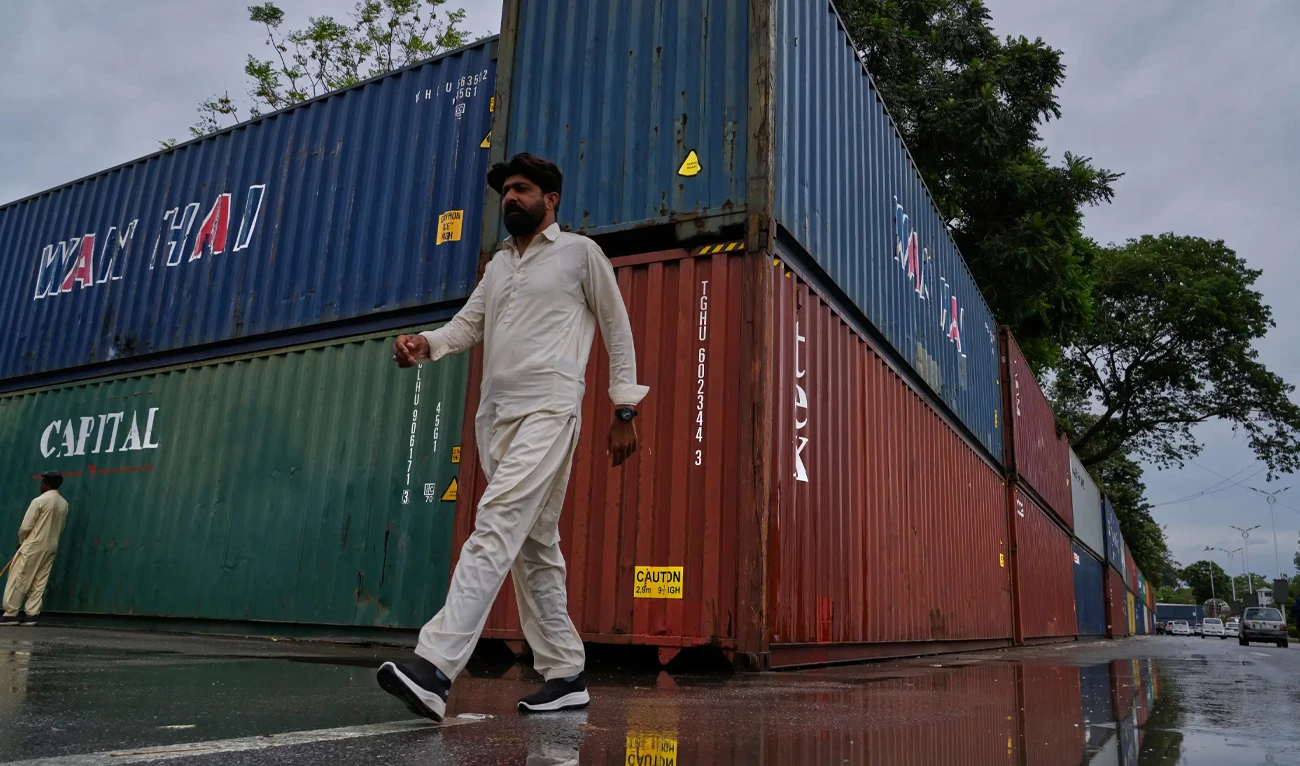
The federal government has previously used shipping containers and road closures to prevent PTI protesters from entering Islamabad, with authorities warning that court orders governing demonstrations in the capital would be enforced during the latest march.
PTI originally planned to begin the march on Sept. 27 but postponed it until Oct. 4 as negotiations with the government continued.
Those talks are now over, leaving the two sides confronting each other on the road as well as over the prospect of federal intervention in Pakistan’s only PTI-governed province.