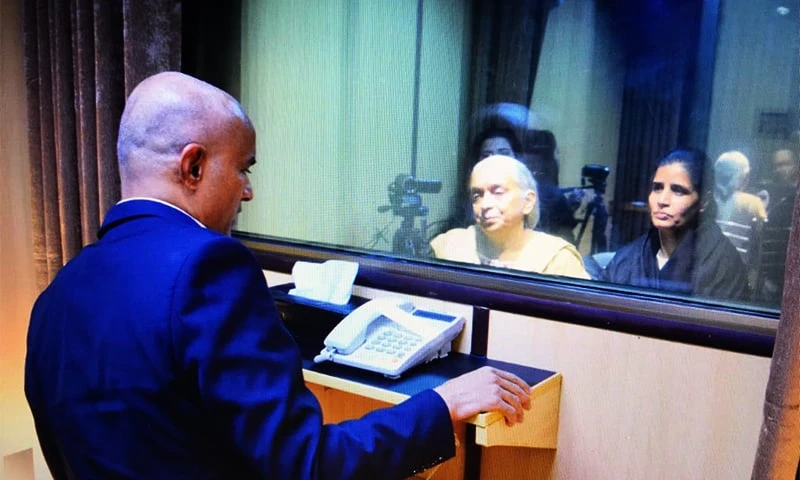
- Indian navy officer Kulbhushan Jadhav was arrested from Balochistan in March 2016 and convicted in 2017
- Last year the International Court of Justice ordered Pakistan to review the death penalty for Jadhav
ISLAMABAD: Pakistan’s Ministry of Law and Justice late on Saturday denied ''allegations'' that the government was offering a reprieve to an Indian man convicted of spying and sentenced to death by a Pakistani military court.
Kulbhushan Jadhav was arrested in March 2016 in Pakistan’s southwestern Balochistan province and was sentenced to death a year later after being convicted of espionage.

“The allegations are baseless, and it is clarified that the Government of India had initiated proceedings against Pakistan in the International Court of Justice (ICJ), in the matter of the detention and trial of an Indian national, Commander Kulbhushan Sudhir Jadhav, who had been sentenced to death by a military court in Pakistan in April 2017,” a statement by the ministry said.
It follows a statement by Pakistan Peoples Party’s (PPP) Chairman Bilawal Bhutto-Zardari who said on Friday that the government was secretly enacting an ordinance “to facilitate Jadhav.”
“The ordinance was introduced to facilitate Kulbushan. Despite the expiry of the ordinance’s time period and the regular meetings of the Senate and National Assembly, it was never presented [in the House],” Bilawal said.
Rejecting the allegations, a law ministry spokesman said that the ordinance was enacted to comply with the directions of the ICJ. On May 20 after the World Court decided to allow Jadhav to appeal for mercy.
Titled the Review and Reconsideration Ordinance 2020, under the ordinance, a review petition may be submitted to the Islamabad High Court within 60 days of the law coming into effect, the deadline for which ends on Saturday.
He added that the Review and Reconsideration Ordinance 2020 was enacted when the parliament was not in session.
“The ordinance was promulgated when the parliament was not in session. Please note that casting aspersions on the decision of the government to promulgate the ordinance in question, reflects a poor understanding in respect of Pakistan’s delicate security issues and international obligations and is an attempt to confuse the public,” the statement read.
Under Article 89 of Pakistan’s Constitution, the president retains the final prerogative power to promulgate an ordinance when the parliament is not in session.
The development comes a few days after Pakistan, on Thursday, offered consular access to Jadhav for the second time.
“Two consular officers of the Indian High Commission in Islamabad were provided unimpeded and uninterrupted consular access to Commander Jadhav at 1500 hours,” the Ministry of Foreign Affairs (MoFA) said in a statement.
India insists Jadhav is innocent, and last year the World Court ordered Pakistan to review the decision to impose the death penalty.
Jadhav’s wife and mother were granted permission to visit him in 2017, eight months after he was sentenced to death.
According to Pakistani authorities, Jadhav confessed that he was ordered by India’s intelligence service to carry out espionage and sabotage in Balochistan, a province that is part of the $60 billion, Chinese-backed Belt and Road Initiative, a multinational development project.
In a transcript released by Pakistan of Jadhav’s confession, the former naval officer is quoted as saying the disruption of Chinese-funded projects was the main goal of his activities.