- US embassy Charge d'affaires expresses 'confidence' in Pakistan government’s policies for economic stability
- Pakistan has been in economic turmoil for months as talks to secure critical IMF loan have not yielded fruit
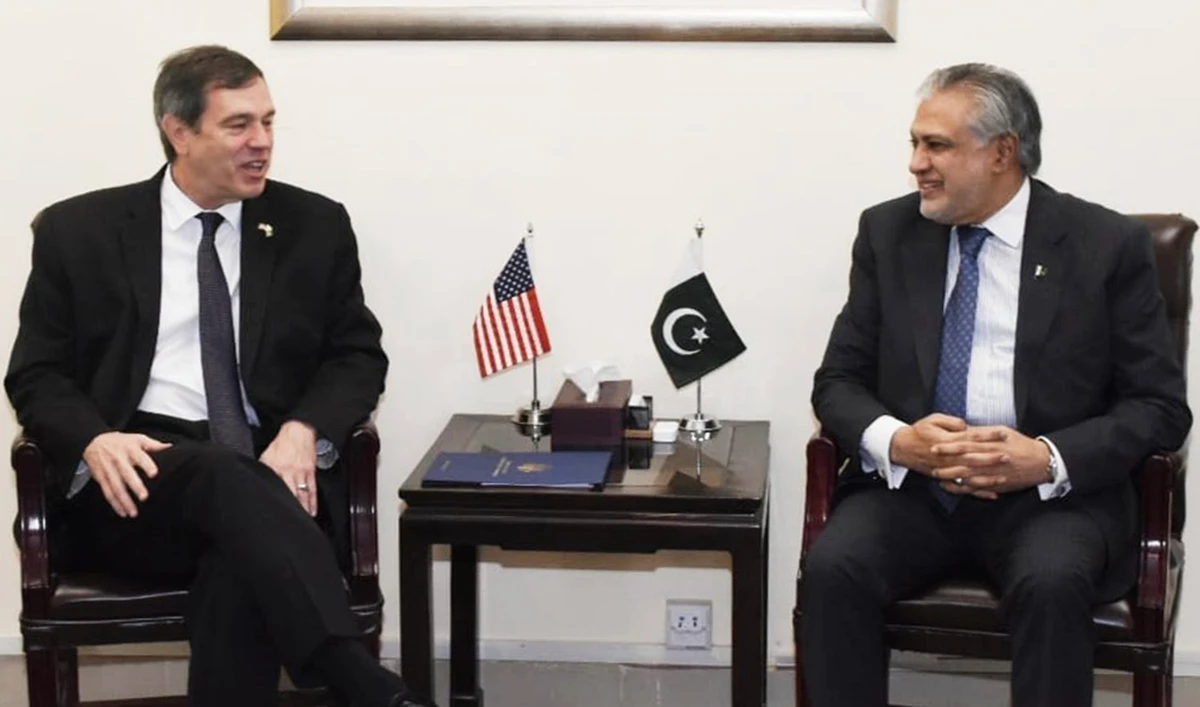
ISLAMABAD: Pakistan on Wednesday assured the United States that it was committed to completing an International Monetary Fund (IMF) loan program signed in 2019, a statement from the finance division said after Finance Minister Ishaq Dar met US embassy Charge d'affaires Andrew Schofer.
Pakistan signed a $6.5 billion bailout package with the IMF in 2019, with another $1 billion added to the program last year. Recently, the South Asian country has been in economic turmoil for months with an acute balance of payments crisis while talks with the IMF, ongoing since November, to secure $1.1 billion as part of a $6.5 billion bailout have not yielded fruit.
“Finance Minister apprised him [Schofer] of the economy of the country and discussed the current challenges being faced by the country,” the finance division statement said.
“He further communicated about the difficult policy decisions recently being taken by the government with the aim of stabilizing the economy and then taking the economy on an upward curve ensuring sustainable and inclusive growth.”
The statement added that Dar briefed the US diplomat about the ongoing IMF programme and assured him that the Pakistan government was “committed” to completing it.
In response, Schofer “voiced his confidence in the policies and programmes of Government of Pakistan for economic stability of the country and extended his support to advance the existing economic and trade relations between both the countries.”
The delay in the IMF program has worsened Pakistan’s economic woes despite it getting external financing guarantees from friendly nations like Saudi Arabia, the United Arab Emirates and China.
The failure to reach an agreement also comes after Pakistan had to complete a series of prior actions demanded by the IMF, which included reversing subsidies in the power, export and farming sectors, a hike in energy and fuel prices, a permanent power surcharge, jacking up the key policy rate, a market-based exchange rate, and raising over 170 billion rupee($613.17 million) in new taxation through a supplementary budget.
To make matters worse, Pakistan inflation rose to a record 36.4% in the year to April driven mainly by food prices, the highest rate in South Asia and up from March's 35.4%, the statistics bureau said on Tuesday. The finance ministry said headline inflation was expected to remain at elevated levels in the months to come, despite contractionary monetary policy by the central bank.
The successful completion of talks with the IMF would eventually attract more capital inflows, stabilise the exchange rate and alleviate inflationary pressures, the finance ministry said on Tuesday.