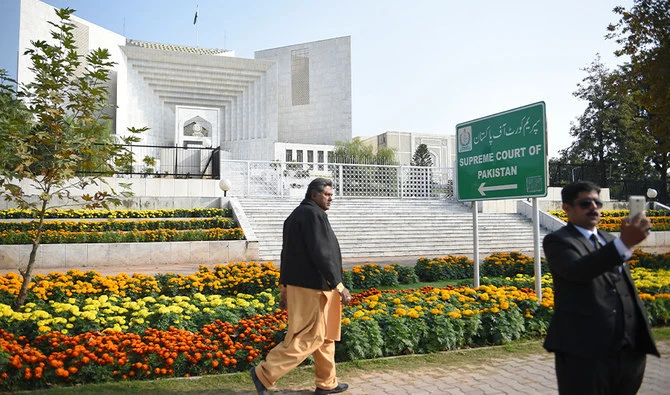
- The Supreme Court is hearing a presidential reference seeking interpretation of Article 63-A which deals with disqualification of parliamentarians
- The reference was filed after the opposition brought a no-trust move against PM Khan who was publicly criticized by his allies, party members
ISLAMABAD: Chief Justice of Pakistan Umar Ata Bandial said on Thursday it would be offensive to not to court a lawmaker's vote during a no-confidence session against a prime minister while hearing a presidential reference seeking the apex court's interpretation of Article 63-A of the constitution.
Pakistan's attorney general Khalid Javed Khan submitted the reference on behalf of President Arif Alvi after the opposition filed a no-trust motion against Prime Minister Imran Khan on March 8.
The government demanded the court's interpretation of Article 63-A, which sets down rules for the disqualification of lawmakers in the case of defection and violation of party policy, after a number of lawmakers belonging the ruling Pakistan Tehreek-e-Insaf (PTI) party publicly criticized Khan's administration.
Through the reference, the government has requested the court to give its opinion on whether a defector should be disqualified for life from electoral activity or public office and if his or her vote, after defecting, should be counted in a parliamentary motion.
"Chief Justice of Pakistan (CJP) Umar Ata Bandial on Thursday observed that not counting a vote that has been cast during the no-trust proceedings against the prime minister would be 'contemptuous', adding that the real question was how long a dissident MNA [member of the National Assembly] could be disqualified for," reported Dawn newspaper.
While the attorney general presented his arguments, Justice Munib Akhtar maintained that Article 63-A was meant to prevent defection from party policies.
"The party's collective opinion is above an individual's opinion," Dawn quoted him as saying. "The collective opinion is important for the stability of democracy."
He observed that Article 63-A could be interpreted in a way that would prevent the counting of votes by dissident lawmakers.
The attorney general argued that political parties were fundamental to parliamentary system of government, making it imperative for lawmakers to follow party directives.
At one point when he mentioned Article 19 that guarantees individual freedom of expression, Justice Ijazul Ahsan noted the attorney general was "talking about the difference between the voting rights of a member of the assembly and a common man."
Later, the court adjourned its hearing until Friday, March 25.