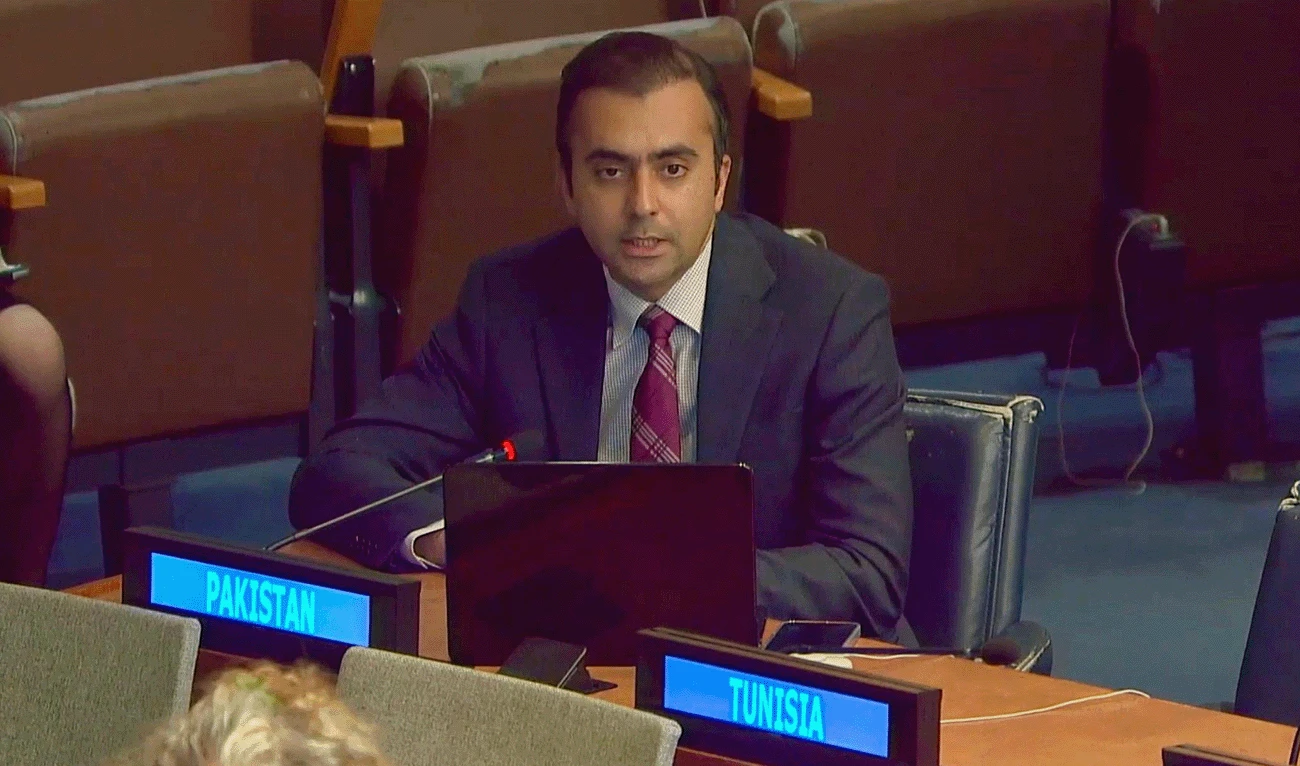
- Pakistani UN delegate says voluntary measures cannot replace legal obligations to prevent space weaponization
- UN delegate’s call comes as Islamabad expands satellite and human spaceflight cooperation with China
ISLAMABAD: Pakistan this week called for a legally binding treaty to prevent an arms race in outer space, warning that weapons deployments and space-based missile defenses threaten global stability and the satellites that support everyday life.
The existing international framework, anchored in the 1967 Outer Space Treaty, prohibits nuclear weapons and other weapons of mass destruction in orbit but does not impose an equivalent blanket ban on conventional weapons. Pakistan argues that this gap requires further binding restrictions.
Pakistan’s appeal to the UN General Assembly follows a September announcement by US Air Force Secretary Troy Meink that Washington has weapons deployed in orbit to protect its forces against hostile action. The disclosure sharpened international concerns about competition in a domain used for communications, navigation and other essential services.
“But they can neither substitute for legally binding obligations nor be made a precondition for them,” Pakistani delegate Husham Ahmed said of voluntary transparency, confidence-building measures and norms of responsible behavior, in a statement to the UN General Assembly’s disarmament committee earlier this week.
Ahmed said Pakistan supported negotiations at the Conference on Disarmament, the UN-backed arms control forum in Geneva, on a binding instrument to prevent an arms race in outer space.
He warned that integrating missile defenses with space-based systems could prompt countermeasures and accelerate military competition. Governments needed to act before deployments became established and harder to reverse, he added.
Pakistan’s concerns come as it develops its own space capabilities through cooperation with China, including satellites for communications, agriculture, environmental monitoring and disaster management.
The country’s national space agency, SUPARCO, launched its first hyperspectral satellite from China in October 2025. The satellite collects detailed imagery intended to support natural resource management, food security and disaster response.
Pakistan is also preparing for its first astronaut mission under an agreement with China’s manned space agency. Two Pakistani candidates are undergoing training, with one to be selected to conduct scientific research aboard China’s Tiangong space station, according to SUPARCO.
The cooperation extends to lunar exploration. SUPARCO plans to send a Pakistani-built rover aboard China’s Chang’e-8 mission, scheduled for 2028, to study the Moon’s surface near its south pole.
At the diplomatic level, Pakistan has submitted proposals for both binding obligations and voluntary measures to a UN working group examining space security. The group is due to make recommendations to the General Assembly in 2028.