- India’s Prime Minister Narendra Modi wants to discuss a political roadmap for Jammu and Kashmir with pro-India parties from the disputed region
- Political analysts say they are not optimistic about the outcome of the talks
NEW DELHI: A former chief minister of Indian-administered Jammu and Kashmir region on Tuesday asked New Delhi to initiate a dialogue with Pakistan to resolve the outstanding issues related to the disputed territory between the two countries while making a reference to India’s alleged involvement in the intra-Afghan peace talks in Qatar.
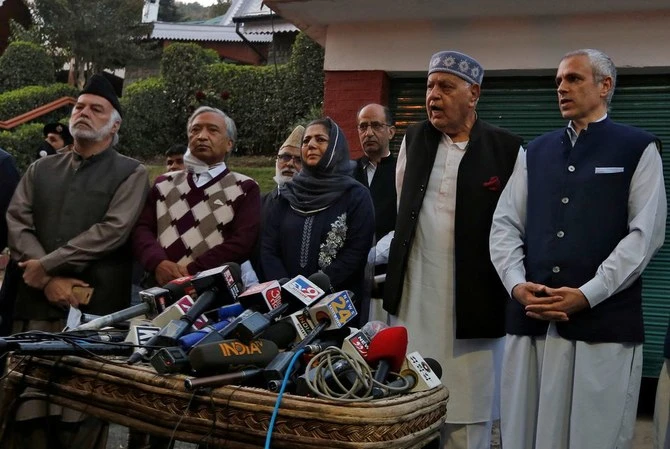
“If they [Indian officials] can go to Doha and talk to the Taliban, they should have a dialogue with us and with Pakistan too to bring about a resolution,” Mehbooba Mufti, who is also the president of Peoples Democratic Party (PDP), said during a news conference in Srinagar.
Indian media on Monday quoted a senior Qatari diplomat involved in the Afghan peace process as saying that Indian officials were engaged in talks with the Taliban.
Mufti’s remarks came ahead of a meeting called by India’s Prime Minister Narendra Modi on Thursday, summoning major parties from the region to discuss the political roadmap for Jammu and Kashmir.
Seven leading pro-India parties in Kashmir, under the banner of People’s Alliance for Gupkar Declarations (PAGD), accepted Modi’s invitation on Tuesday.
Another former chief minister of the region, Farooq Abdullah, who belongs to Kashmir’s oldest People’s Conference party, will also attend Thursday’s meeting along with Mufti on behalf of the PAGD.
The talks will be the first major interaction between New Delhi and Kashmir-based political parties in three years since the Modi administration annulled the region’s special constitutional status.
In a dramatic move in August 2019, India scrapped the region’s constitutional autonomy and put the entire territory under a curfew for several months, denying residents their fundamental rights, and detaining hundreds of political workers and activists.
Most political activists and leaders, including Mufti and Abdullah, were put under house arrest for more than a year.
New Delhi also divided the state into two federally administered union territories (UTs): Ladakh and Jammu and Kashmir. A UT is administered by a Lt. Governor appointed by New Delhi, and the elected assembly is subservient to the political appointee.
The PAGD was formed ahead of the move in August 2019 to restore Kashmir’s constitutional rights, a condition reiterated by Mufti and other leaders on Tuesday, amid reports that New Delhi might give Kashmir its statehood back.
“Statehood is the prime minister’s own commitment,” Mufti said. “They won’t be doing us a favor by giving us statehood back. The PAGD was formed for the restoration of what was taken away from us on August 5, 2019.”
Mufti, who was Jammu and Kashmir chief minister in alliance with the ruling Bharatiya Janata Party (BJP) until June 2018, added she favored dialogue to resolve the issue before demanding the release of all political prisoners to “create an atmosphere for talks.”
“There are many who are still in jails. We will also seek immediate shifting of prisoners back to J&K jails from various Indian prisons,” she added.
There is no declared agenda for Thursday’s meeting. However, Kashmir’s political parties said they would voice “concerns of the people of Jammu and Kashmir and Ladakh.”
“Our concerns are constitutional rights which have been arbitrarily withdrawn and the downgrading of Jammu and Kashmir as a union territory,” PAGD spokesperson Mohammed Yousuf Tarigami told Arab News.
“What New Delhi did to us was not needed,” he added, “and it has proved counterproductive.”
Abdul Ghani Bhatt, a leader of Kashmir-based pro-freedom All Parties Hurriyat Conference (APHC) alliance “refused” to comment on “the happenings within the NC and PDP” when contacted by Arab News on Tuesday.
Political experts, however, are not too optimistic about the outcome of the engagement.
“What can Delhi offer to the political parties in Kashmir now?” Subhash Chander Gupta, a Jammu-based lawyer and political analyst, wondered while talking to Arab News.
“Delhi’s decision to disturb the status quo in Kashmir was not well thought out. The reality is that people in Jammu feel lost and without any power after the loss of Kashmir’s special status,” Gupta said, adding that he was “not optimistic” about Kashmir’s special status being restored.
“The ruling BJP will pay a political cost if it goes back on its stand on Kashmir. They will lose the rest of India if they do that,” he explained.