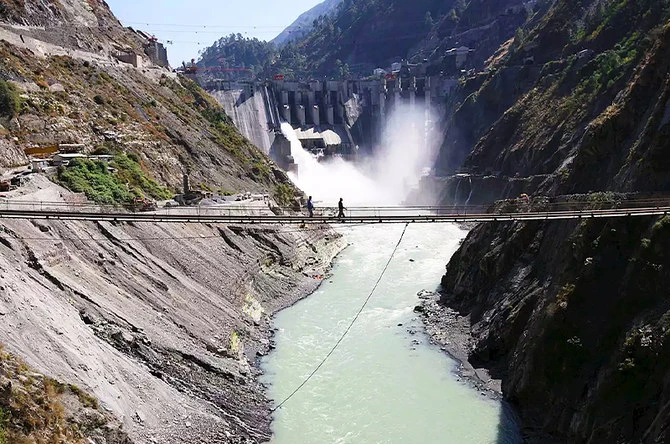
- In recent years, India has begun ambitious irrigation plans, construction of many upstream dams
- Pakistan opposes some of these projects, says they violate World Bank-mediated Indus Water Treaty
ISLAMABAD: An Indian delegation will be visiting Pakistan for a three-day meeting of the Permanent Indus Commission starting on March 1, Pakistani officials said on Monday.
In recent years, India has begun ambitious irrigation plans and construction of many upstream dams, saying its use of upstream water is strictly in line with the Indus Water Treaty (IWT), signed between the two countries in 1960.
Pakistan has opposed some of these projects saying they violate the World Bank-mediated treaty on the sharing of the Indus waters, upon which 80 percent of its irrigated agriculture depends.
The Permanent Indus Commission will hold its annual meeting in the Pakistani capital of Islamabad from March 1 to March 3, according to Ehsanullah Shahzad, a deputy director at the Pakistani Ministry of Water Resources.
“Agenda is being finalized. Delegation will be of ten members as we have been informed by the Indian side for 117th Permanent Indus Commission Meeting,” Syed Muhammad Mehar Ali Shah, Pakistan’s Commissioner for Indus Waters, told Arab News on Monday.
Shah will be leading the Pakistani side during the three-day talks.
The discussions are likely to be focused on Pakistan’s objections to Indian hydroelectric projects namely Pakal Dul (1,000 MW), Lower Kalnai (48 MW) and Kiru (624 MW) in Chenab basin in Jammu and Kashmir and few small hydroelectric projects in Ladakh, The Hindustan Times reported.
Under the IWT, India has been given the right to generate hydroelectricity through run-of-the-river projects on the western rivers subject to specific criteria for design and operation.
The pact also gives the right to Pakistan to raise objections to designs of Indian hydroelectric projects on the western rivers. Pakistan has raised objections on the design of these projects.
Shortly after the partition of the sub-continent into Pakistan and India in August 1947, tensions soared over water rights of the rivers flowing between them.
Since the ratification of the treaty after nine years of negotiations, both neighbors have not engaged in any water wars, despite waging full-scale wars over the Muslim majority Kashmir valley, which both claim in full and rule in part.