- Earlier this month, Balochistan’s counter-terrorism unit claimed killing 13 militants during separate encounters
- Ghulam Din alias Shoaib was involved in several suicide attacks across the province, Balochistan CTD says
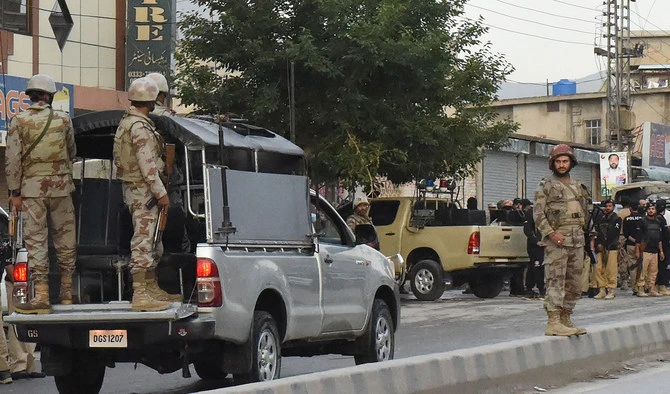
QUETTA: In the third major operation against militants in southwestern Pakistan this month, Balochistan’s Counter-Terrorism Department (CTD) on Wednesday claimed killing an important leader of the local chapter of militant outfit Daesh, accusing him of being involved in several suicide attacks that killed hundreds of people in the province.
According to a CTD spokesperson’s statement, Ghulam Din alias Shoaib was a key leader of Daesh’s Balochistan chapter who was gunned down during an exchange of fire between CTD forces in Mastung, 50 kilometers away from Balochistan’s provincial capital of Quetta. This was the third intelligence-based operation against militant hideouts in the province during September.
On September 2, Balochistan CTD said it had killed eight militants in Washuk district bordering Iran while on September 7, the counter-terrorism unit said it had gunned down five Pakistani Taliban militants in Quetta’s Aghberg area.
“The CTD force asked the terrorist Ghulam Din alias Shoaib to surrender but he started firing on the Counter Terrorism Force to flee the area,” the statement said. “During exchange of firing, he was killed on the spot.”
Ghulam Din joined Daesh in 2015 after receiving training in Pakistan’s tribal Waziristan district from the Tehreek-e-Taliban Pakistan (TTP) or the Pakistani Taliban, the CTD spokesperson said. He said that the militant was involved in multiple militant attacks in Balochistan, including the August 2016 suicide attack on lawyers in Quetta’s Civil Hospital that killed over 70.
“He planned multiple attacks on police and [paramilitary] Levies force in Balochistan, including the suicide attack on a senior member of the Jamiat Ulema-e-Islam Fazl (F) Maulana Ghafoor Haideri in October 2014 which killed 27 people in Mastung,” the CTD said.
The counter-terrorism unit added the militant was also involved in a foiled suicide attack that targeted prominent Pakistani politician, Jamaat-e-Islami (JI) chief Siraj-ul-Haq in July 2023 in Balochistan’s Zhob district.
Balochistan, which shares a porous border with Iran and Afghanistan, has been the scene of a low-level insurgency by Baloch nationalists for around two decades. Separatists say they are fighting what they see as unfair exploitation of the province’s wealth by the federation, an allegation denied by Pakistani authorities. The province is Pakistan’s largest one by land but smallest in terms of population and its most impoverished one.
Pakistan has long accused neighboring countries and hostile agencies for harboring Baloch separatist fighters and other armed groups that operate in the rugged, southwestern province.