- Officials say smoke detectors, automatic alarm were present at KMC headquarters but they are investigating if they worked
- Expert says prevention, detection and building-level preparedness remain Karachi’s ‘more fundamental’ fire-safety problems
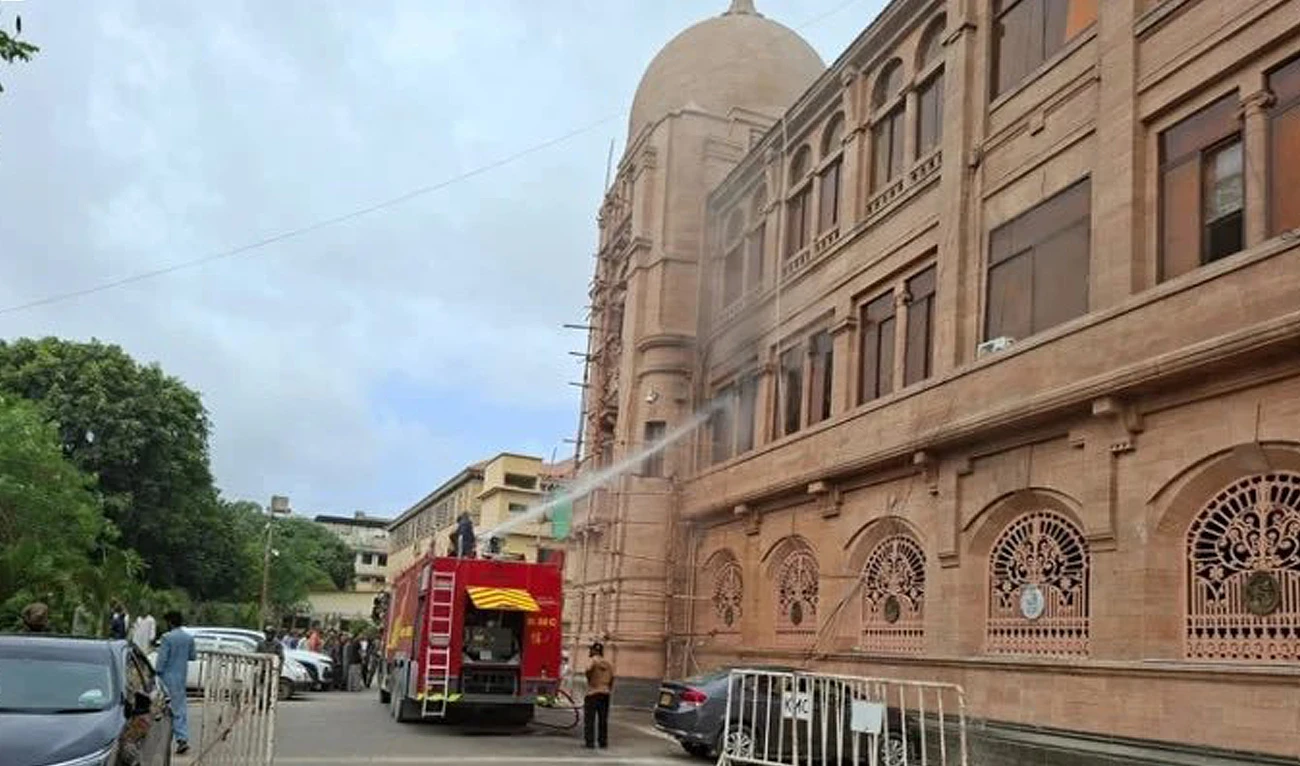
KARACHI: A fire, which damaged the Karachi mayor’s office on Tuesday, has raised questions over building safety protocols and fire preparedness in Pakistan’s largest city after the blaze struck the historic building of the municipal authority that runs Karachi’s fire brigade.
This was the second such incident in the city in as many days after a major fire gutted a factory in Karachi’s Landhi Export Processing Zone on Monday, renewing scrutiny of fire safety protocols in the metropolis.
Mayor Murtaza Wahab said the fire broke out at around 9:15am at his office at the Karachi Metropolitan Corporation (KMC) headquarters, with a short circuit in an air conditioner among the possible causes being investigated.
“The initial assessment is that this happened inside the air conditioner in my room,” Wahab told reporters, adding that no one was injured and all records were safe as firefighters contained the fire.
Hassaan-ul-Haseeb, a spokesperson for Sindh Rescue 1122, said smoke detectors and an automatic fire alarm system were observed at the building but investigators had yet to determine whether they went off when the blaze broke out.
“We need to find out why people didn’t know about the fire, or if they did, whether there was a delay in calling us,” Haseeb told Arab News.
A post-fire assessment is expected to take up to three days that would examine the cause, functionality of fire-safety equipment and a timeline of the incident.
Arab News reached out to KMC spokesperson Karamullah Waqasi but he did not respond to queries about when the KMC headquarters building was last inspected for fire safety.
PREVENTION ‘FIRST LINE OF DEFENCE’
Karachi has witnessed a number of fire incidents in recent months. In May, a fire at a used garments factory in the Sukhan area took around six hours to contain, while a fire erupted at a plastic processing unit in Feb. that spread to a neighboring building and took around 13 hours to control.
A deadly blaze at the city’s famous Gul Plaza Shopping Mall in January killed at least 67 people and reduced the building to ashes.
Asked about the recurring incidents, Dr. Muhammad Masood Rafi, chairman of the Department of Earthquake Engineering at NED University, said faulty or overloaded electrical wiring, combustible materials, overcrowding, blocked emergency exits, poor ventilation and non-functioning fire-safety equipment could turn a manageable fire into a major disaster.
“In my opinion, the bigger and more fundamental problem is prevention, detection and building-level preparedness,” Rafi told Arab News.
“If a building has functioning alarms, clear exits, firefighting systems and properly enforced safety standards, many fires can be contained before they become major disasters.”
He said emergency response remained another weakness, with limited resources, difficult access and delays worsening an incident, but prevention and enforcement should be the “first line of defense.”
“Some areas in Karachi are effectively inaccessible to fire vehicles because of narrow streets,” he said, adding that illegal parking spaces and encroachments could obstruct timely positioning of ladders, hoses and other equipment.
HERITAGE BUILDINGS, MODERN RISKS
The KMC headquarters on MA Jinnah Road was purpose-built for Karachi’s municipal administration and the sandstone building has been home to the city’s municipal offices for nearly a century.
Tania Ali Soomro, an architect and heritage conservation expert, said buildings from that era were designed around passive cooling, with large windows, ventilators, verandas and open corridors providing natural ventilation.
“In this particular building, corridors have been closed off and converted into office spaces,” Soomro told Arab News.
Partitions have been installed and ventilation openings closed, changes that could restrict airflow and trap smoke during a fire at the building. The woodwork, common in such historic buildings, could further increase fire risks, according to the expert.
The problem was particularly acute in the Old City area, where many heritage buildings originally built for residential purposes had been converted into commercial premises, with upper floors often used as warehouses. Windows and other openings are often sealed for security reasons, while some buildings have only a single entry and exit route.
“Their current usage is the biggest threat to the buildings,” she said.
Soomro urged the use of functioning fire alarms and appropriate suppression systems, unobstructed evacuation routes, regular fire drills and designated assembly areas to avoid such incidents.
Rafi said modern fire-safety systems could be incorporated into historic structures without unnecessarily damaging their architectural character, including through wireless detection systems and discreet, reversible installations developed in consultation with conservation experts.