- Says Supreme Court on ‘trial,’ will be “exposed” before people if it didn’t protect right to protest
- Defends Russia visit, says did not know Putin would invade Ukraine the day Khan landed in Moscow
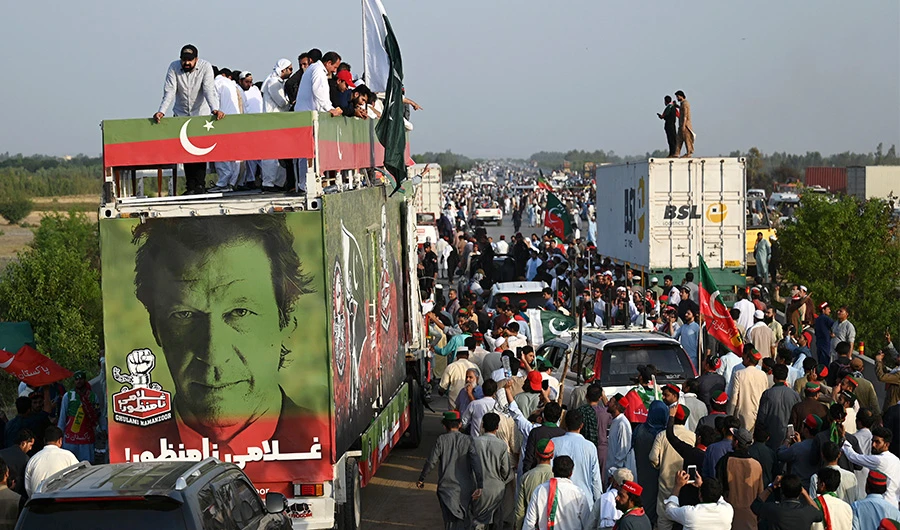
ISLAMABAD: Former Prime Minister Imran Khan has said many supporters participating in a long march he led to the capital last week were carrying “pistols” and he had called off the protest fearing unrest and bloodshed.
Khan rallied thousands of supporters to Islamabad last Wednesday, with plans to stay in the capital until Prime Minister Shehbaz Sharif gave in to a demand to announce a date for new polls. However, Khan told his followers early on Thursday morning to disband.
Khan’s statement followed a long day of clashes between law enforcement officials and marchers. Police in the central Pakistani city of Lahore, the epicenter of the clashes, said they had recovered weapons from the cars of two office-bearers of Khan’s Pakistan Tehreek-e-Insaf (PTI) party ahead of the protest march, and feared that PTI marchers were planning violence.
Khan’s party had previously denied his supporters had carried weapons to the march but in an interview to a private TV channel broadcast on Monday, Khan said he was aware that many of his supporters had brought guns.
“The hatred against police had already grown [because of what] they [government] made the police do … this would have intensified,” Khan said, explaining why he had disbanded the protest. “And seeing me they [supporters] would have become more impassioned and at that point I was 100 percent sure that bullets would be fired.”
“Even on our side, people were ready, many people I saw were carrying pistols, so I was afraid that the next step would be that there would be unrest.”
Khan’s call for a march on Islamabad had prompted the government to seal off main roads leading to the capital, but late on Wednesday the Supreme Court ordered that the barriers be removed, telling the government to designate an open venue for Khan’s supporters to gather.
The protesters didn’t follow the court orders, however, and hundreds reached the heart of the capital, where they fought running battles with police over several hours before Khan and the main body of the rally entered the city.
Police fired tear gas and baton-charged the vanguard of the protest march, and detained hundreds of protesters, who had set fire to trees, vehicles, shops, and a bus station on the main thoroughfare leading to parliament.
At least 18 police and paramilitary troops were wounded, said Information Minister Marriyum Aurangzeb, after dozens of the protesters breached the last line of security outside the parliament.
There were also clashes in several cities in Punjab province and the southern port city of Karachi.
Khan said it was the job of state institutions to protect the rights of the people at this “decisive moment for Pakistan.”
“If at this time, institutions don’t do their work, they will be exposed in front of the whole public,” he said, referring to the top court. “At this time, if the Supreme does not protect the fundamental right of the people, then this is not a democracy, then they should make it clear this is not democracy.”
“If this is democracy,” he added, “then the constitution gives us the right to move, to protest and the right to speech. This is a trial of the Supreme Court also.”
In a separate interview broadcast on Sky News, Khan insisted he wasn’t aware Russia was going to invade Ukraine on the same day he met Russian President Vladimir Putin in Moscow in February.
Khan stirred controversy for having face-to-face talks with Putin and shaking hands with him just hours after the war in Ukraine began on February 24.
“How the hell was I supposed to know that the day I landed in Moscow that Putin was going into Ukraine,” Khan said in the interview. “I have never believed in military solutions, ours was a bilateral meeting, it was planned long before. We didn’t realize that when I would reach there Putin would go into Ukraine. How was I supposed to know and how can you be punished for that?”
Commenting on his government’s close ties with China and Russia, both adversaries of the West, Khan said he was elected to serve the people of Pakistan.
“There are 50 million people in Pakistan below the poverty line, I was not elected for them to correct all the wrongs that are going on in the world,” he said. “My responsibility was to my country and so all my relationships, whether it was with China, with the United States, with Russia, were for the benefits of our own people.”