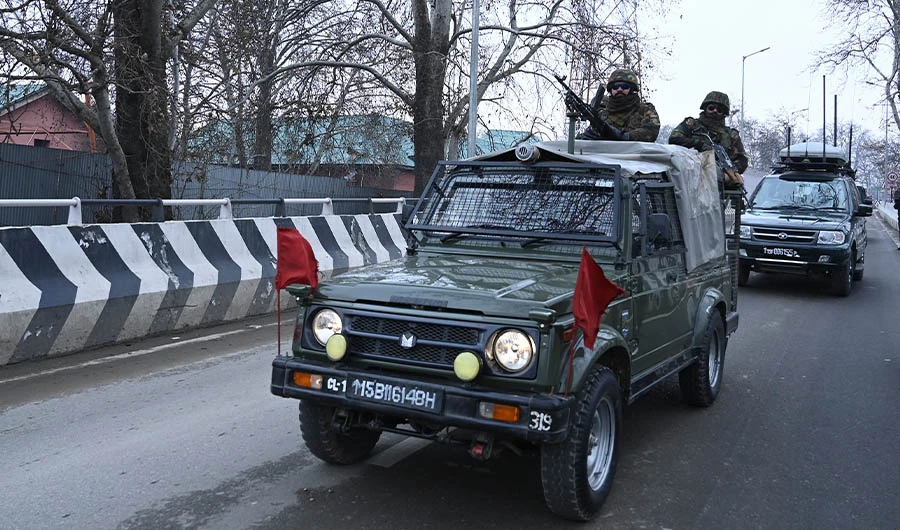
- Diplomats were driven by Indian authorities in a motorcade amid tight security
- India’s government ended Kashmir’s semi-autonomous status in August 2019
SRINAGAR, India: Envoys from 15 countries including the United States arrived in Indian-administered Kashmir on Thursday, the first visit by New Delhi-based diplomats since the government stripped the region of its semi-autonomous status and imposed a harsh crackdown five months ago.
The diplomats were driven by Indian authorities in a motorcade amid tight security from the airport to the military headquarters in Srinagar, where they were briefed on the security situation, an army officer said. He spoke on condition of anonymity as he was not authorized to speak to reporters.
They also held discussions with some government officials at a luxury hotel and were expected to meet civil society members and some pro-India Kashmiri politicians later Thursday.
India’s Hindu nationalist-led government ended Muslim-majority Kashmir’s semi-autonomous status in August. The move was accompanied by a harsh crackdown, with New Delhi sending tens of thousands of additional troops to the already heavily militarized region, imposing a sweeping curfew, arresting thousands and cutting virtually all communications.
Authorities have since eased several restrictions, lifting roadblocks and restoring landlines and cellphone services. The Internet service is yet to be restored in the Kashmir valley.
They have encouraged students to return to school and businesses to reopen, but top political leaders from the region continue to be under arrest or detention.
Outside access to the region remains limited, with no foreign journalists allowed to visit since the clampdown began.
In October, a group of European Parliament members had visited the region, which is claimed by both India and Pakistan in its entirety.
Diplomats representing the United States, Bangladesh, Vietnam, Norway, the Maldives, South Korea, Morocco, Niger, Nigeria, Argentina, the Philippines, Fiji, Uzbekistan, Peru, and Togo comprised the delegation visiting Thursday.
Jairam Ramesh, a leader of the opposition Congress party, on Thursday, criticized Prime Minister Narendra Modi’s government for not yet allowing Indian political leaders to visit the troubled region.