- Government cites surge in militant violence, accuses former PTI-led provincial administration of failing to act
- Analysts question constitutional grounds, duration and why similar measures have not been taken in Balochistan
ISLAMABAD: Pakistan’s decision to impose emergency rule in the northwestern Khyber Pakhtunkhwa province has divided legal experts over its constitutional justification and effectiveness, with some defending federal intervention against rising militancy and others warning it could deepen political instability without improving security.
The debate follows Sunday’s suspension of the elected provincial government led by the Pakistan Tehreek-e-Insaf (PTI) party of jailed former prime minister Imran Khan, after talks between Islamabad and the opposition broke down over competing political and security demands.
President Asif Ali Zardari approved emergency rule and the transfer of provincial executive powers to the federal government on the advice of Prime Minister Shehbaz Sharif’s cabinet, which accused the PTI administration of failing to cooperate in efforts to combat militancy.
The move has raised questions about the extent of federal powers over an elected provincial government, the duration of the emergency and why similar measures have not been imposed in neighboring Balochistan, another province grappling with militant violence.
Ahmed Bilal Mehboob, president of the Pakistan Institute of Legislative Development and Transparency (PILDAT), said the circumstances broadly justified federal intervention, pointing to the conduct of Khyber Pakhtunkhwa Chief Minister Sohail Afridi, who had been leading protests demanding Khan’s release.
“Since he took over, he has been focusing mostly on agitation, and I think that is not the intent of the constitution,” Mehboob said, though he maintained that the courts would ultimately have to determine whether the constitutional threshold for intervention had been met.
However, Mehboob questioned whether emergency rule would achieve its stated security objectives, noting that similar interventions in Pakistan had historically failed to resolve the crises that prompted them.
“Historically, it has hardly ever solved the problem for which the emergency was proclaimed,” he said.
He argued that the federal government would have to demonstrate that assuming control of the province had produced measurable improvements in counterterrorism operations.
“So, it will be a very tough challenge for the government to prove that their effectiveness has increased against the fight against terrorism. It will all have to be backed by the statistics, independent statistics,” Mehboob said.
WHY WAS EMERGENCY RULE IMPOSED?
The emergency followed months of confrontation between the federal government and the PTI, which has continued to mobilize supporters over Khan’s imprisonment since 2023.
The party had planned a protest march toward Islamabad to demand his release, but postponed its original September 27 start date to October 4 to allow negotiations with the government.
Those discussions failed to resolve the standoff. Islamabad sought cooperation from the PTI-led provincial administration on counterterrorism operations, while the opposition pressed demands concerning Khan’s medical care, family access and political grievances.
The dispute unfolded against a surge in militant violence in Khyber Pakhtunkhwa, which borders Afghanistan and has experienced repeated attacks by the Pakistani Taliban and other armed groups.
The federal government accused the provincial administration of failing to take adequate action against militants, while the PTI said any counterterrorism operations in Khyber Pakhtunkhwa should be agreed upon by the federal and provincial authorities and avoid civilian casualties and displacement.
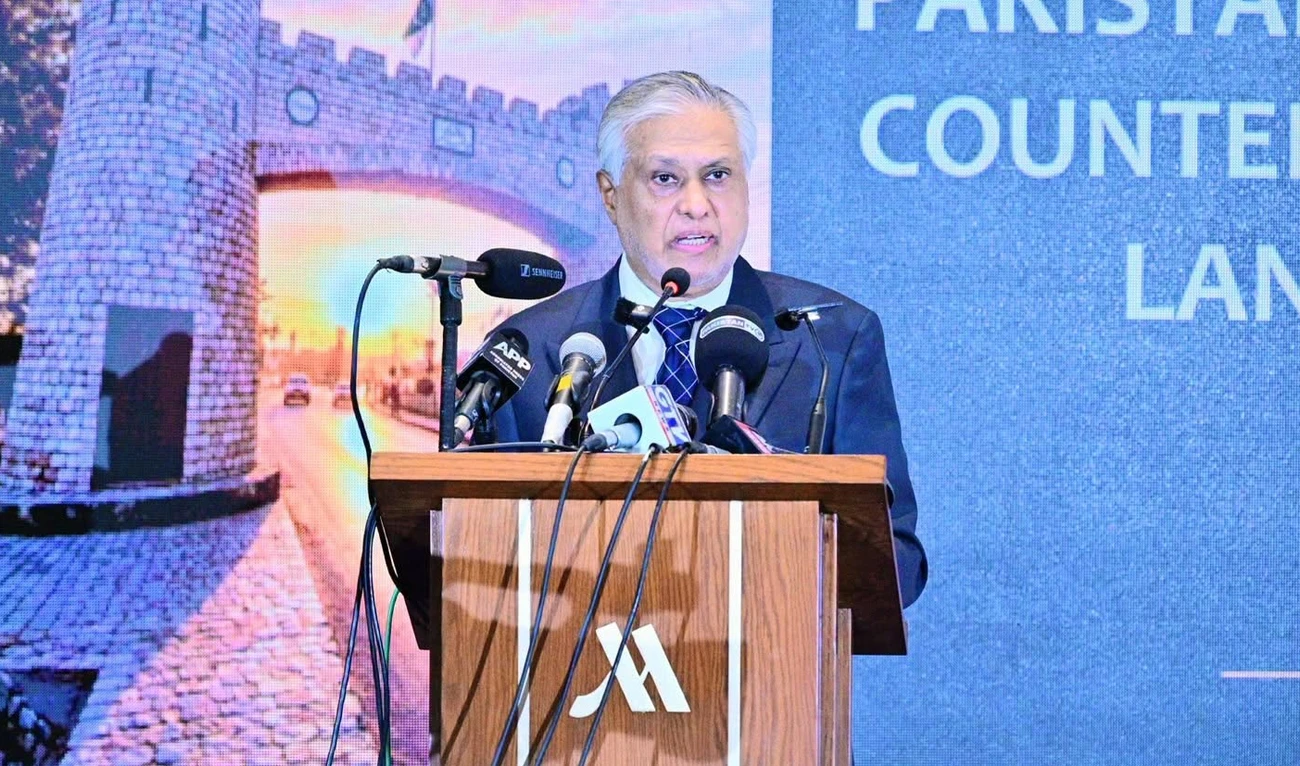
Addressing foreign media representatives in Islamabad, Law Minister Azam Nazeer Tarar said the government had acted because of deteriorating security and what it regarded as the provincial administration’s failure to respond.
According to government figures presented by Tarar, terrorism-related incidents in Khyber Pakhtunkhwa increased from 2,911 during 2021-2024 to approximately 8,600 during 2024-2026, a rise of roughly 200 percent. The figures cover overlapping periods and were not independently verified.
Tarar said Pakistan’s constitution provided mechanisms for federal intervention when extraordinary circumstances threatened security or prevented a provincial government from functioning in accordance with the constitution.
“The constitution provides that if the circumstances so warrant, the federal government, the prime minister [and] the president... may take these decisions,” he said.
The government invoked Articles 232 and 234 of the constitution. Article 232 allows the president to proclaim an emergency when national security, or the security of part of the country, is threatened by war, external aggression or internal disturbances beyond a provincial government’s control.
Article 234 separately allows the president to assume, or direct a provincial governor to assume, executive functions when a provincial government cannot be run in accordance with the constitution.
Together, the provisions formed the basis for the federal government’s takeover of Khyber Pakhtunkhwa’s administration and the transfer of the provincial assembly’s legislative powers to parliament.
WHY KHYBER PAKHTUNKHWA, NOT BALOCHISTAN?
The government’s decision has also drawn scrutiny because Balochistan, which borders both Afghanistan and Iran, faces a longstanding separatist insurgency and attacks by other militant groups.
Critics have questioned why Islamabad considered emergency rule necessary in Khyber Pakhtunkhwa but not in Balochistan, where security forces have also been engaged in extensive counterterrorism operations.
Tarar defended the distinction, saying the increase in militant attacks in Balochistan was lower and that its provincial government was cooperating with federal security agencies.
The minister argued that the central issue in Khyber Pakhtunkhwa was not militant violence alone, but the federal government’s assessment that the provincial administration was failing to discharge its responsibilities.
Constitutional lawyer Salahuddin Khan Gandapur disputed the distinction, arguing that security conditions in Balochistan were similarly severe and questioning whether the government was applying consistent standards.
The contrasting treatment of the two provinces has become central to the debate over whether the emergency was driven primarily by security concerns or by the federal government’s political confrontation with the PTI.
IS THE EMERGENCY CONSTITUTIONAL?
Legal experts are also divided over whether the situation in Khyber Pakhtunkhwa satisfies the conditions laid down in the constitution.
Former Sindh High Court Bar Association president Salahuddin Ahmed said the government had failed to establish the breakdown of constitutional machinery required to invoke Article 234.
“Clearly there was no breakdown of constitutional machinery to justify a proclamation under Article 234,” Ahmed said.
He also disputed the government’s reliance on Article 232, arguing that an increase in militant violence did not automatically establish the kind of grave emergency contemplated by the constitution.
“The threshold, in my opinion, is higher than the one currently being advanced, [namely] a rise in terrorist incidents.”
The constitutional dispute extends to the procedure for imposing emergency rule.
Article 232 requires a resolution of the provincial assembly when an emergency is declared because of internal disturbances beyond the provincial government’s control. If the president acts independently, the proclamation must instead be placed before both houses of parliament for approval within 10 days.
Ahmed questioned whether the necessary conditions had been met, while Mehboob argued that the president could act without a provincial assembly resolution if the proclamation subsequently secured the required parliamentary approval.
The government maintains that invoking Articles 232 and 234 together provides the constitutional basis for its intervention.
HOW LONG CAN IT LAST?
The duration of emergency rule has emerged as another point of disagreement, with the government and constitutional lawyers offering differing interpretations of the provisions.
Tarar said Article 232 did not prescribe a fixed maximum duration for an emergency, arguing that it could continue while the circumstances justifying it persisted, subject to parliamentary oversight.
“No one can exactly predict whether it is 30 days, 60 days or 90 days,” he said.
The minister acknowledged that Article 234 imposes a six-month limit on the special arrangement for provincial administration, but argued that the expiry of that period would not necessarily end an emergency proclaimed under Article 232.
The constitution requires an Article 232 proclamation to be placed before a joint sitting of parliament within 30 days and approved within two months to remain in force, alongside additional approval requirements for an emergency imposed without a provincial assembly resolution.
Article 234 provides for parliamentary approval and extensions of governor’s rule in increments of up to two months, with an overall maximum of six months.
Gandapur challenged the government’s suggestion that the arrangements could continue indefinitely, saying the constitution imposed clear procedural safeguards.
“They have to present it in parliament within a month, but right now they are talking about it being imposed for an indefinite period, whereas there is no such provision,” Gandapur said.
He said the decision could be challenged in court.
“It can certainly be challenged in court because it is ultra vires [beyond legal authority].”
CAN THE COURTS INTERVENE?
The dispute could ultimately be settled by the judiciary, which has previously examined the legality of emergency proclamations and federal interventions in provincial affairs.
Tarar cited the 1998 emergency imposed after Pakistan’s nuclear tests, which was challenged but upheld by the Supreme Court, while acknowledging that courts had also invalidated emergency measures found to lack sufficient legal justification.
Gandapur pointed to earlier federal interventions under the governments of Zulfikar Ali Bhutto and Asif Ali Zardari, some of which were subsequently overturned by the judiciary.
Ahmed said the president’s assessment of an emergency was subject to judicial review, particularly where a decision was made in bad faith, by an authority lacking jurisdiction or without a lawful basis.
He said courts would not simply substitute their judgment for that of the president, but the decision must be supported by relevant and objectively verifiable facts.
“There must at least be objectively verifiable and relevant facts upon which the President justifiably reached his satisfaction. If there were no such facts, the action would be mala fide and can be struck down,” he added.