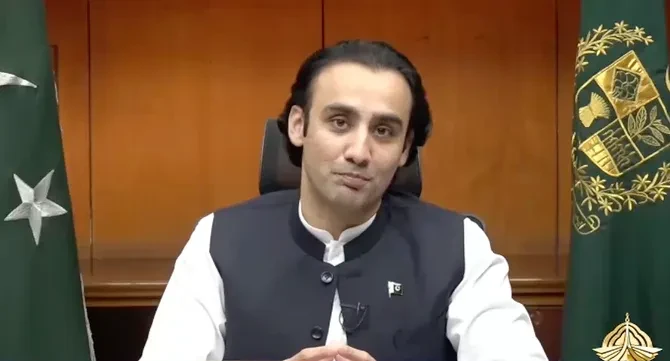
- The program brought together member states, UN entities and industry participants for discussions on digital assets, blockchain, AI
- Pakistan’s Bilal bin Saqib says the question is not whether these technologies will scale but who will shape them, in whose interest
ISLAMABAD: Pakistan Virtual Assets Regulatory Authority (PVARA) Chairman Bilal bin Saqib called on United Nations (UN) member states to move collectively to building regulatory and institutional frameworks needed to govern the next generation of global finance, the Pakistani information ministry said on Saturday.
The statement came during his virtual keynote address at the UN session on ‘Digital Assets and Blockchain for Sustainable Development: Advancing Digital Finance through Innovation,’ convened by Pakistan’s UN mission in collaboration with UNDP, UNCTAD and the Office of the Secretary-General’s Envoy on Technology (ODET).
The program brought together member states, UN entities and industry participants for discussions on digital assets, blockchain, artificial intelligence, digital identity and the policy conditions required for responsible implementation.
Saqib told participants that digital assets, tokenization and distributed ledger technologies present emerging economies with an opportunity to rethink financial infrastructure around inclusion, efficiency and access.
“The question before this room is not whether these technologies will scale. They will. The question is: who will shape them, and in whose interest,” he said.
Pakistan has in recent months stepped up efforts to draft rules for regulating the fast-expanding market for digital coins and tokens, requiring virtual asset service providers to secure government approval. Islamabad’s move to embrace digital currency marks a significant policy shift as it had banned cryptocurrency in 2018, citing financial risks.
Saqib placed ordinary people at the center of the debate, pointing to the 1.4 billion adults globally who remain outside the formal financial system, alongside billions more who participate on unequal terms through expensive remittances, slow settlement and limited access to credit.
He highlighted the continued cost of cross-border remittances, noting that the average cost of sending $200 remains more than twice the 3 percent target established by the UN. Closing that gap, he said, would return billions of dollars annually directly to families.
The development potential of digital finance extends well beyond payments. Digital identity and verifiable financial histories could help small businesses, farmers and women entrepreneurs demonstrate economic activity without relying exclusively on traditional collateral or documentation, according to Saqib.
Meanwhile, Tokenization could create new ways to mobilize capital by fractionalizing assets ranging from infrastructure bonds to renewable energy projects, while distributed ledgers could strengthen transparency across public expenditure and supply chains. These priorities closely reflected the briefing’s focus on payments, remittances, financial inclusion, capital mobilization, digital identity, traceability and responsible implementation.
Saqib, however, cautioned against treating technology as an automatic solution. He pointed to risks ranging from retail volatility and illicit finance to concentration of power and a widening divide between countries with sophisticated regulatory capabilities and those without them.
“The choice before every Member State is not regulate or don’t regulate. It is simpler, and starker, than that: to govern the future, or be governed by it,” he said.
Regulation must evolve alongside innovation as frameworks introduced too late can fail consumers and markets, while regulation driven primarily by fear can push technological activity into less transparent environments, according to Saqib.
The emerging lesson from jurisdictions around the world is that regulation should be treated as market-building rather than market-blocking.
“No nation rises alone, and no nation should be left to rise alone,” he added.