BREDA, Netherlands: Dutch scientists are recreating the deaths of some of the world’s most famous personalities by reconstructing their last moments using scents and sounds. From the sweet smell of Jacqueline Kennedy’s perfume mingled with the scent of John F. Kennedy’s blood to Whitney Houston’s last drug-fueled moments in a Beverly Hills hotel, scientists at Breda University say they offer visitors a unique, if somewhat macabre, historical snapshot.
“We all have seen the images of JFK’s assassination, but what did it smell like?” asks Frederik Duerinck, from the communication and multimedia design faculty of Breda’s Avans University of Applied Sciences.
To find out, visitors with a sense of the morbid are invited to lie in a series of four silver metal boxes similar to those found in a morgue. The boxes, which are pitch-dark inside, are rigged with pipes leading to bottles containing pressurised smells. A soundtrack is played and on queue different scents are released into the box to recreate a specific “final moment.”
For around five minutes, visitors can relive the smells and sounds believed to have surrounded four people whose deaths are etched into the world’s collective memory: Kennedy (1963); Princess Diana (1997); and Whitney Houston (2012). For instance, those wanting to experience Houston’s final moments are transported to the same place at the upmarket Beverly Hills hotel where the diva died.


Dutch scientists use smell to recreate Diana, JFK deaths
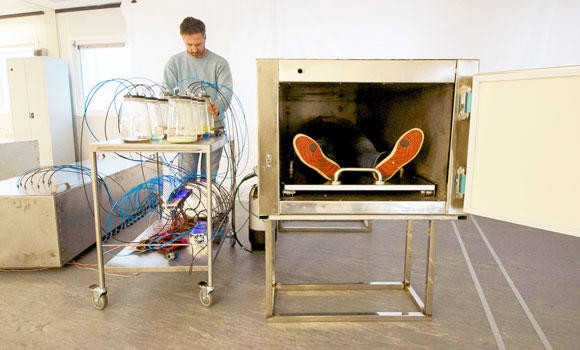
Dutch scientists use smell to recreate Diana, JFK deaths

Fans bid farewell to Japan’s only pandas
TOKYO: Panda lovers in Tokyo said goodbye on Sunday to a hugely popular pair of the bears that are set to return to China, leaving Japan without the beloved animals for the first time in half a century.
Loaned out as part of China’s “panda diplomacy” program, the distinctive black-and-white animals have symbolized friendship between Beijing and Tokyo since the normalization of diplomatic ties in 1972.
Some visitors at Ueno Zoological Gardens were left teary-eyed as they watched Japan’s only two pandas Lei Lei and Xiao Xiao munch on bamboo.
The animals are expected to leave for China on Tuesday following a souring of relations between Asia’s two largest economies.
“I feel like seeing pandas can help create a connection with China too, so in that sense I really would like pandas to come back to Japan again,” said Gen Takahashi, 39, a Tokyo resident who visited the zoo with his wife and their two-year-old daughter.
“Kids love pandas as well, so if we could see them with our own eyes in Japan, I’d definitely want to go.”
The pandas’ abrupt return was announced last month after Japan’s conservative premier Sanae Takaichi hinted Tokyo could intervene militarily in the event of any attack on Taiwan.
Her comment provoked the ire of Beijing, which regards the island as its own territory.
The 4,400 lucky winners of an online lottery took turns viewing the four-year-old twins at Ueno zoo while others gathered nearby, many sporting panda-themed shirts, bags and dolls to celebrate the moment.
Mayuko Sumida traveled several hours from the central Aichi region in the hope of seeing them despite not winning the lottery.
“Even though it’s so big, its movements are really funny-sometimes it even acts kind of like a person,” she said, adding that she was “totally hooked.”
“Japan’s going to be left with zero pandas. It feels kind of sad,” she said.
Their departure might not be politically motivated, but if pandas return to Japan in the future it would symbolize warming relations, said Masaki Ienaga, a professor at Tokyo Woman’s Christian University and expert in East Asian international relations.
“In the future...if there are intentions of improving bilateral ties on both sides, it’s possible that (the return of) pandas will be on the table,” he told AFP.


