

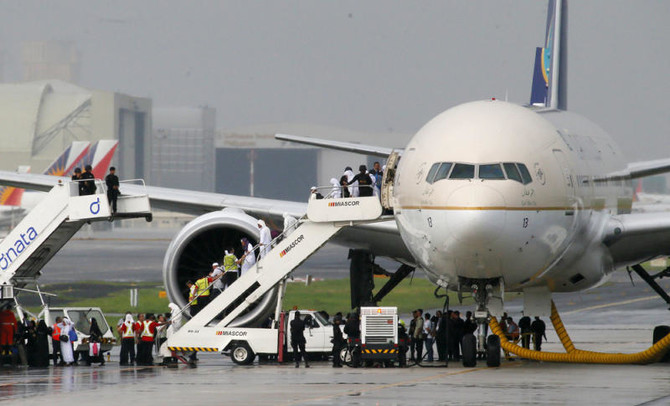
MANILA, Philippines: The flight crew of a Saudi Arabian Airlines plane mistakenly pressed a hijack warning button twice as it approached Manila’s airport on Tuesday, causing airport officials to mobilize security forces and isolate the jet after it landed, Philippine officials said.
Manila airport manager Eddie Monreal said Flight SV872 from Jeddah made the distress call about 20 miles (32 kilometers) from the airport. Airport authorities asked for a verification of the emergency message and the flight crew confirmed the distress call, he said. It was not immediately clear how the confirmation was made, but internationally known emergency codes were used by both the flight crew and control tower, Monreal said.
However, the captain later told the control tower that a button indicating a hijacking was in progress had been pushed accidentally. Despite the assurance, airport authorities quickly convened a crisis committee, Monreal said.
“We can never play around with safety and security,” Monreal said. “We decided that we will not take that call hook, line and sinker saying that it was a mistake.”
The Boeing 777 was isolated after it landed and security personnel were deployed as a precaution. The passengers were later allowed to disembark and told reporters that everything had been normal in the cabin until relatives informed them by cellphone about reports that the aircraft may have been hijacked.
When Princess Habiba Sarip-Paudac, a news anchor at a state-run TV network who was on the plane, peered out of the window, she saw SWAT forces and police, some with dogs, who later boarded the plane. She said the passengers “felt like it was really a hijacking. They thought someone would throw tear gas.”
As the plane sat isolated on the tarmac, “Not even one crew explained. For two hours, they were saying, ‘Sorry ma’am, we don’t know anything, we don’t know what to say,’” Paudac told reporters.
The 71-year-old airline, which operates 119 planes, said on its official Twitter feed later Tuesday that there was a false alarm of a hijacking aboard the flight.
The Civil Aviation Authority of the Philippines said it is investigating the cause of the incident. “Appropriate penalties and sanctions will be imposed on the erring pilot if the result is indeed a human error,” it said in a statement.
The incident came after Philippine officials in February announced they had strengthened security for Saudi Arabia’s embassy in Manila and its national airline because of a possible threat. At the time, officials also said additional armed officers were posted in the boarding area for the Saudi flag carrier and to guard the airline’s luggage.
Haj pilgrims
Monreal said the plane was carrying 410 passengers, plus four pilots and 17 crew members.
Many of them were returning home from the annual Haj pilgrimage.
One of the passengers, Aida Majud, said they were not told why they were being kept on the plane.
“When we saw the armed men we thought, what’s the problem. We wanted to know what was happening,” Majud told ABS-CBN television network.
But she said the atmosphere was calm, with some speculating President Rodrigo Duterte had come to the airport to welcome back the pilgrims and that the armed men surrounding the plane were his security personnel.
Majud said passengers had to undergo body checks after getting off the plane to ensure no one was carrying weapons.
Airport officials said there were no major disruptions to aviation traffic, with planes continuing to land and take off, because the Saudia aircraft had been kept at an isolated area.


