It is quite a surprise when a renowned museum chooses to marshal its resources to help benefit a worthy non-profit organization; and this is exactly how your correspondent found herself — surprised — to discover that the Smithsonian’s Sackler Gallery had opened a section of its museum to replicate the vibrant marketplace of Old Kabul.
The transformation is further enhanced with onsite Afghan artisans demonstrating their skills in jewelry making, wood carving and jali shades, calligraphy, ceramics, carpets, ceramics, emerald and gold jewelry, gem cutting, miniature paintings, and yes, even homemade kites sailing across the ceiling of the exhibition.
The Sackler’s “immersive exhibition” depicts Murad Khani, the cultural center of Old Kabul. This idea of the Smithsonian’s interactive ‘souk’ is in tribute to Turquoise Mountain Trust, a non-profit, non-governmental foundation created in 2006 with the aim of regenerating historic areas, preserving and transmitting traditional craft skills, and creating jobs.
Ferozkoh means “Turquoise Mountain,” in both Dari and Pashto, Afghanistan’s key languages, and it once was the cosmopolitan and lost-lost capital of central Afghanistan’s 12-century Ghorid Dynasty.
“This is … meant to transcend the headlines of war and conflict,” said Julian Raby, the director of the Smithsonian Institution’s Sackler Gallery of Art. “This exhibition highlights the vitality of these new Afghan artisans and demonstrates the power of art and culture to tell the story of artistic creativity, resilience and hope.”
Afghanistan, it often is too easy to forget due to the devastation it has endured through recent wars, was located at the heart of ancient Silk Road trade routes; and for more than 3,500 years it absorbed the cultures and traditions of India, Persia and Central Asia.
These decades of civil unrest that began in the 1970s nearly destroyed this vital heritage. Artisans often were forced to leave their country or abandon their crafts. Murad Khani, once the bustling center of craft and commerce in Afghanistan’s largest metropolis — collapsed into ruin.
The Turquoise Mountain Trust was founded in 2006 when British author and politician Rory Stewart established the trust with the support of England’s Prince Charles, and Hamid Karzai, the then-president of Afghanistan. In just ten years, they have revitalized the Murad Khani district of Old Kabul from slum conditions into a vibrant cultural and economic center, while training more than 450 male and female artisans since its founding eight years ago.
Its success on the ground has won world-wide recognition. Prince Alwaleed bin Talal, for example, has given his support to the project. Its calligraphy school is named after him — the Alwaleed Bin Talal School of Calligraphy and Miniature Painting. Prince Alwaleed “strongly believes in the power and value of preserving and reviving the Islamic arts across the world,” said Dr. Tommy Wild, Director of Exhibitions with Turquoise Mountain Trust. “This has resulted in the Middle East and Afghanistan collaborating and exchanging ideas and support.”
The organization also has invested back by aiding the local community: it has renovated historic buildings, opened a primary school and a medical clinic which serves 18,000 patients per year, and rebuilt necessary infrastructure. Equally important, it has founded Afghanistan’s premier institution for vocational training in the arts which is dedicated to teaching a new generation of Afghan artisans.
Turquoise Mountain is succeeding in reviving the nation’s proud cultural legacy by providing on-the-job training in traditional construction techniques to over 1,000 masons, carpenters, and laborers during the restoration of Murad Khani; the project’s workers have also cleared 30,000 cubic meters of rubbish from the streets, rebuilt or restored 112 historic and community buildings using traditional earth construction techniques and provided water, electricity, and sanitation to the old city.
The Smithsonian’s Sackler Turquoise Mountain exhibition, made possible by the support given through the United States Agency for International Development (USAID), conjures up the unexpected throughout the exhibit.
Here you will find a caravanserai — a courtyard that once served as a gathering and resting place for Silk Road travelers — which was recreated by shipping from Afghanistan more than three tons of hand-carved Himalayan cedar. It includes two 30-foot colonnaded arches and artisan stalls, embellished with colorful toshaks, or Afghan cushions. Visitors are invited to sit and explore with onsite interactive touchscreen maps of Afghanistan which allows visitors to explore the history of the region and better learn of its artistic traditions.
Throughout the duration of the Sackler Gallery’s Turquoise Mountain exhibition, which closes in January 2017, Afghan artisans will travel to Washington and share their skills and traditions with museum visitors. Seventeen visiting Afghan artisans, many of whom are teachers and young entrepreneurs, will showcase their talents to visiting public guests.
And, as an ultimate compliment to their hard work to maintain their heritage, Turquoise Mountain’s artisans have gained worldwide recognition for their beautiful creations. Major international exhibitions have been organized to display their work including the Venice Biennale and the Museum of Islamic Art in Doha. The Trust has also established partnerships with prestigious international retailers from Bloomingdales and Kate Spade in New York, to Pippa Small and Monsoon-Accessorize in London.
For more information log onto: asia.si.edu/turquoisemountain.
— [email protected]


Turquoise Mountain: Preserving Afghanistan’s legacy

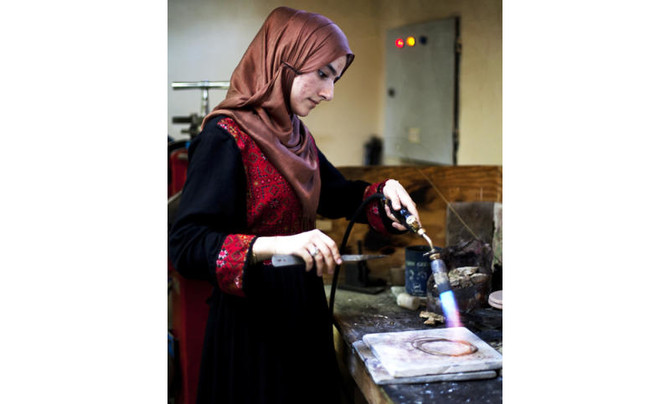


Turquoise Mountain: Preserving Afghanistan’s legacy

From historic desert landscapes to sound stages: AlUla’s bid to become the region’s film capital
DUBAI: AlUla is positioning itself as the center of cinema for the MENA region, turning its dramatic desert landscapes, heritage sites and newly built studio infrastructure into jobs, tourism and long‑term economic opportunity.
In a wide‑ranging interview, Zaid Shaker, executive director of Film AlUla, and Philip J. Jones, chief tourism officer for the Royal Commission for AlUla, laid out an ambitious plan to train local talent, attract a diverse slate of productions and use film as a catalyst for year‑round tourism.
“We are building something that is both cultural and economic,” said Shaker. “Film AlUla is not just about hosting productions. It’s about creating an entire ecosystem where local people can come into sustained careers. We invested heavily in facilities and training because we want AlUla to be a place where filmmakers can find everything they need — technical skill, production infrastructure and a landscape that offers limitless variety. When a director sees a location and says, ‘I can shoot five different looks in 20 minutes,’ that changes the calculus for choosing a destination.”
At the core of the strategy are state‑of‑the‑art studios operated in partnership with the MBS Group, which comprises Manhattan Beach Studios — home to James Cameron’s “Avatar” sequels. “We have created the infrastructure to compete regionally and internationally,” said Jones. “Combine those studios with AlUla’s natural settings and you get a proposition that’s extremely attractive to producers; controlled environment and unmatched exterior vistas within a short drive. That versatility is a real selling point. We’re not a one‑note destination.”
The slate’s flagship project, the romantic comedy “Chasing Red,” was chosen deliberately to showcase that range. “After a number of war films and heavy dramas shot here, we wanted a rom‑com to demonstrate the breadth of what AlUla offers,” said Shaker. “‘Chasing Red’ uses both our studio resources and multiple on‑location settings. It’s a story that could have been shot anywhere — but by choosing AlUla we’re showing how a comical, intimate genre can also be elevated by our horizons, our textures, our light.
“This film is also our first under a broader slate contract — so it’s a proof point. If ‘Chasing Red’ succeeds, it opens the door for very different kinds of storytelling to come here.”
Training and workforce development are central pillars of the program. Film AlUla has engaged more than 180 young Saudis in training since the start of the year, with 50 already slated to join ongoing productions. “We’re building from the bottom up,” said Shaker. “We start with production assistant training because that’s often how careers begin. From there we provide camera, lighting, rigging and data-wrangling instruction, and we’ve even launched soft‑skill offerings like film appreciation— courses that teach critique, composition and the difference between art cinema and commercial cinema. That combination of technical and intellectual training changes behavior and opens up real career pathways.”
Jones emphasized the practical benefits of a trained local workforce. “One of the smartest strategies for attracting productions is cost efficiency,” he said. “If a production can hire local, trained production assistants and extras instead of flying in scores of entry‑level staff, that’s a major saving. It’s a competitive advantage. We’ve already seen results: AlUla hosted 85 productions this year, well above our initial target. That momentum is what we now aim to convert into long‑term growth.”
Gender inclusion has been a standout outcome. “Female participation in our training programs is north of 55 percent,” said Shaker. “That’s huge. It’s not only socially transformative, giving young Saudi women opportunities in an industry that’s historically male-dominated, but it’s also shaping the industry culture here. Women are showing up, learning, and stepping into roles on set.”
Looking to 2026, their targets are aggressive; convert the production pipeline into five to six feature films and exceed 100 total productions across film, commercials and other projects. “We want private-sector partners to invest in more sound stages so multiple productions can run concurrently,” said Jones. “That’s how you become a regional hub.”
The tourism case is both immediate and aspirational. “In the short term, productions bring crews who fill hotels, eat in restaurants and hire local tradespeople,” said Shaker. “In the long term, films act as postcards — cinematic invitations that make people want to experience a place in person.”
Jones echoed that vision: “A successful film industry here doesn’t just create jobs; it broadcasts AlUla’s beauty and builds global awareness. That multiplies the tourism impact.”
As “Chasing Red” moves into production, Shaker and Jones believe AlUla can move from an emerging production destination to the region’s filmmaking epicenter. “We’re planting seeds for a cultural sector that will bear economic fruit for decades,” said Shaker. “If we get the talent, the infrastructure and the stories right, the world will come to AlUla to film. And to visit.”


