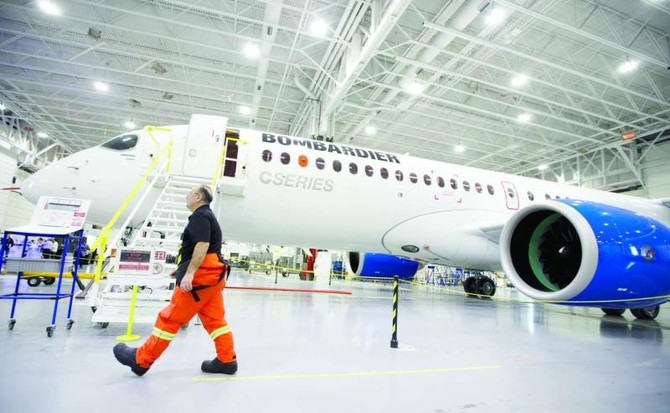
NEW YORK: Canadian aircraft and train maker Bombardier Inc. said it would slash its workforce by about 7,000 over the next two years, while ramping up hiring to support production of its struggling CSeries commercial jet program.
The company said on Wednesday it had signed a letter of intent with Air Canada for up to 75 CS300 aircraft for as much as $3.8 billion, based on the list price.
Montreal-based Bombardier now has 678 total orders and commitments for the CSeries, including 243 firm orders.
The company has been struggling to find buyers for the 100-150 seat CSeries jet, in to which it has sunk billions of dollars, due to fierce competition from Boeing Co. and Airbus Group SE.
Bombardier’s quarterly results missed analysts’ expectations, and it also forecast lower-than-expected revenue for 2016.
The company expects to record $250 million-$300 million in restructuring charges in 2016 in connection with the layoffs. The company said it has about 64,000 employees.
The job cuts, mainly affecting the company’s aerostructures and engineering services and transportation divisions, will be mostly in Canada and Europe, and are set to start in the coming weeks.
Bombardier said the number of employees directly assigned to the CSeries program is about 3,450 worldwide and is expected to keep growing over the next few years, including new jobs at its plant in Mirabel, Quebec.
The company, which was helped by recent cash infusions from pension fund Caisse de dépôt et placement du Québec and the Quebec government, said it expected free cash flow usage in the range of $1.0 billion-$1.3 billion this year.
Still, Bombardier’s stock has declined more than 65 percent over the last 12 months.
The aircraft maker also proposed a reverse stock split on Wednesday, confirming a report by Reuters that said it would consolidate its shares to prop up the sagging stock, which has traded below C$1 since late January, its lowest in 25 years.
The ratio for the reverse stock split will be decided later, but is targeted to result in an initial post-consolidation share price of C$10-C$20 per class A share or class B subordinate voting share, the company said.
Bombardier’s net loss narrowed to 31 cents per share in the fourth quarter ended Dec. 31 from 92 cents per share a year earlier.
The company broke even on an adjusted basis, below analysts’ average estimate of a profit of 2 cents per share.

Bombardier cuts 7,000 jobs
Sustainability Forum Middle East spotlights Saudi role in driving climate finance deployment
MANAMA: Saudi Arabia’s growing influence over sustainable finance and climate-aligned investment was a central theme at the Sustainability Forum Middle East, as regional banks, investors, and policymakers signaled a shift from climate pledges to market execution.
The fourth edition of the forum, held in Bahrain under the theme “Advancing Alignment, Innovation, and Implementation for Energy and Climate Transformation,” brought together more than 500 participants and over 50 speakers from government, finance, energy, and industry.
While the agenda covered climate diplomacy and national strategies, the dominant conversations this year centered on capital deployment, bankability, technology, and the commercial realities of the energy transition.
Saudi Arabia’s role in shaping that transition was repeatedly highlighted, particularly through its efforts to structure green finance instruments, integrate sustainability into Vision 2030 programs, and scale renewable energy ambitions. Global banks at the forum pointed to the kingdom as a key driver of demand for credible sustainable finance frameworks in the Gulf.
“Saudi Arabia has demonstrated clear leadership through Vision 2030 and its green financing frameworks,” Lina Osman, managing director and head of sustainable finance for the Middle East, Africa and Pakistan at Standard Chartered, told Arab News.
“The Public Investment Fund’s green bond issuance is a clear demonstration of the value of the opportunity that is available in Saudi Arabia and how Saudi Arabia is seizing that opportunity,” she added.
Osman also noted that Saudi Arabia’s target of sourcing 50 percent of its electricity from renewables represents a “true demonstration of leadership in sustainability,” adding that financing instruments will need to evolve to serve those ambitions.
She said the bank has been customizing sustainable finance structures for Gulf Cooperation Council clients as the market becomes more sophisticated and sector-specific.
Organizations at the forum said the region has moved beyond ESG signaling and into discussions about return profiles, risk pricing, and revenue impact.
“Financial institutions are now focused on how sustainability generates value — reducing costs, building resilience, and boosting revenue. Previously, it was mostly window dressing,” said Ian McCallum, chief sustainability officer at Bank ABC.
Speaking to Arab News, he added that Saudi Arabia is playing a “significant role in shaping the direction of sustainable finance by continuing to strengthen ESG regulatory and disclosure requirements.”
Speakers from private markets and venture capital also pointed to Saudi Arabia as an emerging market for climate technologies that are moving from pilot phase to commercialization.
Investors highlighted carbon removal, energy optimization, and AI-enabled climate solutions as areas where the Kingdom’s scaling capacity and demand for industrial decarbonization make deployment feasible.
Beyond finance, the forum examined how the GCC can accelerate industrial decarbonization through AI integration, carbon capture, supply chain reform, and the expansion of renewables.
Panels explored how sovereign strategies and industrial policy are aligning across the region, with Saudi Arabia’s energy transition goals seen as an anchor for cross-border capital flows.
The event saw memorandums of understanding and multi-sector partnerships intended to translate national ambitions into deployable projects.
Organizers said the agreements reflect a shift toward implementation, positioning the Gulf as a market where climate action is increasingly tied to competitiveness, industrial growth, and long-term economic resilience.