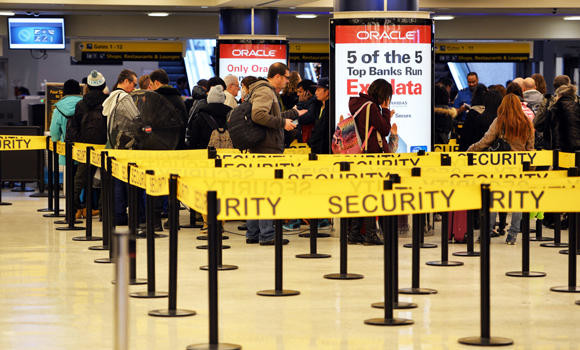
US visas get new scrutiny after attacks

Updated 09 December 2015
Follow

US visas get new scrutiny after attacks

WASHINGTON: Visas used by foreigners to travel to the United States are getting new scrutiny in the wake of shooting massacres in California and France.
House lawmakers passed legislation tightening controls on visa-free travel and requiring visas for anyone who has been in Iraq or Syria in the previous five years.
Some lawmakers said they also planned to re-examine a visa used by Tashfeen Malik, the Pakistani wife accused in the San Bernardino attacks that killed 14 people, to come to the country.
Here’s a breakdown of how some of these visas work:
The visa waiver program lets citizens of 38 countries travel to the United States without a visa for stays of 90 days or less.
Travelers must submit data through an electronic counterterrorism screening program maintained by the Department of Homeland Security before boarding a plane, but aren’t required to show up at a local consulate and apply for a visa as tourists from other countries must do.
Those who fail to pass the screening are required to apply for a visa.
About 20 million visitors come to the United States each year for business or tourism under the program, largely from European countries.


Kosovo, Serbia ‘need to normalize’ relations

Updated 5 sec ago
Follow

Kosovo, Serbia ‘need to normalize’ relations

  • Kosovo, which hopes to join NATO, has also been cultivating relations with Washington in recent months, by removing tariffs on American products

PRISTINA: Kosovo and Serbia need to “normalize” their relations, Kosovo’s Prime Minister Albin Kurti said, several days before legislative elections where he is seeking to extend his term with more solid backing.

Kurti has been in office since 2021 and previous accords signed with Serbia — which does not recognize the independence of its former province — have yet to be respected.

“We need to normalize relations with Serbia,” said Kurti. “But normalizing relations with a neighboring authoritarian regime that doesn’t recognize you, that also doesn’t admit to the crimes committed during the war, is quite difficult,” he added.

Tensions between the two neighbors are regularly high.

“We do have a normalization agreement,” Kurti said, referring to the agreement signed under the auspices of the EU in 2023.

“We must implement it, which implies mutual recognition between the countries, at least de facto recognition.”

But to resume dialogue, Serbia “must hand over Milan Radoicic,” a Serb accused of plotting an attack in northern Kosovo in 2023, Kurti asserted, hoping that “the EU, France, and Germany will put pressure” on Belgrade to do so.

Kosovo, which hopes to join NATO, has also been cultivating relations with Washington in recent months, by removing tariffs on American products and agreeing to accept up to 50 migrants from third countries extradited by the US. So far, only one has arrived.

“We are not asking for any financial assistance in return,” Kurti emphasized. “We are doing this to help the US, which is a partner, an ally, a friend,” added the prime minister, who did not rule out making similar agreements with European countries.

Unable to secure enough seats in the February 2025 parliamentary elections, Kurti was forced to call early elections on Sunday, after 10 months of political deadlock during which the divided parliament failed to form a coalition.

“We need a decisive victory. In February, we won 42.3 percent, and this time we want to exceed 50 percent,” he said.