WASHINGTON: A US drone strike targeted a vehicle in Syria believed to be transporting the masked Daesh militant known as “Jihadi John, according to American officials. Whether the strike killed the British man who appears in several videos depicting the beheadings of Western hostages was not known, British Prime Minister David Cameron said Friday.
Mohammed Emwazi was the target of an airstrike in Raqqa, Pentagon press secretary Peter Cook said in a statement. Officials were assessing the results of the strike, he said.
A US official told The Associated Press that a drone had targeted a vehicle in which Emwazi was believed to be traveling. The official was not authorized to speak publicly and requested anonymity.
Cameron said officials are not yet certain whether a US drone strike killed Emwazi. He said the strike had been a joint effort and that British intelligence agencies were working around the clock to find the British-accented militant, whom Cameron called the militant group“s “lead executioner.”
Cameron also said the US strike had been “an act of self-defense” and the right thing to do. He said targeting Emwazi was “a strike at the heart” of the Daesh group.
Emwazi, believed to be in his mid-20s, has been described by a former hostage as a bloodthirsty psychopath who enjoyed threatening Western hostages. Spanish journalist Javier Espinosa, who had been held in Syria for more than six months after his abduction in September 2013, said Emwazi would explain precisely how the militants would carry out a beheading.
Those being held by three British-sounding captors nicknamed them “the Beatles” with “Jihadi John” a reference to Beatles member John Lennon, Espinosa said in recalling his months as one of more than 20 hostages.
Among those beheaded by Daesh militants in videos posted online since August 2014 were US journalists Steven Sotloff and James Foley, US aid worker Abdul-Rahman Kassig, British aid workers David Haines and Alan Henning, and Japanese journalist Kenji Goto.
A friend of Henning has said she is still “skeptical” following news that “Jihadi John” may have been killed.
Louise Woodward-Styles, who organized a candlelit vigil for the taxi driver after he was captured by the terrorists, said that, even if Emwazi had been killed, the family of the 47-year-old would not get closure following his brutal murder.
She said: “I don’t think there will be closure, particularly for Alan’s family and close friends.
“His body wasn’t returned home and from that aspect it was something they had to deal with privately. For them to say that Jihadi John has been killed doesn’t mean anything. It is something that the Government can say they have done successfully.”
She added that she would have preferred Emwazi to have been brought back to the UK to face justice.
In the videos, a tall masked figure clad in black and speaking in a British accent typically began one of the gruesome videos with a political rant and a kneeling hostage before him, then ended it holding an oversize knife in his hand with the headless victim lying before him in the sand.
Emwazi was identified as “Jihadi John” last February, although a lawyer who once represented Emwazi’s father told reporters that there was no evidence supporting the accusation. Experts and others later confirmed the identification.
Emwazi was born in Kuwait and spent part of his childhood in the poor Taima area of Jahra before moving to Britain while still a boy, according to news reports quoting Syrian activists who knew the family. He attended state schools in London, then studied computer science at the University of Westminster before leaving for Syria in 2013. The woman who had been the principal at London’s Quintin Kynaston Academy told the BBC earlier this year that Emwazi had been quiet and “reasonably hard-working.”
Officials said Britain’s intelligence community had Emwazi on its list of potential terror suspects for years but was unable to prevent him from traveling to Syria. He had been known to the nation’s intelligence services since at least 2009, when he was connected with investigations into terrorism in Somalia.
The beheading of Foley, 40, of Rochester, New Hampshire, was deemed by IS to be its response to US airstrikes. The release of the video, on Aug. 19, 2014, horrified and outraged the civilized world but was followed the next month by videos showing the beheadings of Sotloff and Haines and, in October, of Henning.


US targets ‘Jihadi John’ in IS slaying videos, fate unclear
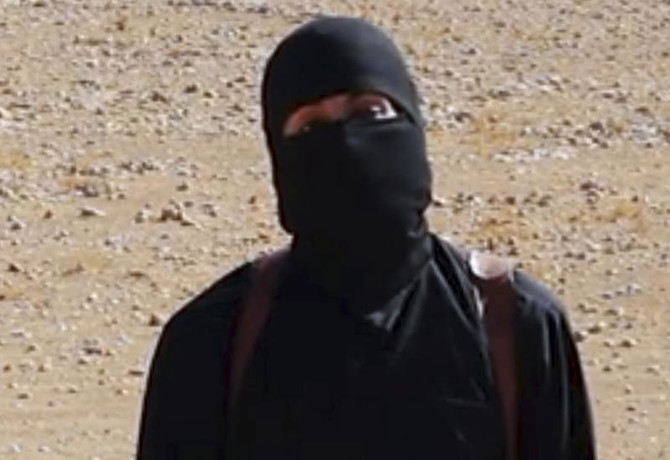
US targets ‘Jihadi John’ in IS slaying videos, fate unclear

Sudan defense minister dismisses ‘intelligence document’ as fabrication after convoy strike
- Gen. Hassan Kabroun tells Arab News claims that army hid weapons in aid convoy are “completely false”
RIYADH: Sudan’s defense minister has firmly denied reports attributed to Sudanese intelligence alleging that a convoy targeted in North Kordofan was secretly transporting weapons under the cover of humanitarian aid.
Gen. Hassan Kabroun described the claims as “false” and an attempt to distract from what he called a militia crime.
The controversy erupted after news reports emerged that a document attributed to Sudan’s General Intelligence Service claimed the convoy struck in Al-Rahad on Friday was not a purely humanitarian mission, but was instead carrying “high-quality weapons and ammunition” destined for Sudanese Armed Forces units operating in the state.
The report further alleged that the convoy had been outwardly classified as humanitarian in order to secure safe passage through conflict zones, and that the Rapid Support Forces had destroyed it after gathering intelligence on its route and cargo.
Kabroun categorically rejected the narrative.
“First of all, we would like to stress the fact that this news is false,” he told Arab News. “Even the headline that talks about the security of the regions, such as Al-Dabbah, is not a headline the army would use.”
He described the document as fabricated and politically motivated, saying it was designed to “cover up the heinous crime they committed.”
The minister affirmed that the area targeted by drones is under full control of the Sudanese Armed Forces and does not require any covert military transport.
“Second, we confirm that the region that was targeted by drones is controlled by the army and very safe,” Kabroun said. “It does not require transporting any military equipment using aid convoys as decoys because it is a safe area controlled by the army, which has significant capabilities to transport humanitarian aid.”
According to the minister, the Sudanese military has both the logistical capacity and secure routes necessary to move equipment openly when needed.
“The army is professional and does not need to deliver anything to Kadugli or Dalang on board aid convoys,” he said. “The road between Dalang and Kadugli is open. The Sudanese forces used that road to enter and take control of the region. The road is open and whenever military trucks need to deliver anything, they can do so without resorting to any form of camouflage.”
Kabroun further rejected any suggestion that the military uses humanitarian operations as cover.
“Aid is transported by dedicated relief vehicles to the areas in need of this assistance,” he said. “Aid is not transported by the army. The army and security apparatus do not interfere with relief efforts at all, and do not even accompany the convoys.”
He stressed that the Sudanese Armed Forces maintains a clear institutional separation between military operations and humanitarian work, particularly amid the country’s crisis.
“These are false claims,” he said. “This fake news wanted to cover up the heinous crime they committed.”
Sudan has been gripped by conflict since April 2023, when fighting broke out between the Sudanese Armed Forces and the Rapid Support Forces, plunging the country into what the United Nations has described as one of the world’s worst humanitarian disasters.
The latest dispute over the convoy comes amid intensified fighting in South Kordofan, a strategically sensitive region linking central Sudan with the contested areas of Darfur and Blue Nile.
The false report suggested that intelligence monitoring had enabled the RSF to strike what it described as a military convoy disguised as humanitarian aid. But Kabroun dismissed that version outright.
“The intelligence agency is well aware of its duties,” he said. “The Sudanese Army has enough weapons and equipment to use in the areas of operations. These claims are completely false.”
He argued that the narrative being circulated seeks to shift blame for attacks on civilian infrastructure and humanitarian movements.
“This shows that they are trying to cover up the atrocities,” he added, referring to the militia.
Kabroun maintained that the army has regained momentum on multiple fronts and remains fully capable of sustaining its operations without resorting to deception.
“The region is secure, the roads are open, and the army does not need camouflage,” he said. “We are operating professionally and transparently.”
“These claims are completely false,” Kabroun said. “The Sudanese Army does not use humanitarian convoys for military purposes.”


