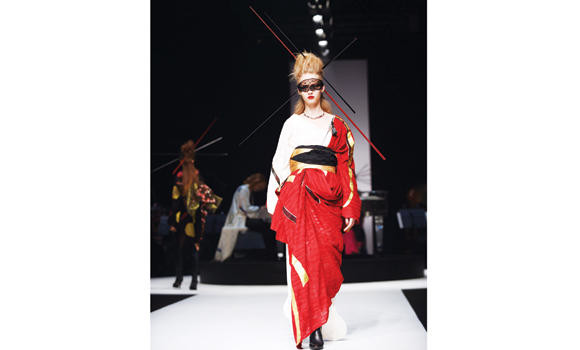
Kimonos get rock ‘n’ roll makeover

Updated 18 October 2015
Follow

Kimonos get rock ‘n’ roll makeover

TOKYO: Tokyo fashion week drew to a close at the weekend showcasing a glamorous new twist on the kimono, as the Japanese classic makes a quiet comeback into women’s wardrobes.

In a departure from the heavy silk usually used to make the traditional garb, designers are turning to other fabrics such as jersey, wool and even denim to reinvent the kimono.
“The kimono is fashion... it shouldn’t be presented as old-fashioned,” said celebrated designer Jotaro Saito.
“I want to spread the message that kimono can be worn every day, it’s something people can wear like they wear modern clothes, not... something that makes them feel like they are in a costume,” Saito told AFP.
Kimono, which translates as “something to wear,” was originally an umbrella term that covered a range of garments worn by Japanese men and women for centuries, but has now come to signify an outer robe tied with a wide sash known as an obi.
The kimono’s decline dates back to the late 1800s when Japan’s rulers opened up the country to modern influences after hundreds of years of self-imposed seclusion, signaling a shift that would see future generations embrace western clothing.
The garment never quite recovered its popularity thanks to a prohibitively high cost that can run into the thousands of dollars, compelling many brides to rent rather than purchase kimono for their weddings.
But observers said the fashion industry’s renewed interest may do more to ensure its survival.
Designer Saito, born into a family of kimono-dyeing artists in Kyoto, has worked with the garment for two decades and believes change is critical to its future in fashion.
“What we need to do now is evolve the kimono. We cannot just do what previous generations have already done,” Saito said.
In a nod to labor-intensive Japanese traditions, Saito’s kimono — which can cost more than one million yen ($8,300) — are all made by hand, from the dyeing stages to stitching, printing and embroidery.
In his debut showing Saturday night at fashion week, heavy-metal rocker Yoshiki collaborated with a Kyoto-based brand on body-hugging kimono, slashed to miniskirt-length and worn with stilettos, leather collars and high-heeled boots.
The dyed-blonde co-founder of the band X Japan — who opened the show with a piano recital from Swan Lake — used leopard-print fabric and gold netting in his designs and told AFP he wanted to see women wear his kimono to concerts.
“I tried to combine rock & roll with tradition,” he said.


Arts festival’s decision to exclude Palestinian author spurs boycott

Randa Abdel Fattah. (Photo/Wikipedia)
Updated 12 January 2026
Follow

Arts festival’s decision to exclude Palestinian author spurs boycott

  • A Macquarie University academic who researches Islamophobia and Palestine, Abdel-Fattah responded saying it was “a blatant and shameless act of anti-Palestinian racism and censorship,” with her lawyers issuing a letter to the festival

SYDENY: A top Australian arts festival has seen ​the withdrawal of dozens of writers in a backlash against its decision to bar an Australian Palestinian author after the Bondi Beach mass shooting, as moves to curb antisemitism spur free speech concerns.
The shooting which killed 15 people at a Jewish Hanukkah celebration at Sydney’s Bondi Beach on Dec. 14 sparked nationwide calls to tackle antisemitism. Police say the alleged gunmen were inspired by Daesh.
The Adelaide Festival board said last Thursday it would disinvite Randa ‌Abdel-Fattah from February’s ‌Writers Week in the state of South Australia because “it ‌would not ​be ‌culturally sensitive to continue to program her at this unprecedented time so soon after Bondi.”

FASTFACTS

• Abdel-Fattah responded, saying it was ‘a blatant and shameless act of anti-Palestinian racism and censorship.’

• Around 50 authors have since withdrawn from the festival in protest, leaving it in doubt, local media reported.

A Macquarie University academic who researches Islamophobia and Palestine, Abdel-Fattah responded saying it was “a blatant and shameless act of anti-Palestinian racism and censorship,” with her lawyers issuing a letter to the festival.
Around 50 authors have since withdrawn from the festival in protest, leaving it in doubt, local media reported.
Among the boycotting authors, Kathy Lette wrote on social media the decision to bar Abdel-Fattah “sends a divisive and plainly discriminatory message that platforming Australian Palestinians is ‘culturally insensitive.'”
The Adelaide Festival ‌said in a statement on Monday that three board ‍members and the chairperson had resigned. The ‍festival’s executive director, Julian Hobba, said the arts body was “navigating a complex moment.”

 a complex and ‍unprecedented moment” after the “significant community response” to the board decision.
In the days after the Bondi Beach attack, Jewish community groups and the Israeli government criticized Prime Minister Anthony Albanese for failing to act on a rise in antisemitic attacks and criticized protest marches against Israel’s war in ​Gaza held since 2023.
Albanese said last week a Royal Commission will consider the events of the shooting as well as antisemitism and ⁠social cohesion in Australia. Albanese said on Monday he would recall parliament next week to pass tougher hate speech laws.
On Monday, New South Wales state premier Chris Minns announced new rules that would allow local councils to cut off power and water to illegally operating prayer halls.
Minns said the new rules were prompted by the difficulty in closing a prayer hall in Sydney linked to a cleric found by a court to have made statements intimidating Jewish Australians.
The mayor of the western Sydney suburb of Fairfield said the rules were ill-considered and councils should not be responsible for determining hate speech.
“Freedom ‌of speech is something that should always be allowed, as long as it is done in a peaceful way,” Mayor Frank Carbone told Reuters.