Experiments or research in human cloning is an offense punishable by law and any violation means a fine of SR200,000 and six months in jail.
According to a new law on ethics in the research of synthetic biology, violators also face sanctions that begin with a warning to suspend research until further notice.
Cloning is the process of producing genetically identical individuals without natural conception. Because of legal, ethical and health hazards resulting from such production, a decision to impose such fines and sanctions was made.
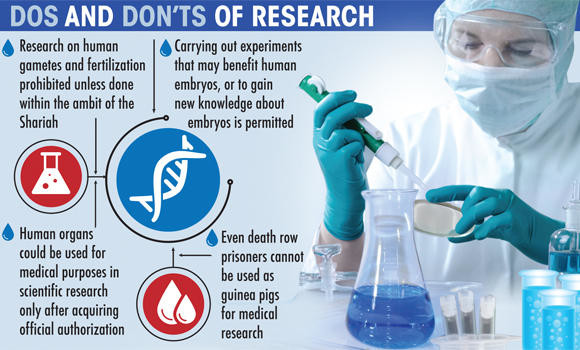
The law prohibits research on human gametes (a male or female cell that unites with a cell of the opposite sex to be finally developed into an embryo) and fertilization unless done within the ambit of the Shariah and the generally accepted medical norms, and if the research is justified in terms of its contribution to medical knowledge and technological applications.
Under the new law, it is mandatory for a researcher to take approval from the human gametes’ donors or spouses, in addition to informing them on the expected benefits and hazards of the research. “Human organs could be used for medical purposes in scientific research only after acquiring official authorization.”
The law states that research on human embryos is prohibited, but allowed only for purposes such as finding a cure for infertility, in which case the research must be carried out in a facility certified to treat such problems.
Carrying out experiments that may benefit human embryos, or to gain new knowledge about the conditions and status of embryos, which are likely to benefit the humans as well, are allowed.
The law also permits research on tissues, living cells and separate human parts, including stem cells taken from the umbilical cord, or from the elderly. However, for doing this, there are tough conditions such as not cloning embryos for the purpose of obtaining and using its stem cells in research, and not using surplus fertilized eggs outside the womb, or deliberately fertilizing the egg and the sperm from donors for therapeutic purposes or for stem cell research.
Research on minors or the mentally challenged is prohibited unless the researcher gets formal authorization from parents or guardians by informing them the implications and risks involved. Parents or guardians have the right to withdraw their approval during any stage of research if they think that the process is not in the best interests of their child, the law states.
The law says that prisoners should be treated like any other individual while conducting medical research on them, even if they face the death sentence.
Local prison committees should not give approval for such research on prisoners’ behalf unless the research aims to study criminal behavior without putting his/her life at risk, or aims to study the circumstances of prisons, the inmates, diseases that spread inside, or the circumstances that led to committing the crime, the law states.


![]()
Cloning a punishable offense
Cloning a punishable offense
Latest updates


© 2026 SAUDI RESEARCH & PUBLISHING COMPANY, All Rights Reserved And subject to Terms of Use Agreement.